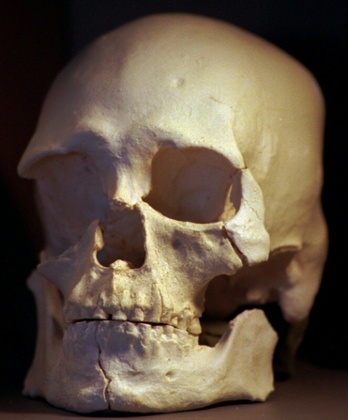
Genetic tests on one of the most important human skeletons ever found in North America have re-ignited a fierce debate over the rightful fate of the remains.
The ancient skeleton of Kennewick Man became the focus of a bitter $5m court battle between the US government, which planned to return the bones to Native Americans for reburial, and scientists who wanted to study the remains.
In 2004, a US court ruled in favour of the scientists after it judged that Native American tribes had failed to prove their kinship with Kennewick Man.
But now the story has taken an ironic twist. Genetic tests performed by a separate group of researchers have all but proved that Kennewick Man is indeed Native American. Having rescued the bones for science, science has nudged them closer to the grave.
“This is where all hell breaks lose,” said Eske Willerslev, a world expert in ancient DNA who led the analysis at the University of Copenhagen in Denmark. “I am completely confident Kennewick Man is Native American. He is as much Native American as Native Americans living today.”
Jim Boyd, a member of the Confederated Tribes of the Colville Reservation in northern Washington, who fought for repatriation of the remains said: “This is a happy time for us. We have maintained throughout that the Ancient One is a relative of ours, so these findings are wonderful for us.”
“We expect to have a fight, but we would like to see him buried very respectfully in a resting place where he should be. My own belief is that we will get the remains back,” he added.
The near-complete skeleton of Kennewick Man was discovered by chance in 1996, when students stumbled upon a skull while wading through the Columbia river in Kennewick in Washington state.
The skeleton had the police, archaeologists and the local coroner baffled. Kennwick Man did not look Native American. But his teeth were free from fillings and profoundly worn down: a clear dental signature of an ancient diet.
Closer inspection revealed a sharp stone spearpoint wedged in the man’s hip, placing him firmly in prehistory. The true age of the skeleton emerged soon after, when carbon dating of a bone fragment put the man at 9,000 years old.
On hearing the age of the remains, the US Army Corps of Engineers, who manage the land where the skeleton was found, claimed ownership and blocked scientists from studying the bones. Local Native Americans then appealed to the corps to return the remains under US repatriation laws. The army corps, already in negotiations with the tribes over fishing rights and pollution problems, agreed.
But the looming reburial of Kennewick Man distressed some scientists. One group, led by Douglas Owsley at the Smithsonian Institution in Washington DC, decided to sue the government in the hope of saving the remains for science. The US courts ruled in their favour in 2002, and again in 2004 when the government appealed the decision. Ordered to give the scientists access to the bones, the corps set aside 16 days for researchers to study the remains.
The Smithsonian’s work pointed to an unusual origin for Kennewick Man. From the size and shape of his skull and bones, he appeared to be descended from the people who gave rise to modern Polynesians, the scientists said.
But Willerslev now contests those conclusions. He commissioned researchers in Switzerland to reanalyse the bone measurements used by the Smithsonian team. The Swiss group concluded that it was impossible to say where Kennewick Man came from. The remains of one individual are simply not enough to go on. The Smithsonian Institution had not responded to requests for comment at the time of publication.
Writing today in the journal, Nature, Willerslev and his colleagues describe how they extracted and sequenced DNA from 200 grams of Kennewick Man’s hand bone. When they compared the ancient DNA to samples taken from people around the world, they found the closest match with Native Americans, in particular the Colville tribe, which still lives in the region.
“Of all the Native American genome sequences we have, the Colville is the closest we have to Kennewick Man,” Willerslev told the Guardian. “Our data show that the Colville come from same population as Kennewick Man.” In other words, they are his direct descendants.
Willerslev refused to share his own view on what should happen to the remains now, but he has spoken with the Colville tribe about his findings.
“They lost that law case based on what I’d call poor scientific evidence,” he told the Guardian. “They have been devastated ever since the ruling and they feel very strongly about reburying. They believe the spirit won’t rest until it is reburied. I expect they will make a claim again.”