Thailand’s political opposition is beginning to show a more deliberate strategic division of roles, with the two main opposition forces — the People’s Party (PP) and the Democrat Party — pursuing markedly different agendas against the government.
While the Democrats have seized on the highly tangible issue of energy prices and alleged policy mismanagement, the PP has applied pressure on the government to move ahead with constitutional amendments following the pro-charter amendment mandate delivered through the Feb 8 referendum and election process. The contrast is striking not only in substance but also in political timing, according to a political analyst.
The Democrats are focusing on an issue with immediate economic consequences for households and businesses. The PP, by comparison, is championing a structurally transformative but politically abstract cause whose benefits may not materialise for years. In practical political terms, one side is speaking to voters’ wallets while the other is speaking to the architecture of the state.
At this juncture, the Democrats appear to be winning more public attention, the analyst said.
The Democrats’ renewed focus on energy policy is not accidental. The party has historically sought credibility on economic governance and policy scrutiny, particularly in areas that directly affect middle-class and urban voters.
By attacking the government over electricity tariffs, fuel pricing structures, power purchase agreements and alleged monopolistic practices in the energy sector, the Democrats have positioned themselves as defenders of consumers struggling with the rising cost of living.
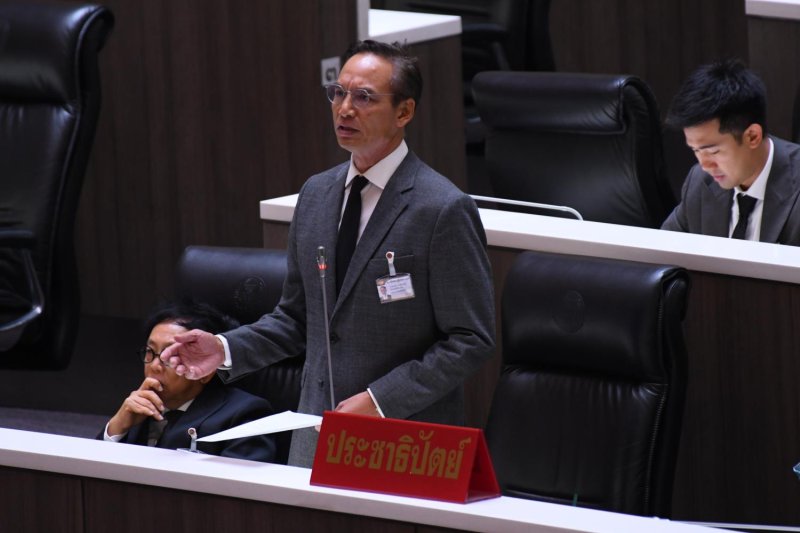
The analyst said energy policy is fertile political ground because it produces visible hardship, and no Democrats have been more forceful in attacking the government on that front than deputy party leader Korn Chatikavanij, a former finance minister. He questioned the government’s handling of energy policy, which he alleged has driven up household electricity bills while keeping fuel companies profitable.
The analyst added that rising electricity bills are immediate and measurable. Businesses complain about operating costs, while households feel the burden every month. This gives opposition criticism emotional and practical resonance far beyond parliamentary debate.
The Democrats have therefore managed to occupy a politically advantageous position: they are opposing the government on an issue that is technical enough to project policy competence, yet simple enough for ordinary voters to understand, according to the analyst.
This may explain why the party, despite years of declining electoral relevance, has recently regained visibility disproportionate to its parliamentary numbers.
The strategy also reflects a broader reality of coalition politics. The current government remains vulnerable to accusations that it has struggled to balance populist promises with structural economic management. Energy pricing has become one of the clearest openings for opposition attacks because it connects directly to wider frustrations over inflation and economic uncertainty, the analyst pointed out.
Importantly, the Democrats are not merely criticising policy outcomes. They insist the energy issue is evidence of systemic governance failure — portraying the administration as either unwilling or unable to confront entrenched business interests within the energy sector.
That narrative has traction because it taps into long-standing public suspicion regarding transparency in energy policymaking, the analyst added.
The People’s Party, meanwhile, is playing a much longer game, according to a source.
Rather than competing head-on with the Democrats on bread-and-butter economic issues, PP has returned to one of its defining ideological missions: constitutional reform.
The party argues that the government cannot ignore the reform mandate expressed during the Feb 8 political process and should begin steps towards drafting a new charter.
For the PP, constitutional amendment is not merely a legal issue but the foundation for democratic restructuring — including reform of political institutions, checks on unelected power centres and revisions to rules that critics say constrain electoral democracy.
However, constitutional politics poses a major challenge: it excites politically engaged voters far more than the broader electorate, the source said.
For many ordinary voters, charter amendment feels distant from everyday concerns. Electricity bills, wages and debt pressures are concrete realities. Constitutional engineering is abstract, procedural and often highly technical.
Moreover, constitutional reform in Thailand carries historical baggage.
The source explained that the issue is deeply polarising because it inevitably raises questions about the balance of power between elected politicians, independent institutions, the judiciary and the military-linked establishment. Any attempt to amend the charter risks unleashing accusations that reformers are seeking to dismantle political safeguards or reopen old conflicts.
As a result, the PP’s campaign may energise its ideological base without significantly expanding its broader electoral appeal.
This is the paradox confronting the party. Constitutional reform remains central to PP’s political identity, yet it is not necessarily the issue most capable of broadening support beyond already sympathetic voters.
Despite their differing approaches, the Democrats and the PP may unintentionally be creating a functional “division of labour” within the opposition ecosystem, the source said.
The Democrats are handling immediate governance attacks, while the PP is maintaining pressure on systemic reform.
In theory, this allows the opposition camp to fight on two fronts simultaneously — one tactical and short-term, the other structural and long-term.
Such an arrangement could benefit the broader opposition movement by preventing duplication and widening issue coverage. Instead of competing over the same political territory, the two parties are targeting different voter anxieties.
Yet the arrangement also exposes an imbalance in political rewards, the source said.
The Democrats’ focus on energy policy generates immediate media attention because the issue directly affects livelihoods. The PP’s constitutional campaign, while potentially more historically consequential, lacks the same day-to-day urgency. This creates the risk that the PP appears detached from public priorities, particularly when economic pressures dominate political discourse.
For a party that has often been strongest among younger, urban and politically conscious voters, the challenge is especially acute. PP must demonstrate that structural reform and everyday economic realities are connected rather than separate political universes.
Otherwise, it risks reinforcing criticism from rivals that it prioritises ideological battles over practical governance concerns, the source said.
For the government, the opposition’s split strategy presents a complicated challenge.
The Democrats’ attacks on energy policy threaten public confidence in economic management. The PP’s constitutional demands, meanwhile, threaten to reopen politically sensitive debates the government may prefer to avoid. Ultimately, the opposition divide reflects two different political clocks operating simultaneously.
The Democrats are campaigning in the present tense, focusing on issues voters feel today.
The PP is campaigning in the future tense, maintaining that without structural reform, Thailand’s recurring political crises will persist regardless of which government is in office.
The immediate political advantage currently belongs to the Democrats because economic hardship invariably commands public attention faster than constitutional theory. But the PP appears willing to sacrifice short-term popularity in order to preserve its identity as the principal vehicle for systemic political reform.
Whether that strategy proves electorally rewarding will depend on whether voters eventually come to see constitutional restructuring not as a distant elite debate, but as directly connected to governance failures affecting their daily lives.
Until then, the Democrats may continue to dominate the political spotlight — even as the PP attempts to shape the longer arc of the country’s political future.
Eying council gains in capital
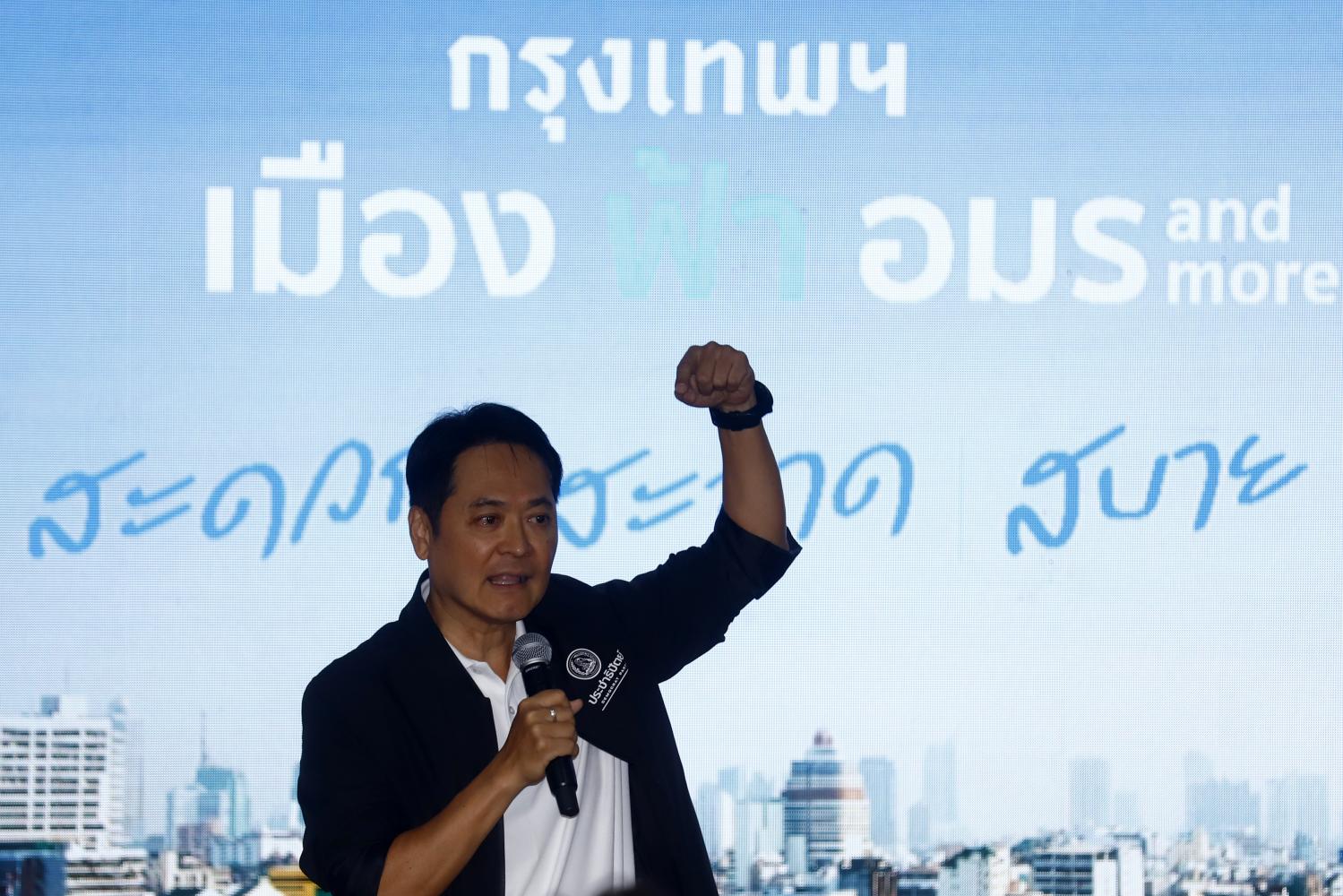
The Democrat Party’s decision to field Anucha Burapachaisri in the Bangkok governor race appears aimed more at protecting its political base in the capital than securing victory, according to political observers.
A former two-term Bangkok MP and government spokesman under former prime minister Prayut Chan-o-cha, Mr Anucha is widely seen as no match for former governor Chadchart Sittipunt, who is reportedly seeking a second term.
During his four years in office, Mr Chadchart, who won 1.38 million votes in the 2022 gubernatorial election, has faced little criticism and remains the clear favourite in the contest tentatively scheduled for June 28.
Mr Chadchart resigned almost a week before his term ended on May 21 in order to attend his son’s university graduation ceremony overseas. The city clerk will serve as acting governor until a new governor is elected.
Yuttaporn Issarachai, a political scientist at Sukhothai Thammathirat Open University, said the Democrats’ choice of candidate suggests the party has limited options.
Former governor Apirak Kosayodhin and Football Association of Thailand (FAT) president Nualphan Lamsam were both rumoured to be under consideration. Either would have posed a strong challenge to Mr Chadchart had they agreed to run, according to observers.
The fact that the Democrats ultimately settled on Mr Anucha may indicate that both declined, Mr Yuttaporn said.
Although Mr Anucha served two terms as a Bangkok MP, he lacks the dynamism expected by city voters, according to Mr Yuttaporn.
“The Bangkok governor position requires a boots-on-the-ground personality. Mr Anucha does not fully meet that expectation,” he said.
Still, the Democrats retain one important advantage in the election, according to Mr Yuttaporn. The party still has an established voter base in parts of Bangkok that has not entirely disappeared despite years of declining popularity.
In the upcoming election, voters who backed three separate candidates in the 2022 governor race could unite behind Mr Anucha. He was referring to Suchatvee Suwansawat, the Democrat candidate in the previous election; Sakoltee Phattiyakul, who has since returned to the party and now serves as secretary-general; and former governor Aswin Kwanmuang.
Mr Suchatvee finished second behind Mr Chadchart, narrowly ahead of Wiroj Lakkhanaadisorn of the then Move Forward Party. Mr Sakoltee and Pol Gen Aswin together received more than 445,000 votes.
The return of Abhisit Vejjajiva as party leader may also help consolidate support among Bangkok voters who remain loyal to the Democrats.
Mr Yuttaporn said this creates the possibility that Mr Anucha could secure several hundred thousand votes, allowing him to stay ahead of the People’s Party (PP) candidate Chaiwat Sathawornwichit, also known as “Dr Joe”.
“In terms of total votes, he may even approach 700,000 if conservative and traditional Democrat support consolidates. But that would still likely fall short of what is needed to defeat Mr Chadchart,” he said.
Given the choice of candidate, the analyst said the Democrats’ primary objective may be to increase their representation in the Bangkok City Council election, which will be held alongside the gubernatorial poll, rather than to win the governorship itself.
The Democrats currently hold nine council seats and could potentially increase that number to around 15 if their support base remains intact.
“In that sense, the Democrats could already regard the election as a success,” Mr Yuttaporn said.
Stithorn Thananithichot, a political scientist at Chulalongkorn University, said neither the Democrat Party nor the PP has fielded a candidate capable of generating enough support to defeat Mr Chadchart.
As a result, Bangkok City Council candidates from both parties will have to rely largely on their own personal networks rather than the popularity of their governor candidates, he said. The absence of candidates from the Pheu Thai Party could also influence the outcome, he added.
Pheu Thai has opted not to field either a governor candidate or official council candidates under its banner. Political observers believe the party concluded that its brand remains weak in Bangkok and decided to stay out of the race.
Mr Stithorn said this leaves parts of Pheu Thai’s traditional support base up for grabs by the Democrats and the PP.
However, he noted that the main opposition party will find the local contest more challenging than the general election, in which the PP dominated the capital.
“Without a highly popular candidate, the party may have to focus heavily on voter mobilisation. That is not easy in a local election, as the PP does not enjoy the same momentum in local politics as it does in national elections,” he said.