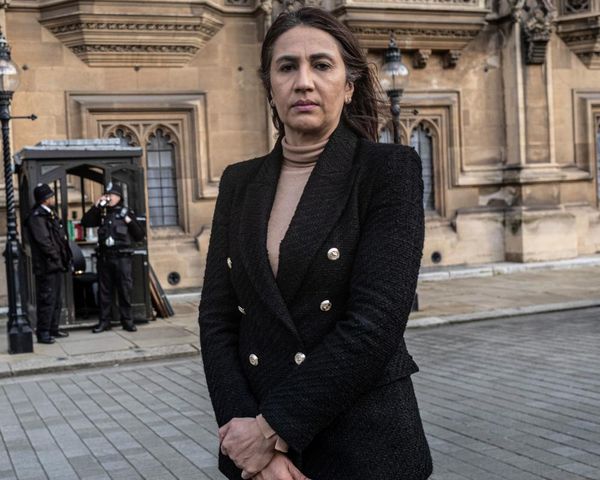
The face of God? Novelist Kathleen McGowan
Those of you rejoicing in the belief that you'd heard the last of the words "controversial", "novel", "bloodline", and "Christianity" in the same sentence, would do well to grasp your rosary beads a little tighter, writes James Anthony.
American author Kathleen McGowan is poised to herald the second coming of this thorny issue with her novel, The Expected One. A "personal odyssey" based on her own "real life" experiences, it returns once again to the notion of a union between Jesus and Mary Magdalene. This book, or rather the author, claims to "answer every question that a Da Vinci Code reader could ask".
McGowan has been able to resurrect this theme partly due to the growing interest in the forgotten women of the bible, and partly due to the unique selling point - I mean unique angle - of her novel: McGowan claims to be a direct descendant of Jesus Christ.
The novel has a life-imitating-art feel to it - the plot involves an author researching a book about a union between Jesus and Mary Magdalene - prompting the reader to dare to dream that the character may, in fact, be the author herself.
Her "unique situation" has allowed her access through doors previously locked to other researchers, as one might expect from someone vested with power descended from the holy trinity. This should bring with it an accompanying sense of authority. However, this is somewhat undermined by the total lack of proof McGowan is able to muster to support her claim. A self-confessed "folklorist by nature and by training", McGowan claims that "academics of the world will never accept my material because we have fundamentally different approaches to 'truth'.
"Frankly, I am suspicious of virtually anything that is considered academically acceptable," McGowan continues. "These legends exist, whether you choose to accept them or not."
So what we are left with? An author whose sole corroboration is a text which she freely admits is a work of fiction, and a reminder to the sceptical that legends "exist".
Or, taking the author's word - sorry, Word - is this "a complete story of the 1st century, as well as a modern story"? If so, it couldn't have come from a more authoritative source.