For decades, historians were fairly confident a Roman bridge once crossed the Aare River at Solothurn, Switzerland, but nobody could actually prove it. That changed when divers, hired ahead of renovation work on a nearby railway bridge, found wooden piles buried in the riverbed and dated them to the fourth century CE. The discovery finally confirms a Roman river crossing at ancient Salodurum, today's Solothurn, closing a gap that had puzzled archaeologists for years despite plenty of circumstantial evidence pointing to exactly this spot. What makes this find so satisfying isn't just the confirmation itself, but the quiet irony that survival came not from careful preservation, but from being accidentally shielded and simply forgotten. This one already has the closing passage in place. Want a fresh alternative, or should I leave it as is?
Get breaking news anytime, anywhere. Download the TOI app now!
Why historians suspected a bridge here for so long
Roman roads had already been identified on both sides of the Aare near Solothurn, which made it hard to explain how travellers on this long-distance route could have continued their journey without some way to cross the river. The location itself made sense too, since the winding Aare narrows into a tighter channel right at Solothurn, exactly the kind of spot a Roman engineer would pick to build a crossing. Even the town's ancient name offered a clue, since Salodurum is generally understood to come from a Celtic term meaning river narrows or gateway of the waves.
How divers finally found physical proof
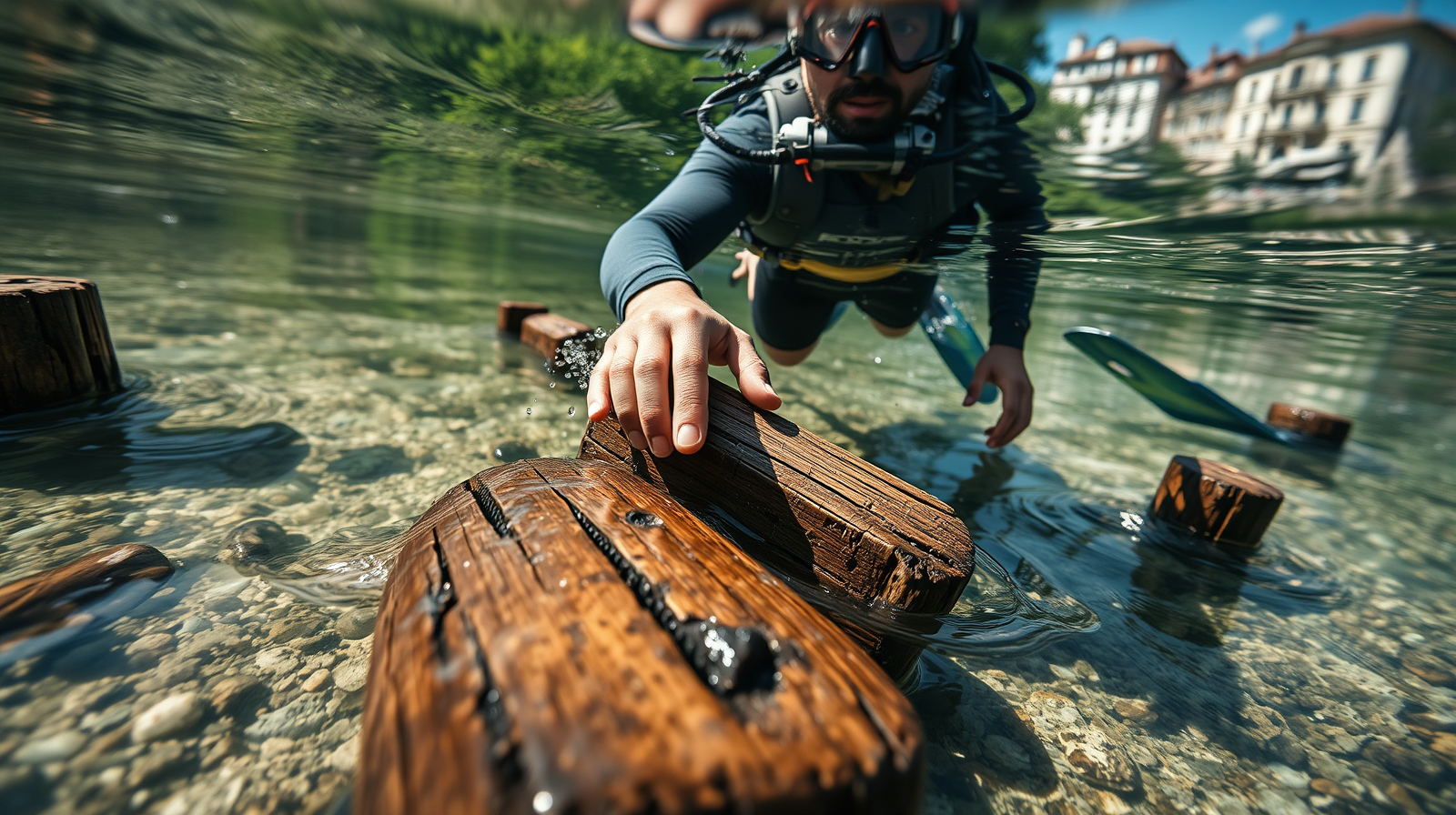
Since spring 2025, divers working on behalf of the Cantonal Archaeology Office of Solothurn had been searching the riverbed repeatedly for traces of an older crossing, partly guided by earlier reports that had vaguely mentioned wooden piles somewhere in the area. According to an official statement released by the Canton of Solothurn , the team eventually located several piles still embedded in the riverbed just a few metres upstream from the modern Wengi Bridge, roughly ten metres from the southern bank. The timbers form a row measuring just under two metres long, running in the direction of the current.
What wood dating revealed about the bridge
Once divers recovered wood samples from the piles, laboratory dating placed the timber firmly in the fourth century CE, meaning the crossing is roughly 1,700 years old. Archaeologists believe the wood belonged to a pile trestle, a type of bridge pier that would have supported the roadway running above the water. This period lines up closely with a major shift at Salodurum, when the earlier Roman settlement, which had existed there since the first century, was being rebuilt into a fortified site known as a castrum, part of a broader pattern seen across Roman Switzerland as the later empire responded to growing military pressure and political instability.
Part of a major Roman road linking Italy to the Rhine
The newly confirmed bridge was not just a local crossing; it formed part of a long-distance Roman road running from Italy over the Great St Bernard Pass, across the western Swiss plateau and through the Jura toward the Rhine frontier. Sections of this same road had already been identified on both sides of the river near Solothurn, between Buren an der Aare and Nennigkofen, strengthening the case that a crossing must have existed at exactly this point to keep the route intact.
How the timber survived nearly 1700 years underwater
Given how much can happen to a riverbed over seventeen centuries, the survival of these piles owes a lot to sheer luck. During river engineering works carried out in 1969 as part of the Jura water correction project, large sections of the riverbed near Solothurn were dredged, an operation that likely would have destroyed the Roman piles entirely. According to the cantonal authorities, the structure of the modern Wengi Bridge ended up shielding the older remains, allowing them to stay buried and protected beneath the sediment while the surrounding riverbed was reshaped around them.
Why archaeologists are leaving the bridge exactly where it is
Rather than pulling the ancient timber out of the water, archaeologists have decided to leave the piles submerged, since waterlogged wood tends to survive far better in the constant moisture of a riverbed than it would if exposed to open air, where decay would set in quickly. The new railway bridge project will not disturb the remains either, meaning this fragile piece of Roman engineering gets to stay exactly where it has rested for the better part of two millennia.
What comes next for this discovery
Solothurn's archaeologists plan to continue diving in the area, hoping to locate additional piles that may belong to the same structure, since what has been found so far likely represents only a small portion of the original bridge. Even in its current, partial state, the find gives historians something they have wanted for decades, solid physical proof turning a long-standing assumption about Roman Salodurum into confirmed archaeological fact.