The churches are still standing
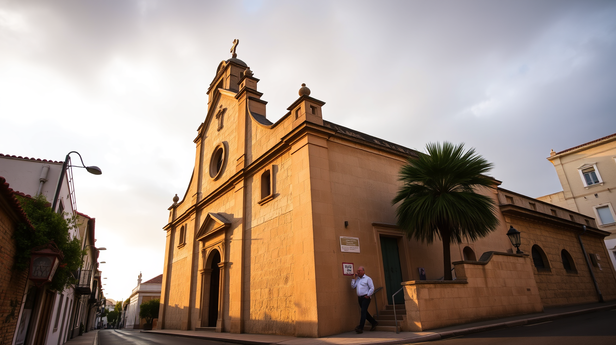
The first thing that stops you in Diu is a church. Not a temple, not a mosque, a church built in 1601 by the Jesuits, its limestone facade holding the particular grey of old Portuguese stonework, its nave cool and echoey in a way that feels imported from somewhere far west of the Arabian Sea. The Church of St. Paul still stands in the old town. So does the Church of St. Thomas, which is now a museum. So does the Church of St. Francis of Assisi, which has been converted into a hospital. The Portuguese left in 1961 under pressure from the Indian military during Operation Vijay. The churches stayed.
There is something quietly disorienting about this. You are in India. The rupee works here, the auto-rickshaws run here, the flag is the same tricolour that flies over every government building from Ladakh to Kanyakumari. And yet the oldest buildings in the town were built by men who answered to Lisbon, who named the streets in Latin, who planted a fort on the western edge of the island so large it still takes a full hour to walk its perimeter.
Diu is a Union Territory, administered directly by the central government, not part of Gujarat despite sharing its coastline. That administrative fact is its own kind of residue, the island was held apart for so long that even reunification required a separate category.
What four hundred years does to a street
The Portuguese arrived in Diu in 1535, not by conquest initially but by treaty, securing the island from the Sultan of Gujarat in exchange for military support against the Mughals. They stayed for 426 years. That is not an occupation measured in decades. That is long enough to reshape the grammar of a place, the way streets bend, the way houses face the sea, the way a town decides where its centre is.
Walk through the old quarter and you will notice that the houses have a particular quality: thick walls, inner courtyards, wooden balconies with turned balusters that belong to a tradition of carpentry that never had anything to do with Gujarat. Some facades still carry the ghost of Portuguese tile-work. The street widths are narrower than an Indian town of comparable age would typically plan. The whole place has a density that reads as Mediterranean before it reads as coastal Indian.
You will also notice that it is quieter than almost anywhere else on the western coast. Diu has no heavy industry. The fishing boats go out before dawn and come back by mid-morning. By afternoon, the town settles into a stillness that feels less like laziness and more like a place that has been pausing for a very long time, waiting for something it cannot name.
The liberation that didn't change the light
Operation Vijay lasted thirty-six hours. On December 19, 1961, Indian forces moved simultaneously into Goa, Daman, and Diu. The Portuguese governor surrendered. The Estado da India, Portugal's Asian colonial state, ceased to exist. India absorbed three territories it had been asking Portugal to hand over peacefully since 1947, and Portugal had refused every time.
The date is marked. December 19 is Goa Liberation Day. There are monuments. In Diu, there is a small memorial near the fort. But the liberation, decisive as it was politically, did not change the architecture. It could not. The Church of St. Paul was already 360 years old when Indian soldiers arrived. The fort walls were older. The street plan was fixed. What liberation changed was the flag and the administration. What it could not change was the accumulated weight of four centuries of a different civilisation making itself at home on a small island in the Arabian Sea.
This is the specific texture of Diu that no other Indian destination quite replicates. Pondicherry has its French quarters, yes. But Pondicherry is a city with a French district. Diu is an island that is, in its oldest parts, almost entirely Portuguese in its bones. The Indian presence here is the newer layer.
What you carry when you leave
The fort at the western end of the island was built in 1535, the same year the Portuguese secured their foothold. It sits on a promontory with the sea on three sides. The walls are thick enough that a cannon ball fired from a ship would have spent itself before reaching the interior. There are lighthouses inside the fort compound, one built by the Portuguese, one added later. There are dungeons. There are views of the water that are genuinely beautiful in a way that has nothing to do with tourism brochures, the light in the late afternoon comes off the Arabian Sea at an angle that makes the old stone glow amber, and for a moment the fort looks less like a ruin and more like something that was just built yesterday by people who knew exactly what they were doing.
You stand there and you feel the pull of two things at once. The place is Indian. You are Indian. And the thing you are standing inside was built by someone who would have seen you as a subject, or an obstacle, or nothing at all. That is not a comfortable feeling to hold. It is also not a feeling you can resolve by walking back to your hotel.
Colonial heritage tourism in India tends toward one of two postures: pride in what survived, or anger at what was taken. Diu refuses both. The island is too small and too specific for either posture to hold. What it offers instead is the rarer thing: a place where you can stand inside history without being told how to feel about it.
The churches, the fort, the curved streets, the stillness, they don't add up to a lesson. They add up to a place that was shaped by people who are gone, that is now home to people who stayed, and that carries both facts in the same stones without resolving the tension between them. That unresolved weight is what you bring back. It is also, if you are honest, what makes Diu worth the trip.