
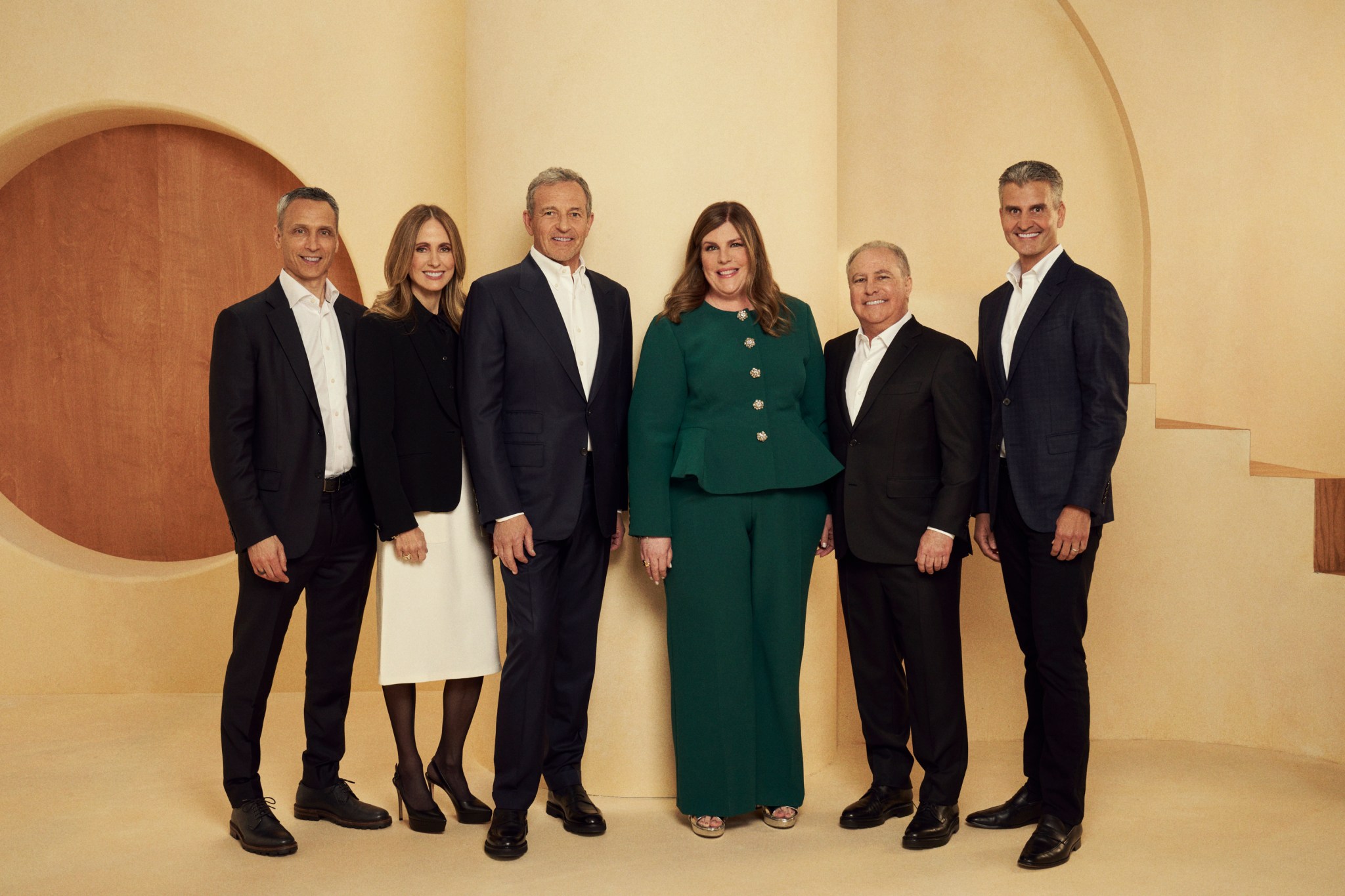
Disney leader Bob Iger delivered his final historic announcement as head of the esteemed entertainment corporation with the promotion of Josh D’Amaro to CEO and Dana Walden to President and Chief Creative Officer. They are part of a media leadership succession dream team, groomed from within in a classic succession process of trial assignments, leading to proven competence and credibility.
Disney’s Iger era has been marked by numerous monumental achievements, namely transforming the company from a traditional media and entertainment institution into a dynamic and formidable force across entertainment, experiences, and sports, capable of contending with the most advanced digitally native competitors. He parachuted in with a messianic mission akin to those of Michael Dell of Dell Technologies; Steve Jobs of Apple, or Howard Schultz of Starbucks, each of whom returned to active duty service at the request of their boards.
We have termed these heroic figures “generals” in a book entitled The Hero’s Farewell (Oxford University Press). In fact, the Second World War was a triumph of such mothballed leaders returning to active duty, lions such as Charles de Gaulle, Winston Churchill, George Patton, Douglas MacArthur and Bernard Montgomery being pressed into service.
In the corporate world, such “generals” had repeat transformational impact on their enterprises but their returns allowed things to stabilize and begin building again. But as the chief executive of one of the most iconic enterprises in the world, few decisions are as important as ensuring the successful long-term transition of the organization to the next generation of capable leaders.
Iger has become one of the most iconic, admired, and capable leaders in the media world. He mastered strategic technological, consumer, and global diplomatic shifts while also resolving inherited domestic political battles and industrywide writer and director contractual challenges, acting as the pillar of leadership for the entire sector. It is impossible to imagine where this great global iconic enterprise would be now if Iger did not interrupt a comfortable retirement in 2022, not just to secure his already revered tenure, but to safeguard a Disney legacy that had come under extreme duress.
The selection of D’Amaro will be closely scrutinized by Wall Street over the coming months, following the relatively brief but tumultuous term of Bob Chapek, who was tapped in 2020 to succeed Iger. Upon his return, Iger moved quickly to remedy the damage caused by Chapek, learn from his failings, and establish a more robust succession plan, drawing on his experience and that of others.
Three key takeaways from that planning have become apparent with the official appointment of D’Amaro and Walden. First, D’Amaro does not suffer from the myopic, centralized operator mentality ascribed to Chapek, appreciating the creative talent that is core to Disney magic. Second, Walden’s promotion addresses any experience gap D’Amaro has in the highly creative, relationship-driven environment of the Entertainment segment, analogous to a strategy Iger used to supplement his limitations in the Experiences segment when he was appointed CEO in 2005. Finally, Iger and the Disney board humbly sought deeper guidance from leaders with proven success in succession planning.
Bringing a Different Skillset and Perspective from the Same Experiences Segment
Despite both D’Amaro and Chapek having served as Disney Experiences Chairman immediately before their appointment to the top job, the executives took two very different paths to get there.
Chapek was a skilled operator with a well-known preference for following tight budgets and schedules. However, his admirable career trajectory unfolded in consumer products, where he spent nearly three decades developing skills in data analysis, licensing fees, and cost minimization. In contrast, D’Amaro shaped his career within the theme parks division. He joined the company in 1998 at Disneyland Resort and rose through the division’s operations, eventually becoming president of Disneyland and then Walt Disney World.
While Chapek prioritized operational efficiencies, it came at the expense of constraints on the creative process. He imposed strict policies and damaging restrictions on the renowned Disney Imagineers—the research and development arm responsible for creating, designing, and constructing theme parks and attractions—seeing their distinctive culture and free spending as opportunities for conventional streamlining. He oversaw a reorganization of Disney Studios that centralized control in a business-oriented unit, which drew sharp criticism from creative executives who lost control over project approvals and distribution. Both actions had damaging effects that were soon reversed when Iger returned.
D’Amaro had coincidentally been leading revitalization efforts for the Experiences segment’s creative engines as chairman, supported by a $60 billion investment in theme parks and resorts, the launch of the first-ever theme park in the Middle East, and nearly doubling the number of cruise ships in its fleet—much of which is directed by the Imagineers. He has also consistently shown respect for the company’s creatives, telling The Hollywood Reporter in a 2023 interview: “This goes back to Walt when he envisioned what this company ultimately was going to be. He had storytelling and content in the middle, and all these businesses surrounding it.”
Fortifying Content Creation with the Promotion of Dana Walden
The Disney board has rightly highlighted D’Amaro’s deep understanding of the organization’s creative spirit. Yet, the reality is more about structural qualities than personal traits. D’Amaro has built stronger relationships and discusses storytelling and creativity more fluently than Chapek did, even as his Hollywood experience is limited. Enter Dana Walden, who was elevated to President and Chief Creative Officer and positioned as an essential leadership component of the transition.
The promotion is not only well deserved—programming launched under Walden has received over 1,200 awards, including more than 400 Emmys. ABC’s status as the top entertainment network has been maintained for several consecutive seasons and it continues to be the most-watched news network in the U.S. Landmark series developed under her purview include The Simpsons, 24, Grey’s Anatomy, Modern Family, Glee, American Horror Story, Abbott Elementary, Only Murders in the Building, and Buffy the Vampire Slayer, among many others—but also necessary to prepare D’Amaro for long-term success.
Also worth noting are the circumstances surrounding Iger’s appointment as CEO. He came to Disney as a respected television and broadcast executive but had comparatively limited expertise in theme parks or consumer products. At the time, limited theme park experience was not considered a significant liability; it was seen as an important but manageable operational challenge that could be managed through smart delegation. Television and content were still regarded as the “heart” of Disney, and Wall Street expected a CEO to have direct fluency.
Today, however, that equation has somewhat flipped, with the Experiences segment (which includes theme parks) now generating 38% of Disney’s total revenue and 71% of operating income in the latest earnings report. Television is in decline, and streaming has become more commoditized, while parks have increasingly required differentiation. D’Amaro’s background should now be seen as a strategic asset, not a liability, so long as he continues to respect Walden’s talents and the creative development she is meant to encourage.
Assembling the Dream Team to Lead Succession Planning
The carefully choreographed promotion of both D’Amaro and Walden, along with the subsequent messaging, provides a best-in-class example of succession planning when a company faces a crisis of riches in the C-suite. After Iger’s return to Disney, the board appointed James Gorman, former Morgan Stanley Chair and CEO, as the new board Chair and head of the Succession Planning Committee. Gorman had just completed his high-stakes CEO transition with three capable candidates ready to fill his position. The Committee was also complemented by General Motors Chair and CEO Mary Barra, who was selected from a group of talented peers and had firsthand experience managing an effective transition.
The parallels between Gorman’s and Barra’s experiences are clear. As Gorman selected the next head of Morgan Stanley, he ensured the other two candidates were publicly respected by elevating them to co-presidents with additional responsibilities and decision-making authority and financially incentivized them with a competitive compensation package comparable to that of the new CEO. Barra, on the other hand, won a CEO race in which her peers were similarly elevated and compensated for their experience. Both of Gorman’s co-presidents remain with the financial institution, while one of Barra’s colleagues stayed for another eight years, and the other remains with the auto manufacturer.
In addition to promoting D’Amaro and Walden, the Succession Planning Committee rewarded the two leaders with a generous compensation package and secured Walden’s employment through March 2030. Having Walden through at least 2030 will give D’Amaro more time to expand industry relationships and knowledge critical to the other business segments. And, underreported but arguably as important was the strategic decision in November to lock in CFO Hugh Johnston—one of the best financial officers in the Fortune 500 and a Wall Street favorite—through January 2029, ahead of the CEO announcement. Johnston will provide one more steady and respected hand as Disney embarks on the long-term transition to the next generation of leaders.
Additional vital members of this loyal dream team include such long-term Disney stars as Alan Bergman and Jimmy Pitaro. Bergman has served as Co-Chairman of Disney Entertainment, since 2023, with oversight duties guiding the global content portfolio for studios including Disney, Marvel, Pixar, Lucasfilm, and 20th Century Studios, having previously brilliantly led the integration of these studies. Bergman produced the entertainment division’s highest-grossing era ever, producing hits such hits as the Avengers: Endgame, Avatar: The Way of Water, Frozen, and The Lion King plus 28 films that yielded over $1 billion each. He has brought in a record $11 billion-plus in annual box office results and sparked Disney+ content growth. Jimmy Pitaro, the Chairman of ESPN, has similarly served as a top Disney executive since 2010, driving massive digital, consumer product, and sports media successes. Previously, he led drove the turnaround of Disney Interactive, managed global consumer products for major brands, and oversaw the launch of ESPN+ and the upcoming “Flagship” direct-to-consumer service, fortifying his future value the business.
Iger’s most significant acquisition was not Pixar, Marvel, or Lucasfilm. Instead, it was the hard-won wisdom to identify mistakes and implement a succession plan to avoid repeating them. With D’Amaro, Walden, and Johnston in key roles, Disney has built a leadership team capable of both preserving and expanding the company’s historic legacy.
The opinions expressed in Fortune.com commentary pieces are solely the views of their authors and do not necessarily reflect the opinions and beliefs of Fortune. This column has been updated to include an additional paragraph.