I won’t dare question the sheer high-fantasy spectacle of Game of Thrones. For five seasons, HBO’s hugely ambitious imagining of George RR Martin’s Westeros has continued to ratchet up the visual stakes. Jumping from red and purple weddings to unruly adolescent dragons to an ice zombie invasion that, despite literally years of overwrought, unfulfilled exhortations about coming winter, still managed to blindside us.
The show is a state-of-the-art rollercoaster: expensively built to jolt, shock, drop stomachs, stir butterflies and generally rivet the hell out of you, but an exquisite machine that also leaves you barren at ride’s end. Nevertheless, Game of Thrones has built a captive, devoted audience since its debut in 2011. So captive, in fact, that it seems like many people have developed the television equivalent of Stockholm syndrome, bonded so thoroughly to HBO that they would rather countenance the abuse of narrative torpor than run into the arms of another show. Over the past 10 weeks, perhaps the greatest casualty of this undiscriminating fealty to Game of Thrones (and now to a lesser degree True Detective) is Showtime’s poignant, profound Victorian monster yarn, Penny Dreadful (the show’s finale aired Monday night in the US).
Created by John Logan, whose screenplay credits include Gladiator and The Aviator, and executive produced by American Beauty director Sam Mendes, Penny Dreadful began as a shambolic mashup of 19th century Victorian heroes and monsters including Victor Frankenstein, Mina Harker, Dorian Gray and – sigh – seductive vampires.

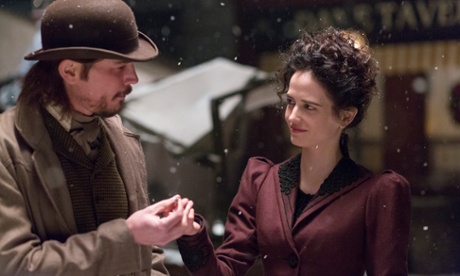
While it didn’t quite hang together for much of the first season, as the show progressed it started to build itself around the mysterious and tortured clairvoyant Vanessa Ives. Fueled by a visceral, intensely committed performance by Eva Green, Ives gradually comes to embody what Penny Dreadful is all about: outcasts learning to accept their suffering lot, embrace their darker, serpentine paths through life and eschew the normality they privately coveted. As a priest says at the end of the first season, being touched by a demon is “like being touched by the backhand of God”.
That line becomes the unstated mantra of season two, in which Penny Dreadful streamlines into a surprisingly heartfelt meditation on remorse, solitude, personal demons and the remote, hazy specter of deliverance. Sure, the season’s story, which focuses on Vanessa Ives’s struggle to decode the “memoirs of the devil” and fight a hissing viper pit of Lucifer’s witches, may be pure pulp burlesque, but that’s just the first layer of Penny Dreadful’s charm. What makes it such a strange breed is how it transcends those ornate, gothic novel trappings to explore, you know, real themes.
No longer a clunky, ill-fitting ensemble of literary legends, the characters in Penny Dreadful fit together brilliantly under Logan’s banner of long-suffering rogues. Harry Treadaway’s Victor Frankenstein buckled under the weight of his monstrous creations, succumbing to his morphine addiction and losing his undead paramour Lily. Meanwhile, John Clare/Caliban, Ethan Chandler, Sir Malcolm and Vanessa all eventually lay the bricks for their own grotesque towers of guilt, and must reckon with the consequences in the season’s final episodes. Further, the quiet, understated scenes between John Clare and Vanessa in the catacombs of the cholera ward allow themes to blossom that few other shows would dare cultivate: God, salvation, theodicy, our responsibility to one another, those truly universal hopes of being accepted and being loved.
It’s especially in these moments, when characters are both vulnerable and direct, fragile and fiercely honest, facing up the why of human existence with near-Shakespearean poise that Penny Dreadful gains ground on the spectacular but vapid Game of Thrones.
It’s ironic in a sort of mordant way that we need to travel to the macabre, supernatural underbelly of Victorian London to find characters that are legitimately relatable. After Vanessa and John’s final rendezvous in the cholera caves, when John tells her his “long dream of kinship” has ended, and the camera cuts to his shuddering sobs, a man reduced to a creature not of malice but of terrible grief, I defy you not to be moved. It’s an absolute testament to Rory Kinnear’s performance – an utterly human bundle of delicate, volatile contradictions – that I can’t even refer to him as Caliban. He simply no longer fits as the kind of stock baddie from sensational “penny bloods” that might take up such a lurid pseudonym; he’s clawed his way into the most painful crevices of humanity.
Underneath its ghoulish milieu, Penny Dreadful throbs with a big, bruised heart and a baroque web of emotional nuance. This is precisely how it eclipses Game of Thrones. Thrones, perhaps struggling under the weight of its monolithic pop culture status, or simply heartlessly breathtaking to begin with, really isn’t about anything anymore. Penny Dreadful’s climactic season two voyage into the witches’ castle is emblematic of the gulf between each show’s respective depths. Trapped in rooms full of illusions and satanic dolls, Logan’s show hits the visual storytelling notes it needs to. But the bedeviled foray also works as a potent allegory on the slow, vice-like workings of conscience, as guilt hunts down the protagonists with the shrieking remorselessness of Greek furies. It’s not just their lives that hang in the balance, but their fates as human beings.
Season two crafted complex characters racked with existential ambivalence – heroines marked for the abyss, fragile, flammable outcasts and desolate prodigies, all of whose private pain was as palpable as the crimson bloodbath head witch Evelyn Poole soaks in. The characters’ rich, angst-ridden inner lives made them relatable in a way that has simply never been possible in Thrones’ pretty-diorama fantasy. These are protagonists we might really come to care about. In other words, the kind Game of Thrones no longer deals in.