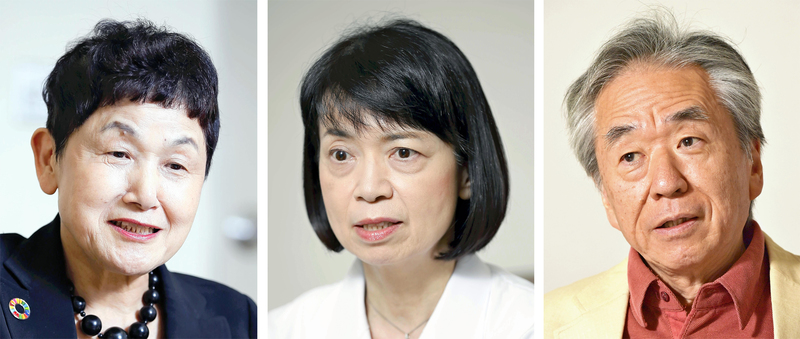
On Aug. 7, Tokyo Medical University admitted to unfavorably manipulating female test-takers' scores on the general entrance exam for its school of medicine. We spoke with three experts about discrimination against women and other issues in medical education and other medical settings. The following are excerpts from the interviews.
(From The Yomiuri Shimbun, Aug. 8, 2018)
Chance to think about fairness of entrance exams
In principle, in university entrance exams, candidates should be fairly selected according to prescribed application guidelines. In this case, Tokyo Medical University was clearly deviating from this general rule as it was curbing the number of successful female candidates without having mentioned a gender-based quota in the application guidelines.
I once served as a dean at Tohoku University and was involved in making admission decisions. In those days, when deciding who passed or failed, there would sometimes be a number of candidates who had the same score. Even so, we did not differentiate their evaluations based on criteria that were not included in the application guidelines. That is because there is no way to explain that to candidates. As a result, the number of successful candidates sometimes exceeded or fell short of the available quotas.
When I was doing research on entrance exams at the National Center for University Entrance Examinations over 20 years ago, an official from a national university with a medical faculty came to me and confided: "We have too many female applicants passing the scholastic ability test. Is there any way to adjust the gender ratio at the entrance exam stage?"
He told me that in places like surgical departments where operations can last for hours, male doctors were more desirable in terms of physical strength. I told him, "I don't know of any method other than capping the numbers of men and women." When this latest case came to light, however, I thought, "It's probably the same at other medical universities, even now."
But even if Tokyo Medical University had set gender-based caps, it could not have avoided being criticized by society. As society aims to become one in which women can play an active role, it can only be called anachronistic.
Until the early Taisho era (1912-1926), women were not even allowed to progress as far as university. After World War II, however, the doors were steadily opened, and in recent years the number of women advancing to four-year universities has risen.
In the preliminary results of the Education, Science, Sports and Technology Ministry's School Basic Survey for the 2018 academic year, the rate of both male and female high school graduates going on to university was 53.3 percent, while women made up 45.1 percent of students in university departments. Both figures were the highest in history.
With such a strong environment for women's education, if discrimination against female candidates continued at Tokyo Medical University, it is truly regrettable.
The entrance exam reforms currently being promoted by the education ministry seek to make comprehensive and multifaceted evaluations of students, taking into account not only knowledge but also thinking ability and independent identity. It is hoped that all universities will better clarify the types of students they want and make selections accordingly.
On the other hand, compared to decisions based on scholastic ability tests, it is also possible that admission standards will become vague. If every university is unable to clearly explain the reasons it has for determining admissions, the trust in entrance exams' fairness will be lost.
At the same time, universities must thoroughly review whether their selection criteria will be accepted by society. The government and universities should take this opportunity to review afresh how to ensure that entrance exams are fair.
-- This interview was conducted by Yomiuri Shimbun Staff Writer Sachiko Asakuno.
-- Katsuhiro Arai / Professor Emeritus at the National Center for University Entrance Examinations
Arai, 70, specializes in higher education research and entrance exams. He has served as a professor at Hiroshima University, Tohoku University and other institutions. He is the chairman of the Japanese Association of Higher Education Research.
Make effort to create female-friendly workplaces
This incident with Tokyo Medical University is incredibly disappointing. Women's acceptance was suppressed, and as a result their social advancement was hindered. Japan is regarded as at a low level for women's advancement among nations in the world. It is terribly disrespectful not only to the women denied entry, but to the men who studied hard and legitimately got in.
I graduated from Tokyo Women's Medical University in 1978 and went to work at the gynecology and obstetrics department. The following year, 1979, my first child was born. I returned to work five weeks after giving birth, and successfully fulfilled seven or eight night shifts a month. Women who were unable to work like men had no choice but to quit the section.
The sense that "housework and childcare are women's jobs" was not only prevalent among men, but also female doctors ourselves. The idea has strongly survived until this day, and is related to the issue at Tokyo Medical University.
In many countries in Europe, 40 to 60 percent of doctors are women, but in Japan the figure is no more than 21 percent. Even in Japan, however, women account for 35 percent of doctors in maternity and gynecology departments, and two-thirds of those are in their 20s. If female doctors do not keep up the good work, we will not be able to sustain Japan's maternity and gynecology departments.
In 2004, I became head of the department of obstetrics and gynecology at Aiiku Hospital in Tokyo, and gradually created systems in which female doctors can easily work. We have exempted the female staff from being on night duty for two years after giving birth, and turned the hospital's uncertified daycare for children into a certified one. Previously, it could only keep children for eight hours a day, but now it can keep them for 13 hours, with a special room added for the care of sick children. We have also introduced the systems of shortening working hours three to four times a week as well as working from home once a week.
As a result, female doctors can work earnestly, maintaining strong motivation to advance in their careers while raising children. There have even been more women who return to the workplace immediately after maternity leave and without taking childcare leave.
On the other hand, in order to dispel a sense of unfairness, we have drastically increased the allowance for the staff's night shift and we have made sure that the staff who end their duties could go home after handing over the task to other staff in the morning. Not a single male doctor is critical of the shift exemptions for women, and there are even some female doctors who express their desire to take on duty while raising children.
Men are unable to take women's place for pregnancy and childbirth, so it is only natural that there are certain periods in which female doctors cannot work. However, these periods do not last forever. If women have the desire to do their jobs and continue them, they will absolutely make great progress thereafter. Most of the women who graduated from Tokyo Women's Medical University together with me continue to do the work of doctors in a variety of different ways, such as in private practice, in the role of part-time doctors, through medical association activities, and becoming industrial physicians.
Tokyo Medical University neglected efforts to make female-friendly workplaces, even closed the doors to women for entering medical faculties, which goes against the times. People in leadership positions in the medical field should take this opportunity to accept the diversity of working styles, take concrete action to reform medical education workplaces and change social consciousness.
-- This interview was conducted by Yomiuri Shimbun Senior Writer Hiroya Yamaguchi.
-- Tomoko Adachi / Director of Aiiku Hospital
Adachi, who has been in her current position since December 2017, is a visiting professor at Tokyo Women's Medical University. She also worked as a representative of the Health, Labor and Welfare Ministry's research team, which looked into the work and other issues of female doctors.
Don't give up, tear down the 'bamboo barrier'
The Equal Employment Opportunity Law, which aimed at doing away with gender-based employment discrimination, was enforced in 1986. In 2016, the law on the promotion of women's participation and advancement in the workplace was enforced, making it mandatory to decide on action plans that include targets for women's advancement. Societal trends have certainly changed over the past three decades, but as this latest incident made clear, discrimination against women is alive and well.
According to the 2017 global gender gap index, which indicates the difference between men and women in terms of social advancement, Japan ranked a remarkably low 114 out of 144 countries. This is because women's economic strength lags behind that of men, and they have been slow to advance in the political world.
In the United States, a situation in which an ethos of male superiority holds back women's career advancement is called a "glass ceiling," meaning a barrier that is unseen but actually there. When I explain Japan's status quo overseas, I use the term "bamboo barrier." It is a term I coined by comparing particularly Japanese obstacles to bamboo. The "bamboo barrier" means that, in Japan, even if women can attain high social status and high-paying jobs, they still face difficult barriers in the initial stages, such as university entrance exams and company entrance tests.
The case of Tokyo Medical University suppressing the number of female entrants is a typical example, but merely the tip of the iceberg. The percentage of candidates who got into universities throughout Japan for the 2017 academic year was about the same for men and women, and a little higher for women in science faculties -- other than medicine -- such as physics, pharmaceuticals and engineering. But in the medical faculties, it was 6.6 percent for men and 5.9 percent for women. I often hear from company hiring staff something like: "If we hired in order of grades, we would only have women, so we give men a leg up." People think this cannot be helped, and this is nothing if not the essence of the problem.
In Japanese society, the assumptions that "women leave work after giving birth" and "women cannot be given jobs with responsibility" are firmly rooted. Women themselves also think, "I can't get anywhere by my strength alone," and give up on pursuing a career. This is a vicious cycle. Although the law is changing and systems are being put in place, the societal advancement of women is only halfway along. As Japan's birthrate declines and the number of elderly people rises, there are fewer and fewer workers. It is a waste to deny excellent candidates opportunities only because they are women.
Universities and companies must first stop affixing labels to women, and then tear down the bamboo barrier. I hope that women, too, will not give up and blame discrimination but will continue to challenge it. If an environment in which women can work is created, then the burden on men will also be lightened. We must work to create an environment in which the abilities of capable women can be put to use, women and men are treated equally when entering school and work, flexible working styles can be achieved with long working hours reexamined, and other measures.
-- This interview was conducted by Yomiuri Shimbun Staff Writer Ayaka Tanaka.
-- Mariko Bando / Chancellor of Showa Women's University
Bando, 71, started working at the Prime Minister's Office (now the Cabinet Office) in 1969. She is a former vice governor of Saitama Prefecture and a former director of the Gender Equality Bureau at the Cabinet Office. She has also written a book titled "Josei no Hinkaku" (The dignity of women).
Read more from The Japan News at https://japannews.yomiuri.co.jp/