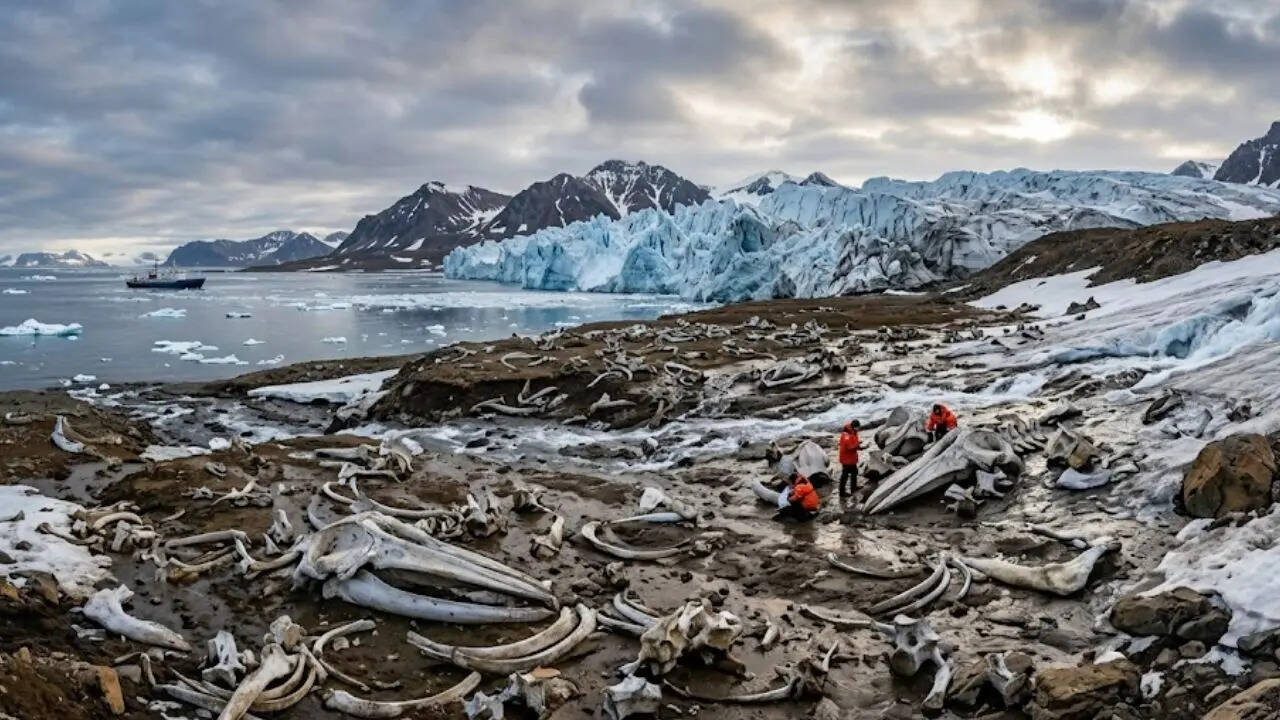
The rapid retreat of Arctic ice is revealing an extraordinary opportunity to gain insight into the Earth’s marine history through fossils. On Wilczek Island, which is found within the remote archipelago of Franz Josef Land, researchers have witnessed the rapid melting of a Russian glacier adjacent to the island, exposing an extensive graveyard of prehistoric whales. The graveyard was discovered during the ‘Arctic Floating University 2025’ expedition, and the subfossil remains have been preserved within the cryosphere’s active layer for thousands of years.
These fossils provide vital information about ancient sea-level changes and how cetaceans migrated to and from the region, allowing the Arctic and Antarctic Research Institute (AARI) to better reconstruct both of these phenomena. Furthermore, as glaciers continue to melt faster than they ever have previously, this biological record of ancient marine life provides a unique, but ultimately sobering, opportunity to study what has happened to marine life due to past environmental changes. These thawing remnants serve as a vital clock, offering scientists a fleeting window to decode the resilience of ancient ecosystems.
Glacier on Wilczek Island unveils prehistoric whale graveyard
Researchers at AARI have documented the rate of ice retreat on Wilczek Island by using archival satellite imagery to confirm that the glacier retreated at an unusual rate. This retreat of ice has exposed a coastal terrace that is covered with the bones of ancient cetaceans. The cetaceans did not all die at once, but instead represent a stratigraphic accumulation of remains of numerous animals over thousands of years. This accumulation of fossils has likely resulted from a combination of shifting shorelines and the stranding of marine animals in a shallow bay.
The role of glacial stability in bone longevity
Currently, the Arctic is experiencing warming that is happening two to three times faster than the global average. Arctic Amplification is the term used to describe this phenomenon. The National Snow and Ice Data Centre (NSIDC) reports that terrestrial ice sheets and permafrost are presently experiencing accelerated melting, serving as a ‘frozen record’ for organic and biological materials. The preservation of whale bones was contingent upon their proximity to the glacier's stable, frozen interior; those bones regularly subjected to cycles of freezing and thawing near the coast exhibited a considerably greater degree of degradation compared to those entombed beneath substantial layers of glacial ice.
How melting ice caps lifted the ocean floor
Geologists and palaeontologists conclude that the state of the skeletal remains suggests there was an ‘extremely rapid relative sea-level fall’ towards the end of the Holocene Era in the northernmost Eurasian archipelago. Research published through UNESCO's Intergovernmental Oceanographic Commission and other global monitoring agencies demonstrates that high-latitude finds are important for calibrating models of post-glacial rebound (the rising of land after a melting ice cap deweights it, stranding marine organisms on emergent coastal terraces now rising to the surface of the land as elevated terraces.
How melting affects the Arctic passage
This scientific discovery is great news, but the degradation of ancient organic carbon could trigger positive climate feedback loops. Research archived by NOAA (National Oceanic and Atmospheric Administration) suggests that the thawing of permafrost might release organisms and greenhouse gases that have been dormant for many years. The AARI team continues to check thermometric boreholes in this area to keep track of how fast deep-soil temperatures are changing and whether or not the Arctic passage is stable.