It all started with Pocahontas.
I was born and grew up in Gravesend, Kent, where Pocahontas died and was buried in 1617 and where there’s a beautiful statue of her. These days there’s a shopping centre behind that statue, but when I was young she stood outlined against the cold grey expanse of the Thames with the industrial landscape of Tilbury in the far distance. There was something about her – standing alone, hands outstretched – that haunted and puzzled me. Her image was so at odds with everything else I knew about Native Americans.
As a child I watched a lot of westerns. There wasn’t much choice. There were endless series on TV – The Virginian, The High Chaparral, Alias Smith and Jones. Any time we went to the cinema the B-movie always seemed to be a western – a clean-cut, morally simple Hollywood version in which the cowboys and cavalry were good, the Indians bad.
When I was around four my uncle, the actor Robert Shaw, played the lead in the film Custer of the West and I took it very personally. As far as I was concerned my uncle had been brutally killed at the Battle of the Little Bighorn along with all his men.
Seeing Little Big Man for the first time when I was around 13 came as a tremendous shock. Custer portrayed as a dangerous lunatic? Surely not! And yet here was a different side to the stories I’d been watching all my life. Maybe this required some thought…
But after Little Big Man, westerns seemed to fall out of fashion. It must have been around the same time that I was taken to see Gone With the Wind, because suddenly Rhett Butler replaced John Wayne as my image of the All-American Hero.
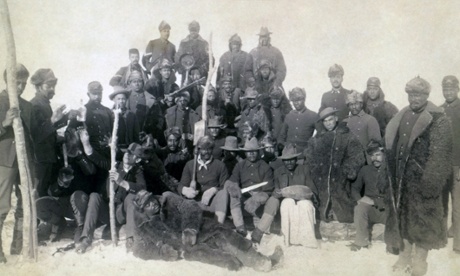
The two worlds – deep south, wild west – seemed a million miles apart. It was only years later, when I was researching my first YA novel Apache, that I began to realise they were closely connected. What joined them was the Buffalo Soldiers. Many of these men were freed slaves who, finding so few options open to them at the end of the American civil war, signed up for the army and were then sent out to fight in the Indian wars. Here was a vital piece of the jigsaw puzzle that had somehow fallen down the back of history’s sofa.
The more research I did, the more I found out that history had been whitewashed by Hollywood. In real life about a quarter of the army fighting in the Indian wars, and a quarter of the cowboys taking part in those huge cattle drives, were African Americans. The man who inspired Alan le May’s The Searchers was Britt Johnson, a former slave whose family were captured by Comanches.
Despite my curiosity I had no plans to write about the Buffalo Soldiers until I came across Cathy Williams, a young woman who was freed at the end of the civil war and who then disguised herself as a man and joined the army because, presumably, it felt like the safest place to be. Her story really got me thinking. If she’d been desperate enough to do that, surely she can’t have been the only one?
Writing fiction is all about the “what ifs?” Cathy Williams was a soldier for almost three years before her real identity was revealed. What if it hadn’t been? What if she’d stayed for the whole duration of the Indian wars? What might have happened to her during those long, terrible years? What would she have seen? How would she have coped? Gradually the figure of Charley O’Hara took shape in my head. Buffalo Soldier is the result.
More from Tanya Landman
Interview: ‘It was a horrible time in US history’
Top tips for writing historical fiction
Extract
Around the bend in the drive come the Yankee army.
I hadn’t never seen no soldiers before but I’d spent a heap of time imagining them. I’d pictured smart uniforms, gleaming boots, fine horses. Men with warm eyes and gentle voices who would speak to us kind. I’d imagined heroes. Gentleman, Angels.
These was worn-out from fighting, I guess. They was shabby, filthy, mean-looking, reeking of blood and sweat. Wasn’t a halo in sight. And wasn’t none of them remotely like Moses, Jesus or Joseph.
Me and Amos, we couldn’t see the front of the big house from the garden but we knew well enough the master was there. He been sitting on the porch for days, rocking in that chair of his, drinking corn whisky, oiling his gun, watching the driveway, cussing all the time and saying that his pa built this place from nothing, and his grandpa before that, and how he wasn’t never gonna let no damned Yankee set foot on his land.
Mr Delaney don’t give no warning. He fires at the soldier leading the column. Clips him is all. The Yankee don’t even fall off his horse. He don’t speak neither. Just cocks his gun, fires it back at the master. We hear Mr Delaney hit the porch deck. Then nothing. He don’t cry out. But Ham does. He been with the master since he was a boy. Ham starts screaming, “He dead! He dead! Master’s dead!”
- Buffalo Soldier by Tanya Landman is published by Walker Books, priced £7.99. Buy it from the Guardian bookshop for £6.39