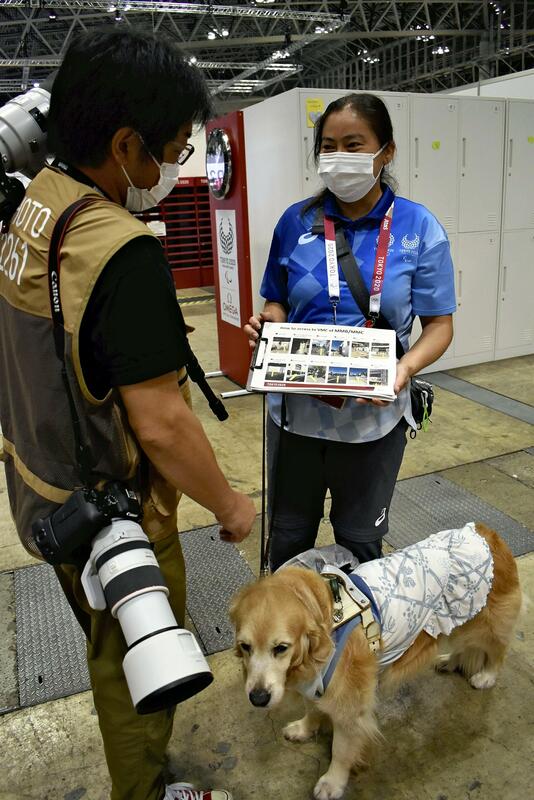
As media members covering sitting volleyball approached the media reception desk at Makuhari Messe in Chiba City last month, they encountered Shino Chiba -- and her guide dog, a golden retriever named Nana.
Speaking from the other side of a plastic sheet, Chiba instructed them to leave their PCR samples.
Chiba, 41, was among the many disabled people who served as volunteers for the Tokyo Paralympics, which came to a close on Sunday. Their efforts were an appeal for the Games to lead to the realization of a more inclusive society.
Chiba, from Katori, Chiba Prefecture, was 20 and taking correspondence university classes when she was diagnosed with retinitis pigmentosa, an intractable disease that causes gradual loss of sight. It was the same disease that afflicted her mother, who uses a white cane. "I can't believe this happened to me," she thought.
She went through a life-changing experience 1-1/2 years later, when she casually decided to become a volunteer for a local marathon. The race was also open to people with disabilities, and Chiba watched as volunteers cheered on wheelchair racers as they battled to finish. Her eyesight was not as weak as it is now, and the scene inspired her to find a way to make a difference.
She got a job as a nursing care assistant, and decided to start swimming, her favorite sport, again. She not only competed in meets, but also volunteered at more than 50 competitions.
"It gave me renewed awareness that no matter what the disability, there is definitely something one can do," Chiba said. "I hope the Tokyo Paralympics will help more people accept that disabilities are individual traits and lead to more disabled advancing into society."
-- Meaning of support
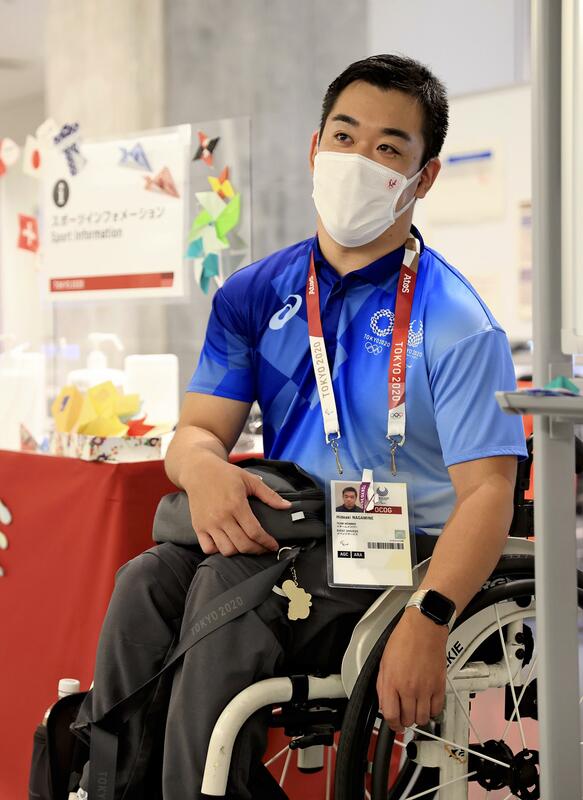
Hideaki Nagamine, who guided athletes and staff at Ariake Arena of Tokyo's Koto Ward, the venue for wheelchair basketball, was a former player himself.
Nagamine, 30, currently a company employee living in Tokyo's Taito Ward, has been disabled since birth. Growing up in Koriyama, Fukushima Prefecture, he became a member of the local wheelchair basketball club team that produced Akira Toyoshima, 32, the Japan team captain at the Tokyo Paralympics.
Nagamine quit the sport at age 20, and when Tokyo was selected as host of the 2020 Games in 2013, he applied for the first time to be a volunteer with the aim of "doing anything I can."
During the Games, he guided foreign athletes to the rest rooms and dining area, and encouraged them by giving them origami made by volunteers. A member of the championship U.S. team personally thanked him and let Nagamine touch his gold medal.
"When I was a player, I naturally received support, but I realized for the first time that there are many people providing that support behind the scenes," Nagamine said. "I'm going to keep volunteering. I want to help increase participation by people with disabilities."
Read more from The Japan News at https://japannews.yomiuri.co.jp/