In disabled sports, athletes are classified according to the type and degree of their disability so that fair competition will be ensured. In this respect, there are quite a few issues, such as the feigning of disability and a lack of experts in disability classification in Japan.
'From head to toe'
In mid-March, a para-equestrian event was held in Gotemba, Shizuoka Prefecture. At the venue, several people surrounded an equestrian with disability in the legs, keenly observing a sequence of actions by the equestrian. One person closely checked the extent to which the equestrian actually could move their legs by watching movements such as mounting and dismounting a horse. The person was an expert international classifier, certified by the International Equestrian Federation.
Masamichi Maeda, a doctor and a certified international classifier, said: "I observed the equestrian from head to toe. It is impossible to lie on a horse."
In the para-equestrian event, disabled equestrians are grouped into five classes from Grade I to Grade V according to the degree of their disability, and those in the same class compete against each other. Since necessary physical functions and characteristics differ among sports, each sport has its own classification rules.
3-step process
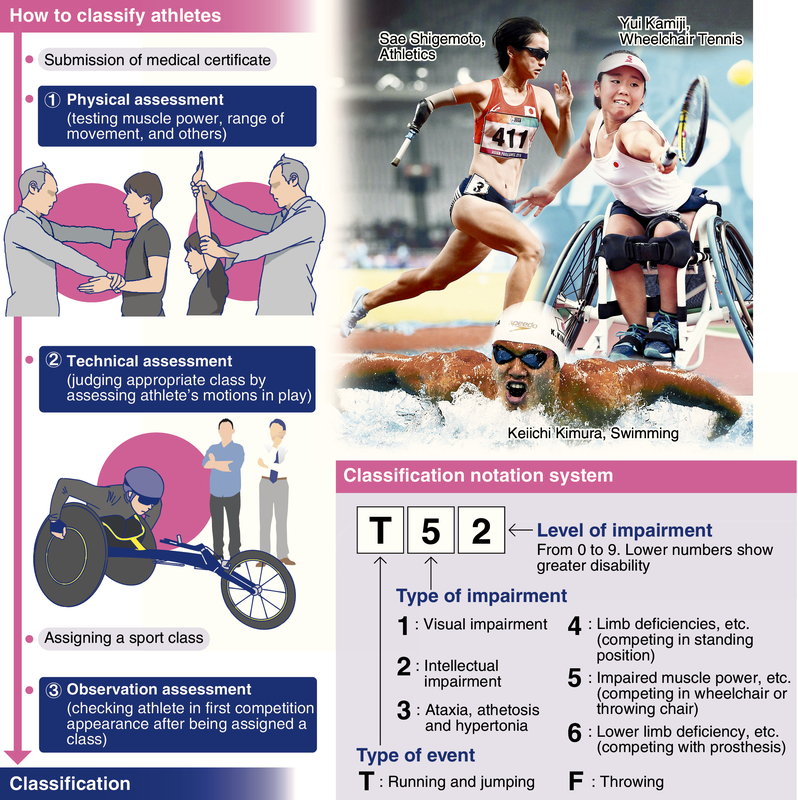
In para athletics, there are three assessments for classification. The "physical assessment" is to check the extent to which athletes can move their arms and legs and assess whether they are eligible.
The "technical assessment" is to decide the appropriate class for an athlete by assessing movements during play and other aspects.
The "observation assessment" is to finally determine a class for an athlete by observing their first appearance in competition after being assigned a class.
In the case of an athlete whose degree of disability could change, such as one with a progressive muscle disease, the classification processes will be repeated multiple times.
Classification is important because some athletes try to get into classes favorable to them by feigning a more serious disability than they actually have.
For example, multiple South Korean athletes who competed in judo events for the visually impaired and blind at the Asian Para Games held in Jakarta in October 2018 are suspected to have had driver's licenses.
At the 2000 Sydney Paralympics, many members of the Spain team that won the gold medal in intellectual disability basketball were found to have only posed as having intellectual disabilities.
"Classification is as important as anti-doping measures. There have been no such violations in Japan, and relevant officials must cooperate to realize a clean Paralympics in Tokyo," said Tatsuru Ibusuki, an international classifier and a board member of Japan Para Athletics.
While the mission of international classifiers is very important, it is difficult to obtain the certificate and continue the work. In order to be certified as an international classifier, one must take lectures held by relevant international federations and practical training, and be recognized as having sufficient knowledge and skills.
Doctors and former athletes are among certified international classifiers, whose work also requires English skills. They need to get off from work to take lectures held overseas. In addition, a certain level of medical knowledge is required.
For these reasons, there are only a few international classifiers in Japan. According to a survey by the Japanese Para-Sports Association, there were 27 international classifiers in Japan as of 2016. Some sport federations have no international classifiers.
Consequently, when participating in international competitions, some disabled Japanese athletes may be required to change their classes at the venues or even face difficulty in participating in the competitions at all. In order to prevent such situations, it is essential for each sport organization to have certified international classifiers and to keep up with the latest information.
The Japanese Para-Sports Association has recently provided subsidies to cover lecture fees and overseas travel expenses while holding workshops for doctors and others.
"We should prevent unexpected disadvantages for athletes," Naoe Yasuoka, an official of the association, said, emphasizing the necessity to raise the awareness of sport organizations and increase the number of experts.
Read more from The Japan News at https://japannews.yomiuri.co.jp/