The coronavirus pandemic has stopped the movement of people around the world. The aviation industry, which has grown against the backdrop of globalization, is facing difficulties. Efforts are underway to navigate through this industrywide shock.
"Securing cash in hand is an urgent issue," said Shinya Katanozaka, the president of ANA Holdings Inc.
At the beginning of a general shareholders meeting held in Tokyo on Monday, Katanozaka apologized to about 600 shareholders for not paying dividends for the first time in 10 years.
At a shareholders meeting of Japan Airlines Co. held June 19, a motion was submitted by a shareholder demanding that salaries for directors be cut in their entirety.
"Since the company receives financial assistance from the government, it is not good that directors receive high remuneration," the shareholder said.
Airline companies have a heavy cost burden, such as payments for airplanes and labor costs. In the ANA Group's case, daily expenses average slightly less than 3 billion yen, even though it was not operating any flights.
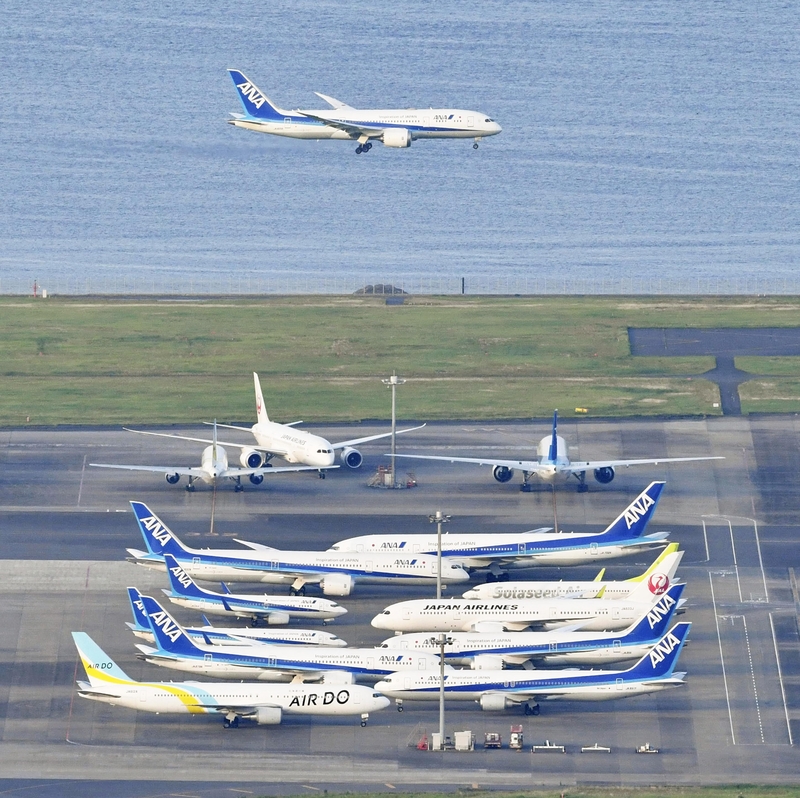
All Nippon Airways Co., the core company of the ANA Group, is reducing domestic flights by about 51% and international flights by more than 90% in July. Given the high flight reduction rates, jetliners are sitting idle at Haneda Airport as they have nowhere to go.
"We will carry out structural reforms," Katanozaka said, emphasizing that the company will make every effort to cope with the unprecedented decline in demand. "We also will raise additional funds as needed."
--Passengers halved
In late February, the government made a request to the nation to refrain from holding large-scale events amid the spread of the novel coronavirus.
Hisakazu Hayashibara, an ANA official in charge of domestic flight schedules, was surprised by the situation as the number of passengers decreased day by day.
The year-on-year rate of decline was rising 10 percentage points every day, and on March 1, the number of passengers fell to half of last year's level.
"If this goes on, the more airplanes we fly, the more losses we have," Hayashibara recalled thinking at the time.
Given the situation, the company hastily decided to reduce domestic flights in order to cut the variable costs generated every time an airplane flies, such as for fuel and landing fees paid to airport operators.
Making and revising flight schedules requires complex judgments.
If an airline chooses aircraft that exceeds forecast demand, operating costs will exceed ticket sales.
Different licenses apply to different types of aircraft. It is sometimes necessary to transport pilots certified to operate certain planes to the port of departure. It is also necessary to consider the working conditions of each staff member, such as allowing pilots and cabin attendants enough time to rest.
The number of domestic flight passengers was down 90% in April and 94% in May from a year earlier. Meanwhile, domestic flights were cut by 56% in April and 85% in May. Thus, the effort to reduce flights could not catch up with the rapid decline in demand.
As for international flights, a minimum level of flights had to be maintained for people returning to their home countries. ANA could not reduce variable costs as intended. For example, only 36 passengers were aboard its 246-seat flight on the Haneda-Jakarta route on March 29.
In an effort to make up for nose-diving demand for air travel, ANA and JAL took the desperate measure of loading medical supplies and other cargo on passenger seats on international flights in April and May. Through these efforts, the ANA Group managed to cut a total of 60 billion yen in variable costs in April and May. However, that was not enough by itself.
--Losing billions
Hit by the plummeting sales, a senior ANA official in April explained to government officials the difficult situation, saying, "Nearly 100 billion yen flew out of our company each month."
The underlying reason for this massive cash outflow is that the expense and revenue structure is unique to the aviation industry.
The annual sales of the ANA Group is about 2 trillion yen. Fixed costs, which are generated even without flying planes, account for 60% of the operating costs for the aviation business. Compared with 20% to 30% in the manufacturing industry, the figure is high.
The purchase price of a midsize airliner is about 10 billion yen. Fixed costs include loan payments for the planes, leases for equipment and labor costs. Simply calculated, fixed costs total more than 80 billion yen a month.
On the other hand, sales from transporting passengers and cargo were about 120 billion yen a month on average last fiscal year. After the outbreak of the novel coronavirus, sales fell by about 100 billion yen a month. Without significantly cutting fixed costs, the company will see a large loss every month. ANA has raised nearly 1 trillion yen, including loans, and will now be able to secure cash flow for the coming 12 months or so, even though the current losses continue. However, if its sales remain sluggish, the company's financial strength will be undermined.
--40% reservation rate
On June 19, interprefectural travel advisories were fully lifted. The economic situation has slightly improved recently. ANA and JAL plan to reduce domestic flights by about 50% in July, compared with 60% to 70% cuts in June.
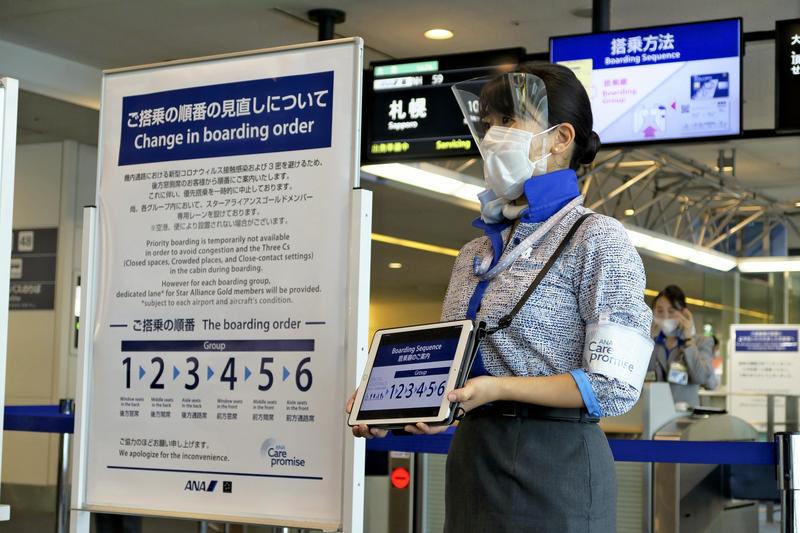
Since June, ANA has assigned special officers at boarding gates at Haneda Airport to ask passengers to wear a mask and board the plane separately to avoid close contact.
However, passengers are slow to return. JAL's domestic flight reservations were at slightly over 20% of the previous year's level for late June and are at a little more than 40% for late July. With concerns looming over a second wave of coronavirus infections, an early recovery cannot be expected.
"Your company's infection prevention measures seem to have problems," a passenger complained to an airline company about families sitting next to each other. Passengers have strong concerns about close-contact settings.
ANA forecasts that demand will recover by 70% for domestic flights and by 50% for international flights by the end of fiscal 2020.
According to Japan Aviation Management Research, a private research company, ANA and JAL will need seat occupancy rates of 60% for domestic flights and 70% for international flights in order to make a profit. Operating international flights is expected to produce deficits for a while.
Some airlines are leaving the middle seat of three-seat rows vacant to avoid close-contact settings. In that case, it is necessary to raise airfares by 40% to 50% in order to ensure a profit, according to the International Air Transport Association (IATA). But this option is not realistic.
So the only remaining option is to reduce costs.
ANA will compile a structural reform plan this summer. It plans to overhaul unprofitable flight routes. JAL will cut fixed costs by 60 billion yen including labor and advertising costs this fiscal year and reduce investments worth 50 billion yen by such means as delaying the receipt of aircraft ordered.
IATA predicts that the demand for air travel in 2020 will be half the level of 2019. After the Sept. 11, 2001, terrorist attacks in the United States and the 2008 collapse of Lehman Brothers, air travel demand dropped just several percentage points. IATA expects that demand will recover to the level before the pandemic in 2023 at the earliest. Will airline companies be able to endure the wait for demand to recover by that time while reducing costs? The future is unknown.
Read more from The Japan News at https://japannews.yomiuri.co.jp/