Foreign ministers have converged on Lausanne to finalise a deal with Iran over its nuclear programme, amid reports that negotiators were close to a general understanding.
The document, according to diplomats, is two or three pages long and lays down the outline of a much more detailed and technical agreement due to be completed by the end of June.
It is thought to include a ceiling for Iran’s uranium enrichment capacity, tentatively agreed at 6,000 centrifuges, and a limit for its stockpile of low-enriched uranium. It would also specify a timetable for the lifting of sanctions and the duration of the restrictions on the Iranian programme, thought to be between 10 and 15 years.
But diplomats warned that not all key points were agreed and that there were differences over whether they would be made public and in what form.
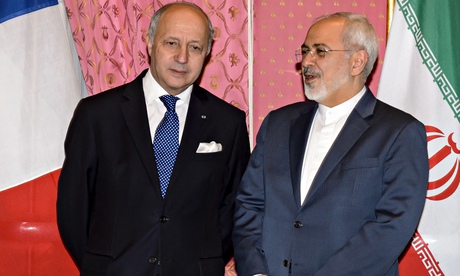
“The talks have been long and difficult. We’ve advanced on certain issues, not yet enough on others,” said the French foreign minister, Laurent Fabius. He said he wanted to ensure that any accord was robust.
His German counterpart, Frank-Walter Steinmeier, arrived in Lausanne soon afterwards to join the US secretary of state, John Kerry, and the Iranian foreign minister, Mohammad Javad Zarif, who had been in discussions since Thursday.After having lunch with the Europeans, Kerry went on a bicycle ride along the shores of Lake Geneva, leaving Steinmeier and Fabius to hold bilateral meetings with Zarif.
The EU foreign policy chief, Federica Mogherini, was expected to fly in, while Britain’s foreign secretary, Philip Hammond, and his opposite numbers from Russia and China, Sergei Lavrov and Wang Yi, are due to join the negotiations on Sunday.
All delegations have said they are focused on overcoming the last few hurdles. However, western diplomats are wary that, if negotiations drag on into the early hours of Wednesday morning, any agreement risks being labelled an April Fool’s deal by sceptics. Kerry is due to fly back to Washington early in the week, in a bid to persuade Congress not to impose new sanctions later in April that could kill off a deal before it can be finalised in June.
“Here, with a view of the Swiss mountains, I’m reminded that as one sees the cross on the summit, the final metres are the most difficult but also the decisive ones,” Steinmeier said on arrival.
If a framework deal is achieved, it is likely to be announced in Geneva rather than Lausanne. The Iranians are said to prefer any ceremony to be carried out under the auspices of the UN institutions in Geneva rather than at a luxury hotel that was the venue of the Lausanne treaty of 1923, which finalised the dismantling of the Ottoman empire and set the borders of modern Turkey.