In 2009, A Lange & Söhne introduced the unprecedented Zeitwerk with large jumping hour and minute numerals as well as a constant-force escapement as a beat controller.
A mechanical heart also drives the easy-to-read digital display of the second-generation Zeitwerk, whose design has been modified while still recalling the famous five-minute clock at the Semper Opera House in Dresden, Germany.
Ferdinand Adolph Lange actually worked with court clockmaker Johann Christian Friedrich Gutkaes on this revolutionary time display that was legible even from the rearmost seats of the opera house.
The five-minute clock was completed in 1841, and four years later Lange established his own workshop in Glashütte.
The company was revived in 1990 by the founder's great grandson, Walter Lange, whose strategy was to make the finest watches, mainly in gold or platinum, and limit the production to only a few thousand pieces per year.
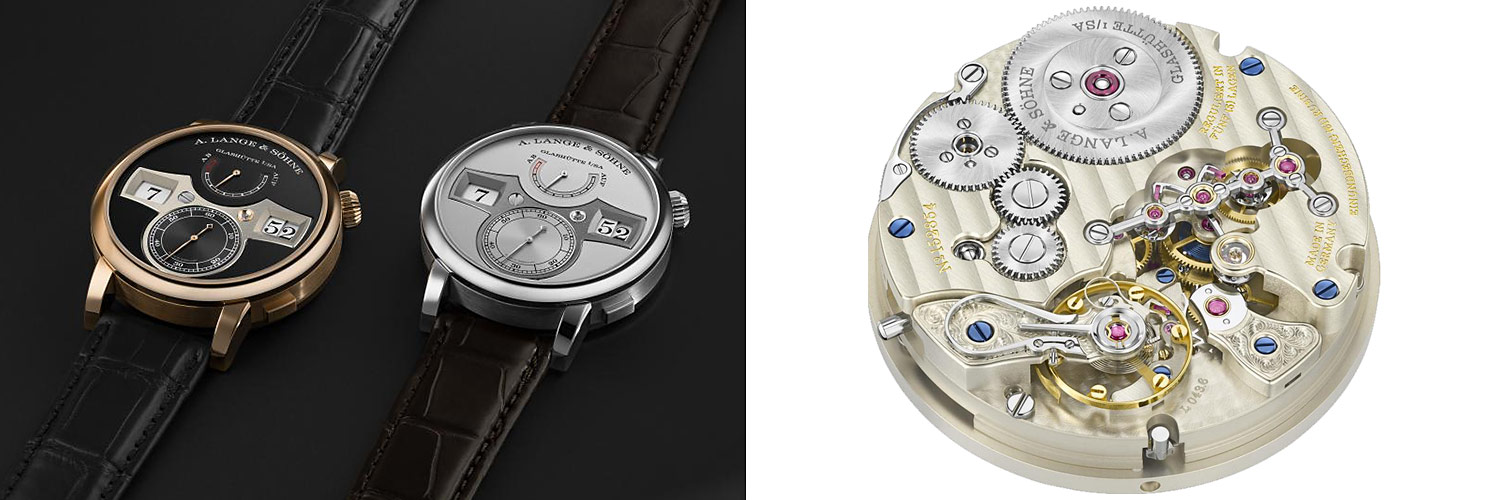
A Lange & Söhne has released two new versions of the award-winning mechanical digital watch housed in a pink gold or platinum case with a diameter of 41.9mm.
The pink gold model has a contrasting black dial and a time bridge made of untreated German silver while the platinum edition features a rhodié dial made of solid silver and a black rhodium time bridge.
The harmonious arrangement on the curved time bridge and the size of the displays ensure superb legibility. The time bridge was subtly reworked to make more room for the subsidiary seconds dial at 6 o'clock.
The minute-by-minute progression of the large jumping numerals is precisely controlled by the manually-wound Lange manufacture calibre L043.6 comprising 451 parts and boasting seven patents.
Firstly, the patented barrel design with two mainsprings doubles the power reserve from 36 to 72 hours, while the oscillation system has its own balance spring and patented beat-adjustment system.
The complex mechanism involves three jumping numerals discs -- one indicates the hours, the other two the units and 10s of the minutes. At the top of the hour, the three discs are simultaneously advanced by one increment.
Challenges in engineering the contemporary complication include fitting the mechanism in the limited dimensions of a wristwatch and providing enough energy to make it work the magic.
"To switch the discs of the jumping numerals mechanism to forward on time every minute, the movement requires much more energy than a classic time display," explains Anthony de Haas, director of product development.
"Not only are the numeral discs very heavy by watchmaking standards, but they also have to be quickly accelerated and braked again. This calls for considerably higher forces than the uniform rotation of a pair of hands of much less weight. The greatest amount of energy is needed at the top of the hour when the movement advances all three discs at the same time."
Moreover, the incremental step is executed precisely after 60 seconds, thanks to the patented constant-force escapement.
A Lange & Söhne has further made the Zeitwerk user-friendly, with the inverted pusher at 4 o'clock allowing the hour setting and separately advancing the display, which is particularly handy for travellers crossing time zones.


.png?w=600)