Private and state organisations in the digital sector have introduced new programmes and tools to help small and medium-sized enterprises (SMEs) adopt digital transformation.
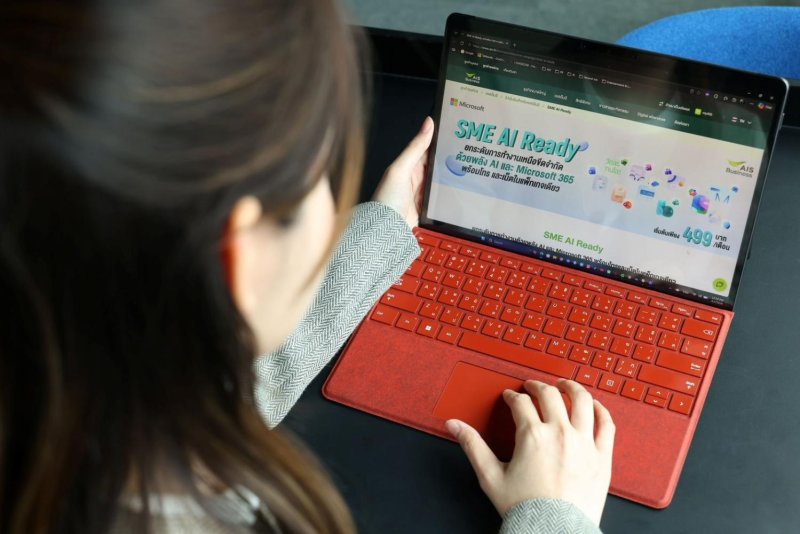
Advanced Info Service (AIS) recently partnered with Microsoft Thailand to roll out its "AI Ready for SMEs" initiative to help them access secure artificial intelligence (AI) adoption, providing them with a competitive advantage.
The move supports Thai entrepreneurs with specially tailored packages for SMEs and nationwide roadshows to improve access to solutions.
Thai SMEs contribute 35% of GDP, according to AIS, and the Thai SME Council reported there are more than 3.13 million SMEs, representing 99.7% of all businesses and 70% of employment in the country.
Phupa Akavipat, chief enterprise business officer of AIS, said helping these businesses adopt AI securely, efficiently and practically will enhance their long-term competitiveness and sustainable growth.
THREE CORE PILLARS
The initiative includes offerings integrated with the capabilities of Microsoft 365 and Copilot solutions, supported by the AIS Service Desk, a dedicated after-sales service team of experts available 24/7 via the 1740 hotline, ensuring SMEs can transition to AI smoothly, safely and with maximum efficiency.
The first 1,000 customers who subscribe to the Copilot package receive free access to a Copilot workshop, according to AIS.
In addition, customers subscribing to 10 licences or more receive a free private on-site training session at their office to tailor AI usage to their specific business needs.
AIS and Microsoft are also co-hosting a series of educational roadshows across Bangkok and key economic provinces that spans seven regions nationwide. The series aims to train more than 700 SME entrepreneurs in AI capabilities by the end of 2026.
The initiative also includes SME AI agents, a set of ready-to-use AI solutions designed to address practical business needs.
The project introduces AI agent templates for Copilot, allowing SMEs to build and customise agents for specific business functions.
Future plans include expanding the templates to other functions, such as human resources and finance, as well as developing specialised AI agents for vertical industries such as smart manufacturing to drive digital transformation.
SMART ENERGY
Meanwhile, True Corporation has deployed "smart energy" solutions to help businesses reduce energy costs.
Teeradet Dumrongbhalasitr, chief business officer at True Corp, said integrated AI and Internet of Things connectivity is becoming the "intelligence layer" of modern energy systems, serving as a vital catalyst for mitigating the energy crisis and lowering costs.
He said 30-40% of energy costs stem from "invisible waste" -- undetected power leaks within SMEs.
True data identified four primary drivers of this waste: always-on standby electrical equipment (12%), air conditioners without precise thermostat sensors (9%), electricity leakage from faulty hardware (8%), and unoptimised lighting in unoccupied areas (6%).
To combat these issues, True deployed intelligent network solutions across various sectors, yielding significant, data-proven savings.
In the retail sector, AI optimisation across more than 1,000 stores has cut energy consumption by 22% through real-time management of heating, ventilation and air conditioning as well as cold-chain systems.
For commercial offices, occupancy sensors have reduced unnecessary after-hours utility use, lowering operational expenses by 28%.
ALL-IN-ONE SUPPORT
The Electronic Transactions Development Agency (ETDA) also launched a nationwide campaign to accelerate digital adoption among Thai SMEs, helping them cut operational costs and drive sustainable business growth.
Meetham Na Ranong, deputy director of ETDA, said the agency's 2025 Digital Maturity Index showed SMEs scored 2.45 out of 4.
While the score rose 3.81% from the previous year, Thai SMEs are classified as digital followers, meaning they have yet to utilise the technology to its full potential to create a business advantage.
Many business operators are only utilising basic digital tools such as social media for front-end sales and communication, Mr Meetham said.
"They have yet to integrate technology into core business operations, such as data analytics for customer tracking, inventory management or workflow optimisation. This is largely due to uncertainty over how to start and hesitation regarding the return on investment," he said.
ETDA teamed up with public and financial partners to create an all-in-one support system for SMEs. The campaign includes targeted roadshows, practical workshops, business matching events and consultation clinics.
The initiative focuses on 16 provinces across four regions, targeting three high-potential sectors: trading, services (including tourism and hotels), and manufacturing.
Veerachai Monsintorn, head of the Small and Medium Industrial Institute (SMI) and vice-chairman of the Federation of Thai Industries (FTI), said local SMEs are caught in efficiency bottlenecks, mainly due to intense price competition from low-cost foreign imports and outdated management styles.
These limitations have prevented local operators from capturing high-value growth opportunities in emerging S-curve sectors, he said.
To facilitate the transition from declining traditional manufacturing to high-potential industries, the SMI and FTI have promoted a shared resources model allowing SMEs to share digital data, technology and personnel.
The project aims to shift businesses away from price-cutting competition towards value-added differentiation.
THREATS AND OPPORTUNITIES
"As an SME under pressure and facing significant disruption, our biggest fear isn't the competitors we can see -- those aren't as scary because we know what they are doing and they have their teams," said Michael Chen, chief executive of Buzzebees, at Microsoft's annual global AI exhibition, held in Thailand on June 9.
"The real terror is unseen competitors who come out of nowhere, using AI to instantly create things, and we simply won't be able to catch up."
Mr Chen said the most frightening aspect isn't AI itself, but the employee mindset.
The hardest part is turning AI usage into actual output that benefits the business. If AI merely makes employees' lives easier or gives them more free time, but the company gains almost nothing from it, that's a major problem, he said.
"If we don't change and don't know how to use it, we definitely won't survive. We have to apply AI to every department: accounting, operations and call centres," Mr Chen said.
"If we don't adapt and act now, I believe 90% of SMEs won't survive."
HUMAN ELEMENT
"No matter how smart AI gets, it cannot completely replace humans because working often requires emotion and empathy, which AI lacks," he said.
Mr Chen likened the rise of AI to the introduction of Excel, saying accountants adapted to the technology rather than being replaced by it.
Human empathy and collaboration remain essential, he noted.
"Collaboration is crucial, and the most important part of communication is body language, not just the words or tone of voice we use when speaking to others," said Mr Chen.
When working remotely, a problem that might take 10 minutes to solve in the office can drag on for a week over messaging apps due to misunderstandings.
"No matter how much you use AI, it cannot solve the lack of direct human communication," he said.
"We must use AI to enhance our skills, expand our knowledge and help us work faster, but it is not a complete replacement for human work."
Ralph Haupter, executive vice-president and chief revenue officer for SMEs at Microsoft, said the fundamental strength of AI is it is agnostic to company size.
A small business and a large enterprise can access the same technology and derive the same benefits, he said at the exhibition.
SME leaders frequently face the same obstacles: recruitment challenges, marketing agility, financial reporting burdens, and the lack of a robust customer relationship management system.
"What we are seeing globally is many SMEs are addressing these problems by building their own lightweight agents and applications," said Mr Haupter.
"The accessibility of AI today makes this entirely achievable, even for the smallest organisations."
AI is driving both efficiency and innovation across virtually every sector, with the financial services industry the leader in AI adoption.
He said the economic case is compelling: 92% of employment globally is generated by SMEs, and the leverage and acceleration potential of bringing AI to that segment is extraordinary.
Dhanawat Suthumpun, managing director of Microsoft Thailand and emerging markets, said in the AI era, size is no longer the deciding factor, but rather speed and creativity.
"A two-person company today can build and deploy numerous agents to handle assigned tasks at scale. Thai SMEs must take that opportunity seriously," he said.
"The urgency for Thai SMEs to engage with AI as a competitive tool is real and immediate."
COST CONCERNS
Regarding concerns about investment costs and potential price increases in the future, Mr Dhanawat said current trends indicate the cost per token and overall AI expenditure are declining, not rising.
"Furthermore, the user-based subscription model allows organisations to start small and scale only as value is demonstrated, with the flexibility to stop at any time. This structure significantly reduces financial risk compared with traditional enterprise technology investments," he said.
Mr Haupter said market competition is the most effective natural constraint on pricing.
Multiple AI model tiers allow customers to optimise their cost structure by matching the appropriate model to each task, he noted.
Applying a high-cost, large-scale model to a simple query is inefficient, much like dispatching a large freight vehicle to deliver a small parcel, said Mr Haupter.
"As the industry matures, greater sophistication in model selection and task optimisation will continue to drive down effective costs for customers," he noted.