In every corner of Mexico you will find small, family-run grocery stores that stock the basic essentials and provide a vital source of income for local communities. But these traditional micro-businesses have suffered from increased competition in recent years, with four closing down for every larger format store that opens. This is a concerning trend, particularly in the more remote and under-developed areas of Mexico where economic opportunities are few and far between.
In a bid to support these small businesses, Mexico’s largest baked goods provider, Grupo Bimbo, is supplying them with mobile point-of-sale terminals that enable them to process electronic transactions for the first time. In collaboration with Visa, Grupo Bimbo has installed over 75,000 terminals in small stores across Mexico in the last year. The terminals initially only facilitated airtime top-up and bill payment services while the retailers grow accustomed to the system, but since then more than 30% have since been enabled to accept credit and debit card payments.
The initiative is aimed at the small and medium enterprises that account for 99.8% of Mexican businesses, including the estimated 700,000 small merchants that are part of Grupo Bimbo’s largest sales channel.
“Our hope is to help these stores become more productive and competitive by connecting them to the digital and financial system,” said Hortencia Contreras, Grupo Bimbo’s vice president of electronic services. “It is very important that these kinds of stores accept credit and debit card payments because the customers that usually make such payments are migrating to other businesses,” she explained. “If they agree to this technology they will retain those customers [and] they will be able to increase their sales and be more productive.”
Grupo Bimbo has provided training for all shopkeepers, of whom the majority are female, and signage for the stores to advertise that they now accept card payments. Financial education is crucial to the success of the initiative, Contreras said, noting that the average Mexican shopkeeper does not understand the business speak of banking professionals. Given that Grupo Bimbo has been in constant contact with most small retailers for decades, Contreras believes the company is uniquely positioned to “capitalise on the trust they have in us and speak their language in a way that makes them feel comfortable with the use of technology.”
Convincing shopkeepers of the benefits of the terminals has proven one of the biggest challenges. “They think that these payment methods are intended only for large stores and they think that it’s very difficult to access them. There’s significant work to do to convince them, to show them the benefits, to train them in the use of technology,” Contreras said. “It may be a challenge for them at first, however with proper training they become regular users in a short time.”
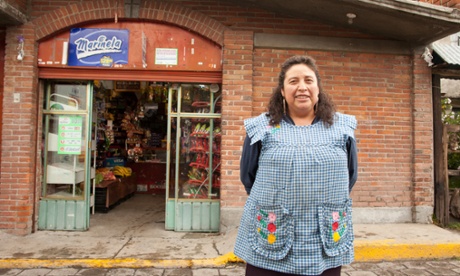
Customers, on the other hand, need little persuading. “Most people here like to pay with a card nowadays,” said Maria Ignacia Porcayo, who received a terminal at her store in Toluca just over a year ago. “[Customers] trust the system. They know we’re not overcharging them and in this way if they forget their cash they know they can always use their card.”
Porcayo said she had not faced any technical difficulties and noted that the terminals had provided immediate benefit to customers. “It’s great for our customers to know that we have a terminal so they don’t have to carry cash.”
Visa and Grupo Bimbo’s efforts are part of a wider trend towards financial inclusion in Mexico. Banks and enterprises have been introducing card readers, installing apps to transform smartphones and tablets into mobile points of sale and facilitating payments via text message.
Even with Grupo Bimbo’s extensive reach across Mexico – and the emergence of other companies working to extend digital payment technology nationwide – Mexico is a long way from going cashless. “Approximately 70% of transactions in Mexico are cash transactions,” said Luz Adriana Ramírez, country manager for Visa Mexico. “In Mexico today we have around six terminals for every 1,000 inhabitants.”
Visa and Grupo Bimbo aim to increase the current number of active POS devices that accept cards by 20%. In order to do so, “we must work to provide infrastructure, financial education and incentives to bolster the continued growth of electronic payments,” Ramírez said.
The stores they have reached so far are already feeling the difference. “It’s great to have these terminals in small businesses like mine. You never used to see them in shops like this before,” Porcayo said. Since installing the terminal, she soon noticed that “sales have increased a little and we have more clients now.”
Content on this page is paid for and provided by Visa sponsor of the Guardian Global Development Professional Network.