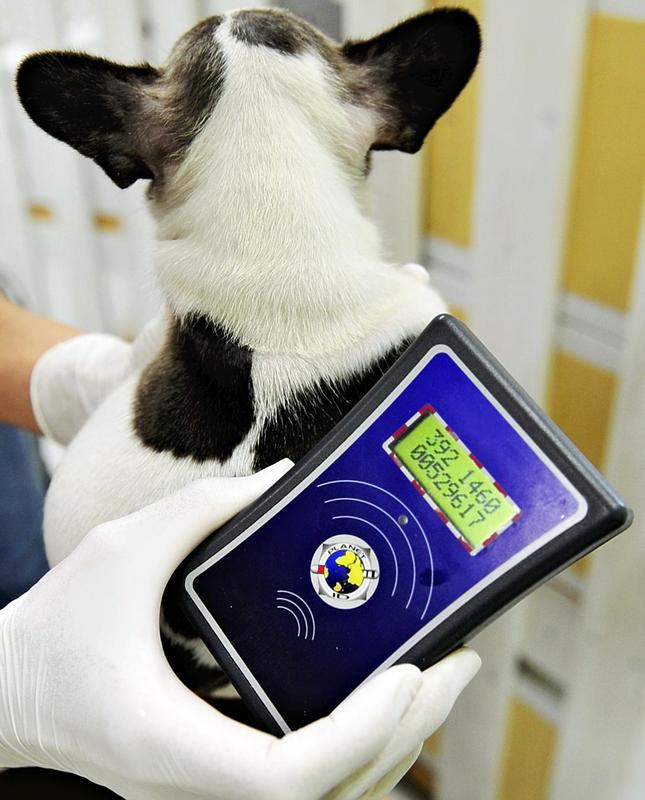
A bill to reform the animal protection law, sponsored by Diet members, was unanimously passed in the House of Councillors on June 12, following its approval by the House of Representative a week earlier. The revised law includes a tightening of penalties for cruelty to animals and the mandatory microchipping of dogs and cats. The ban on the sale of dogs and cats that are 56 days old or younger -- the so-called 56-day regulation -- was a point of contention, and it was debated up to the last minute before the proposal was sent to the lower house.
Behind the move is the recent rash of videos posted on the internet showing the abuse of animals such as dogs, cats and hamsters. Under the law, the maximum penalty for killing or injuring animals will be raised to five years imprisonment or a 5 million yen fine, from two years or 2 million yen. The mandatory microchipping for dogs and cats is intended to discourage the abandonment and abuse of the animals, as their owners can be identified.
Scientific study conducted
The 56-day regulation has already been implemented in some European countries. Animal welfare groups said the regulation should be introduced since dogs and cats that are separated from their mothers at an early stage for sale tend to develop habitual biting and other behavioral problems that can contribute to abuse by their owners. This regulation was included in a bill when the law was last revised in 2012.
At that time, opposition from the pet industry was strong, however, saying this would affect their sales since consumers want to buy dogs or cats as young as possible. As a transitional measure, a ban on the sale of dogs and cats 49 days old or younger was established. It was also pointed out that there needed to be a study comparing the differences and frequency of problematic behavior in animals sold under the 49-day and 56-day regulations after they reach maturity.
Spending five years and about 110 million yen since fiscal 2013, the Environment Ministry commissioned experts on animal behavior to conduct such research and analyses. The experts reported that they found no data to prove the hypothesis that dogs and cats sold under the 49-day regulation develop differently form those sold under the 56-day regulations.
Animal protection groups were not convinced, claiming that arbitrary interpretations were included in the study. They strongly urged a nonpartisan association of lawmakers for animal welfare seeking to reduce to zero the number of dogs and cats destroyed, chaired by House of Councillors member Hidehisa Otsuji, to annul the transitional measure during the current Diet session. Meanwhile, Diet members who were backed by the pet industry maintained their opposition to the 56-day regulation. "We truly understand the feelings of animal protection groups. However, it is difficult for us to counterargue the study results saying there is no scientific basis for the 56-day regulation," a member of the nonpartisan association said.
There was uncertainty about the future of the revision.
A helping hand
But the pet industry is not a monolith. During a hearing April 25 with related organizations held by the Liberal Democratic Party's parliamentary group for animal protection, headed by lower house member Ichiro Kamoshita, some officials of major pet shop chains said that they would accept the 56-day regulation. "They seem to have changed their policy in the face of the strong criticism from animal protection groups," one person involved said.
The decision of the Japan Veterinary Medical Association, which is close to the LDP, to support the 56-day regulation paved the way for its inclusion in the bill. The association promotes the implantation of microchips. Had the revisions come to a deadlock, the mandatory microchipping and its expansion of business activities for veterinarians would not have been realized. Thus, the association changed its stance on the 56-day regulation, although it had not made clear whether it would support the regulation until that time.
Dogs begin to lose antibodies derived from their mother's colostrum about seven weeks, or 49 days, after their birth. For this reason, a certain period of time is needed before selling the animals after vaccination. Naoto Kitamura, the chairman of the Japan Veterinary Federation, a political organization close to the Japan Veterinary Medical Association, said there are "good reasons to say the 56-day regulation is appropriate in general from the recent viewpoint of veterinary practice."
Consideration for Nihonken
However, one hurdle remained to realize the revision.
Officials of the Nihonken Hozonkai, a Nihonken dog conservation society -- chaired by lower house member Nobuo Kishi, and the Akitainu Hozonkai, an Akitainu dog conservation society, chaired by lower house member Takashi Endo -- are said to have strongly lobbied behind the scenes for the LDP and nonpartisan parliamentary groups to give special consideration to Nihonken, or Japanese indigenous dogs, which are designated as a protected species in the nation, since they are reared and kept differently from other types of dogs.
With the upper house election nearing, time was limited for ruling and opposition party members to cooperate and jointly craft the bill. On May 21, the LDP and nonpartisan parliamentary groups agreed that Nihonken would be exempt from the 56-day regulation only when they are bought by general consumers directly from dog breeders and not from pet shops, the latter being associated with impulse purchases.
The draft revision was approved at a general meeting of nonpartisan legislators held at the Diet on May 22. Although some objections were made regarding the exemption for Nihonken in the regulation, Otsuji said: "The draft can be compared to fragile glass. Compromises are necessary to realize legal amendments and promote animal protection efforts."
Read more from The Japan News at https://japannews.yomiuri.co.jp/