Energy regulator Ofgem has opened an investigation into five power companies that took part in the government’s first “capacity market” auction designed to keep the lights on at peak demand.
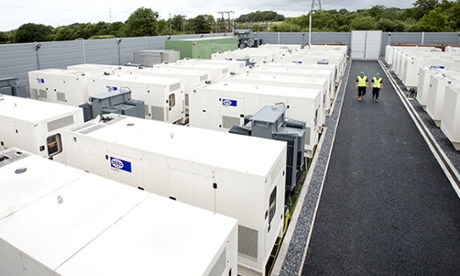
Three of the firms have links to Green Frog, a Birmingham-based business which has been involved in a “diesel farm” boom that has angered environmentalists and frustrated politicians.
The watchdog is scrutinising the actions of GF Power Peaking, Berangere and Adret, all of which have Green Frog links, as well as Alkane Energy and Power Balancing Service.
The companies obtained contracts of up to 15 years in the December auction to provide extra electricity-generating capacity from 2018 on the basis that they would use existing generation or be building new sites.
“Ofgem has opened investigations to see if five generators provided false or misleading information to National Grid about planning consents for some of their proposed generating units that took part in the December 2014 capacity auction,” the regulator said in a statement.
“The opening of these investigations does not imply that we have made any findings about non-compliance,” Ofgem said of the review, which centres on whether planning consents were obtained.
Green Frog declined to comment, while Alkane Energy said it “does not believe it is in breach of the Capacity Market Rules and will fully cooperate with Ofgem’s investigation.” Power Balancing Service could not be contacted.
The move came as the National Grid warned that the gap between expected power demand and supply would remain “very, very tight” – particularly during the winter after next.
Steve Holliday, the chief executive of the National Grid, expressed renewed concerns 24 hours after SSE announced plans to close the 1,000 megawatt power station at Ferrybridge in West Yorkshire next year.
SSE’s move was not a total surprise, he said, but it “absolutely does” point up the fact that old coal-fired and nuclear generating capacity was being taken off the system while not enough new generation was being built.
Holliday was speaking as the Grid reported an 11% increase in adjusted pretax profits to £2.9bn and said return on equity from the UK regulated business had averaged 13.7%.
He said the latter high figure – compared to 8.4% for the US business – was not to the detriment of energy customers because the Grid was bound to share the benefits with power users under the terms of its agreements with Ofgem.
Holliday said the company was using innovation and new technology to drive down the cost of its business, saying robotics, for example, would reduce the number of holes it dug in the ground by 50% between 2013 and 2018.
The Grid boss said that further cost-savings to energy users would come from new contracts to import power via interconnector pipelines with mainline Europe. He stressed that being part of the wider European energy market was “essential for the UK”.