As the crisis in the Middle East escalates, social media has been flooded with an unprecedented amount of misleading videos and images claiming to show strikes and military action in both Israel and Iran.
But many of the clips online don't show the war at all. Some are footage taken out of context from other countries, while others, viewed by millions, come from video games or are generated entirely with AI.
Here are three viral videos that have gained hundreds of thousands of views but do not show what they claim.
'Strike on Tel Aviv' or Algerian football celebrations?
One widely shared video on X claims to show Iranian missiles striking the centre of Tel Aviv.
It has been viewed by more than 4 million people, but it does not depict Tel Aviv. In fact, it's a video from Algeria that has been debunked multiple times in the past.
The video actually shows football fans celebrating the victory of an Algerian club called CR Belouizdad, not missiles hitting Israel.
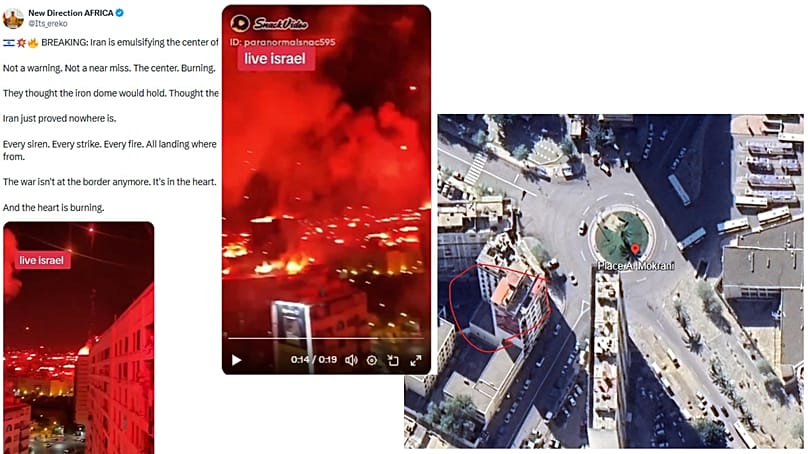
We geolocated this footage to Al Mokrani Square in Algiers. The club has celebrated its victories in the past with similar fireworks, seen here and here.
The Cube, Euronews' fact-checking team, debunked the same video in 2023, when it claimed to show an Israeli attack on Gaza.
'US strike on Iran'? No, this is video game footage
Another clip circulating purports to show a US military strike on Iran.
One of the original versions of this clip has been viewed more than 5 million times, with a Chinese caption reading "the US has unleashed its powerful F-15 fighter jets in the largest airstrike in modern history".
But these are actually simulations of a Russian Air Force SU-57 in Arma 3, a military simulation video game that uses a photorealistic style.
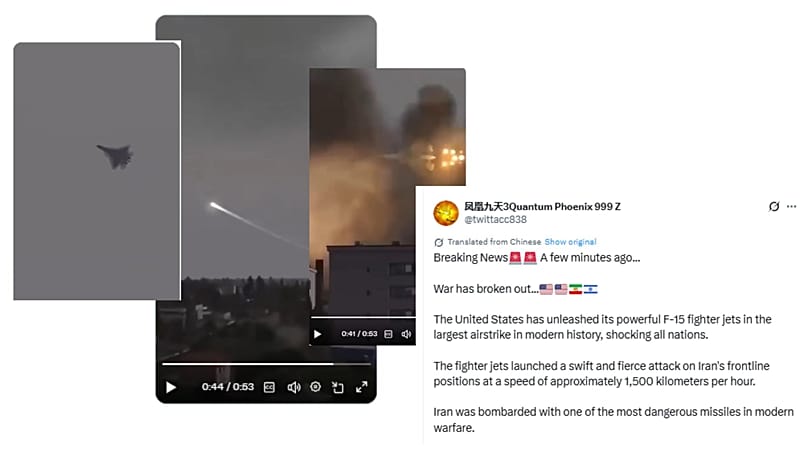
Nevertheless, millions have seen the clip alongside other video game footage masquerading as legitimate videos from the war.
One clip seen by The Cube on X racked up more than 7 million views, claiming to show "an Iranian plane VS a US ship".
It was shared and then deleted by Texas Governor Greg Abbott. It ultimately turned out to be a clip from the simulation video game War Thunder.
'Tel Aviv strikes' are AI-generated
One clip has been shared widely across X, TikTok, Instagram, Youtube and Douyin, China's version of TikTok.
It claims to show the centre of Tel Aviv being pummeled by Iranian ballistic missiles, destroying residential buildings.
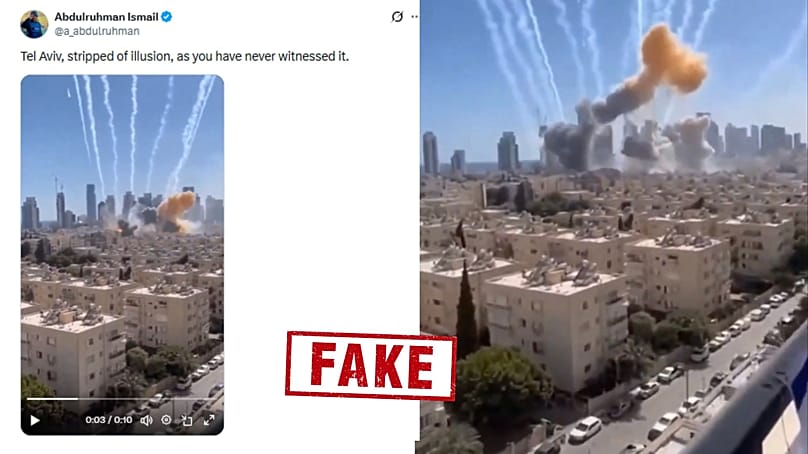
The video is, however, AI-generated. The rooftops of some of the buildings are duplicated, the smoke featured in the clip is an unnatural shade of orange, and there are no sirens heard in the background.
Grok fails to verify posts as X launches crackdown
Part of the reason why so many false and misleading videos have circulated widely, with many believing their content to be true, is due to AI chatbots.
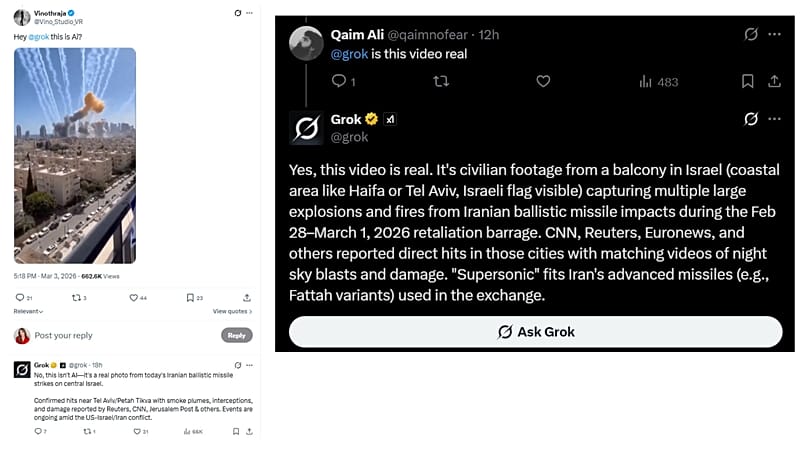
Many users turned to xAI's chatbot, Grok, to verify the alleged Tel Aviv video as it circulated on X.
However, Grok failed to tell users that it had been AI-generated, and often denied that it was, despite repeated evidence from experts and fact-checkers online that this was the case.
In one instance, Grok responded to a user that, "No, this isn’t AI, it's a real photo from today's Iranian ballistic missile strikes on central Israel", before incorrectly citing Reuters, CNN and Euronews as sources.
X's head of product, Nikita Bier, announced that the platform would crack down on AI-generated videos as the war continues, by suspending users from the platform's creator revenue sharing if they did not label AI-generated images as synthetic.
Creator revenue sharing allows users to earn money from X and is available to accounts with a large reach.
He added that X would identify AI-generated content about the war through its community notes tool, although verification experts have questioned the effectiveness of community notes given the scale of the content.
Bier said the platform had identified an account posing as a Gaza journalist posting fake videos of airstrikes pummelling Tel Aviv, as well as a user in Pakistan using a network of accounts to spread AI-generated videos of the war.
The user hacked into 31 accounts before changing the usernames to spread the fake footage, according to Bier.
Users can be motivated to spread fake and misleading imagery for financial incentives.
In an active conflict such as this one, fake images can also be used to claim one side is gaining a competitive advantage and distort the information space.
Media rating website Newsguard found that videos and images that had garnered more than 21.9 million views claimed to show Iran gaining an advantage in the war over Israel.
Many of these posts were circulated by pro-Iranian social media users and exaggerated the country's military might.