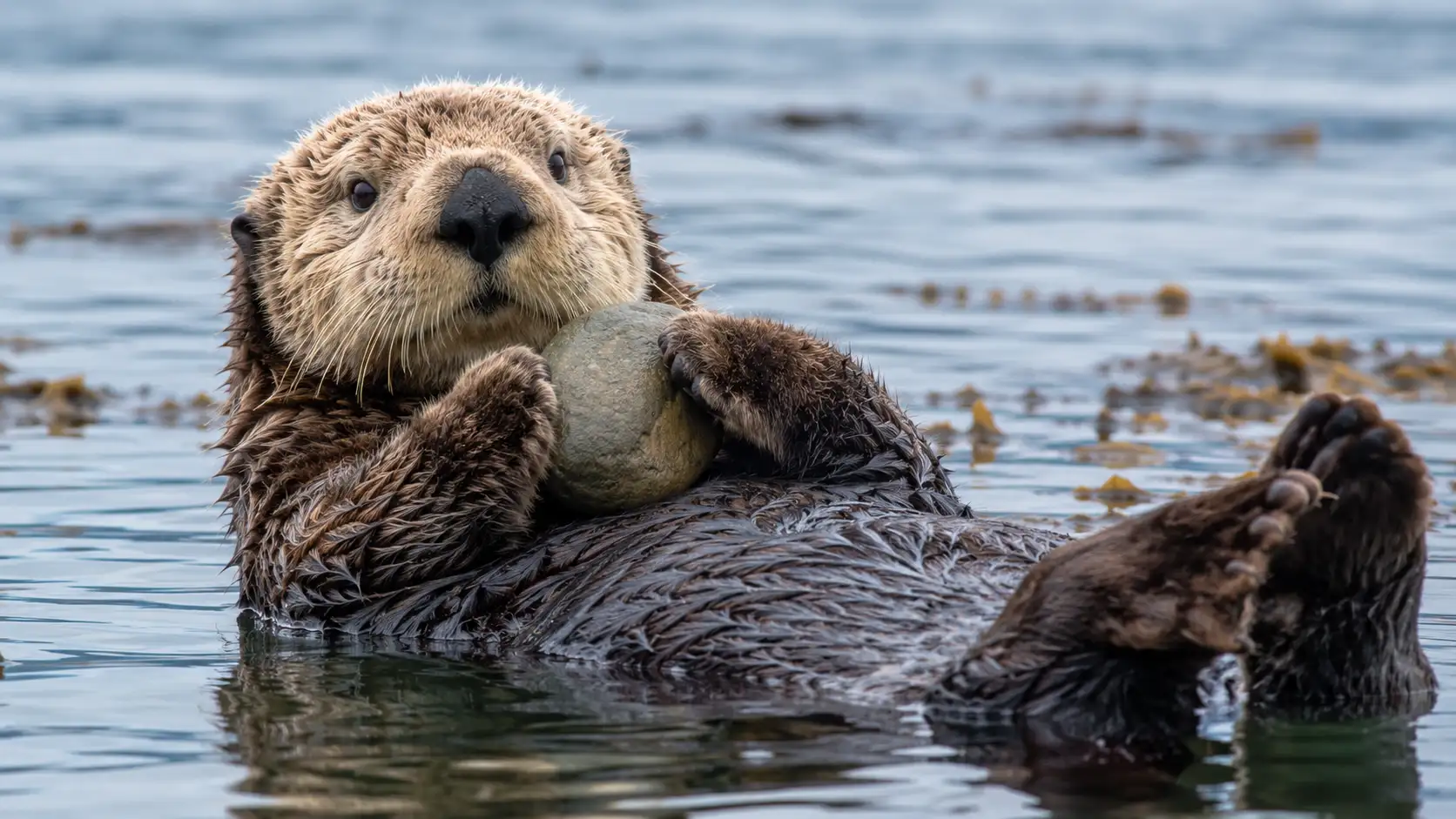
Sea otters are fascinating marine mammals known for their playful behavior, intelligence, and unique survival skills in cold ocean environments. However, surviving in the ocean is only part of their struggle. Sea otters consume hard-shelled prey like clams, mussels, crabs, and sea urchins, many of which are protected by tough outer shells. While their powerful jaws can handle some of this food, the hardest shells require an additional aid quite literally. That’s when their unique tool-handling skills are revealed.
The Smart Use of Rocks as Tools
Researchers have found that sea otters use stones in surprisingly clever ways. Some balance a rock on their chest like an anvil and strike shellfish against it, while others use stones like hammers to pry loose stubborn prey such as abalone from underwater surfaces.
In certain cases, otters even use two rocks together, one functioning as a hammer and the other as an anvil showcasing impressive coordination and problem-solving ability. This behavior mirrors not only survival instinct but also advanced adaptability in nature.
Sea Otter Pockets: Built-in Storage and Favorite Rock Behavior
One of the most intriguing traits of sea otters is the loose skin folds under their forearms, which act as natural storage pockets. These pouches allow them to carry food while diving so they do not need to return to the surface frequently.
But these pockets are not just for food. Several sea otters are known to carry a special rock in these pouches, a tool they repeatedly use. Once an otter discovers a rock that works well, it may keep it for months or even years, carrying it everywhere it goes. Researchers note that this may not be emotional attachment in a human sense, but rather efficiency: a reliable, perfectly sized tool that is too useful to replace.
As reported by Chris Law, a postdoctoral researcher and an Early Career Provost Fellow at UT Austin who headed the study while a graduate student at UC Santa Cruz. , “Sea otters vary in how often they use tools… The females are likely using tools to overcome their smaller body size and weaker biting ability… Raising pups takes a lot of energy, and the females need to be efficient in their foraging. The study shows that tool use is an important behavior for survival.”
Female Sea Otters and Tool Use: Why Rock Use Differs by Gender
Not all sea otters rely on tools equally. Research indicates that females are more likely to use stones than males, mainly because they are smaller and have less powerful bites. Tool use helps them reach harder food sources while saving energy especially crucial during pup-rearing periods. This pattern is also spotted in other intelligent species such as chimpanzees, dolphins, and bonobos, where females often depend more heavily on tools for efficiency and survival.
Intelligence, Survival, and Playful Behavior
Sea otters do not use rocks only for survival they also interact with them playfully. They are frequently seen floating on their backs, tossing stones, and even juggling them in the water.
According to BBC Wildlife observations, otters sometimes engage in group play using objects, demonstrating strong social behavior. In rare instances, they have even been observed “gifting” stones to others, which researchers interpret as possible social bonding or communication.
Although scientists remain cautious about attributing emotions, the consistent selection and long-term use of specific stones suggest advanced intelligence and learned behavior.
Why Sea Otter Rock Use Behavior Matters
Sea otters carefully choose rocks based on size, strength, and shape, selecting tools that best support their survival. These stones must be durable enough to crack shells yet small enough to fit in their forearm pouches.
An otter might carry its favorite rock forever, as per the post by @humanecanada.
This simple yet remarkable behavior features problem-solving ability, adaptation, and sustained tool use in a marine species. It emphasizes that intelligence in nature is not limited to humans but is shaped by environment, necessity, and learning.
Source:
ZME Science
A-Z Animals
FAQs:
Q1. Why do sea otters use rocks?Sea otters use rocks to crack open hard-shelled prey like clams and crabs. This helps them access food that would be difficult to eat otherwise.
Q2. Do sea otters really have a favorite rock?
Yes, many sea otters are observed repeatedly using the same rock for feeding. They often store it in a skin pocket under their arms.