George Osborne has stepped up his campaign against Labour on tax by claiming that the governments of Tony Blair and Gordon Brown increased taxes on earnings on the average household by £1,895 a year in real terms.
The chancellor said on Tuesday: “When it comes to tax rises, Ed Miliband and Ed Balls have done it all before – and they would do it all over again, if they had the chance. Higher taxes and higher debts under Labour would cost jobs and take Britain back to square one.”
Is this true?
It is – but James Browne, senior research economist at the respected Institute for Fiscal Studies, says that’s not surprising because as people’s incomes go up, so does the amount they pay in taxes on earnings. He adds:
Some of this increase was the result of income growth, some the result of fiscal drag as tax thresholds didn’t increase as quickly as peoples’ incomes during this period, increasing the proportion of income paid in tax, and only a part was the result of active policy changes.”
The figures are from the House of Commons library and were put together for the Tories, based on the Office for National Statistics’ data on the effects of taxes and benefits on household incomes. On average, families were paying £1,895 more in income tax and national insurance in 2010/11 than in 1997/98.
The IFS has looked at the impact of the Labour government’s changes to income tax and national insurance between 1997 and 2010. It concluded that they amount to a tax rise of £6.2bn a year - or £600 per household – a more meaningful figure than the one quoted by the chancellor.
Browne also points out that the figures quoted by the Conservatives only examine the amount paid in income tax and national insurance – ignoring tax credits.
He explains:
Of course, Labour made a lot of other changes to the tax and benefit system, most notably increasing the generosity of benefits for low-income families with children and pensioners. Tax credits were an important part of this.”
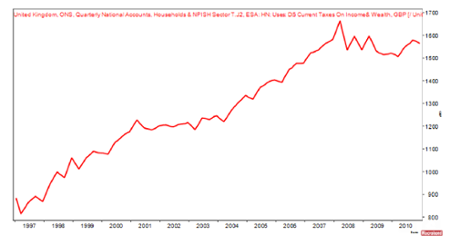
Alan Clarke, economist at Scotiabank, also crunched the numbers for us. He took ONS data from the quarterly national accounts breakdown, and divided that by total employment. That gives us the chart below. So between 1997 and 2010, taxes per person employed went up from around £800 to £1,500 (i.e. an increase of £700 per person employed). But since Osborne and Cameron are saying “per household” you need to make an assumption about how many people in each household are working. You could multiply that by 1.5 and that gives you an increase of about £1,000 – rather than the £1,895 claimed by Osborne.
Clarke says:
Those calculations overlook non-working households – most notably the retired. So their figures seem higher than mine, but there is more than one way to skin a cat.”
The main parties have embarked on a tit-for-tat on tax. Osborne claimed on what the Tories dubbed “Money-back Monday” that 14m working households will be £17 a month (£200 a year) better off as a result of tax and benefit changes coming into force on Monday, as he battled to fend off Labour claims that he was planning to cut the top rate of tax to 40p in the next parliament.
An analysis from the IFS published in January found that households have been on average £1,127 a year worse off as a result of the coalition government’s tax and benefit decisions since May 2010. Low-income households with children have lost the most as a proportion of their income, the think tank said. The calculations take account of the rise in VAT in January 2011, cuts to tax credits for working families and changes to the personal allowance.
Hitting back at the Tories, Ed Balls, the shadow chancellor, highlighted those figures in a speech on Monday. He said earnings after inflation are down £1,600 a year since 2010.
The Liberal Democrats have also waded into the debate about living standards, pointing out that Labour’s plans for a 10p starting rate in tax will only offer taxpayers a £37 tax cut. This compares with the Lib Dem commitment to cut income tax by almost £400 in the next parliament through raising the personal tax allowance.
- This article was amended on Wednesday 8 April 2015 to include additional comments from James Browne of the Institute for Fiscal Studies.