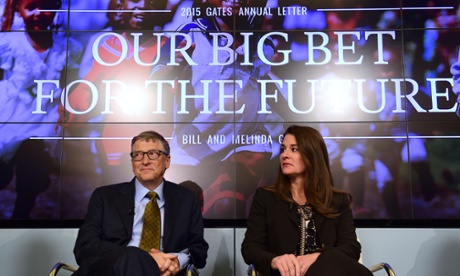
The world is in a mess. We are on the verge of climate chaos, half of global wealth is held by the 1%, 6.3 million children still die before their fifth birthday ... and all of that before we’ve factored in rising unemployment rates, growing fundamentalism, the militarisation of the state and shrinking civil liberties the world over.
We need leaders with the gumption, global network and plenty of green notes to sort it out. But, call me old-fashioned, I prefer my leaders to be accountable to somebody, anybody and not just to their own conscience.
And that’s the problem I have at the moment with Bill and Melinda Gates, and the their foundation, dedicated to doing good works at home and abroad. Despite plenty of evidence that the foundation has had plenty of positive impact, I can’t shake off the thought that there’s something dangerous about the growing, unquestioned influence of private philanthropy.
And it seems I’m not the only one who thinks so. A quick tweet to find out what others made of the annual Gates Foundation letter, published today, got this reaction on Twitter:
Unelected, accountable to no-one but himself, Gates thinks his money allows him the right to tell us what to do @viewfromthecave @ElizaTalks
— ☸ Roger ☸ (@RogTat) January 22, 2015
@ElizaTalks He never says it, but there is heavy suggestion that all the progress made is because of the Gates foundation.
— Tamara Bugembe (@tbugembe) January 22, 2015
This is not about the man’s personal wealth and what he does with it. This is about the reverence that is shown to him and his organisation. It is about the fact that money speaks so loudly that even those who should know better find it difficult to put up any ideological opposition in the face of millions of dollars in funding.
It makes you wonder how the world would respond to Rupert Murdoch if he gave away a little more money? Would he be able to walk into a meeting of heads of state, share his vision on how to transform their economies and walk out, knowing his ideas were going to become policy, simply because he had enough money to fund the fantasy?
Of course Bill Gates is better than that. His foundation is staffed by subject experts and his team invariably makes sure he is well briefed on every topic on which he speaks, but his unregulated power could still be a bad thing for the world. The trouble is, if Gates thinks any idea is good then public funding usually follows, often diverting it from other projects. And if it doesn’t work, who gets the sack? He can’t be unappointed, unelected or impeached.
And just in case you are wondering, a large wallet doesn’t necessarily lead to good policy, or as @RogTat tweeted: “Money can’t buy development.”
Take the foundation’s investments in improving the US education system. The Washington Post reported on admissions of projects that “fell short” of expectations - several billion dollars later - and the changes in focus that were equally well funded but no better informed.
“The fact that assessment experts repeatedly warned against using student test scores as part of a teacher’s evaluation because the method isn’t reliable or valid did not stop the foundation from making these grants. He and his foundation just thought it would work.”
You might say “no harm, no foul”. True, the development community doesn’t talk about failure anywhere near enough so it’s great that its most prolific giver is willing to hang out his dirty laundry. But the questions remain: is the Gates Foundation too powerful to be contradicted? They might like to think of themselves as “impatient optimists” but are they just reckless?
However you perceive Bill and Melinda Gates there is little doubt that the nature of their foundation’s influence is worthy of ongoing debate. In the aftermath of the 2008 recession, some predicted that smaller budgets would force the foundation’s global reach to “slip somewhat in the future” but that hasn’t happened. Instead, the reaction of development organisations, governments and the media to the launch of the seventh annual letter (one development news site compared it to the State of the Union address) has made the 2011 observations by global health workers Laura Freschi and Alanna Shaikh as astute as ever and their question as poignant:
“It is not inconceivable that you might find yourself some day reading a story about a Gates-funded health project, written up in a newspaper that gets its health coverage underwritten by Gates, reported by a journalist who attended a Gates-funded journalism training programme, citing data collected and analysed by scientists with grants from Gates. What happens when we need to move beyond the success stories?”
Read more stories like this:
- How to cure philanthropy of its contradictions
- Venture philanthropy and the quest for aid effectiveness
- Posh white blokes: holding back the struggle for a fairer world?
Join our community of development professionals and humanitarians. Follow@GuardianGDP on Twitter.