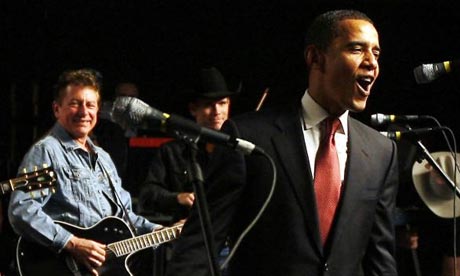
The dust has barely settled and the hangovers are still lingering, but the autopsies on what just happened are already beginning. And it doesn't take distance and hindsight to recognise that that the ascension of Barack Obama to the position of president-elect can rightfully be called the most rock'n'roll election ever.
Which isn't to say that Obama himself is rock'n'roll – he's not - but rather the roles played in his victory by the traditionally left-leaning worlds of rap, rock and pop music cannot be ignored. In an election in which the youth vote was paramount, the endorsement of the Illinois senator by a huge array of respected musicians went way beyond anything the world has seen before.
George Bush may have inspired a strong anti-Republican/anti-war movement in the rock and pop trenches over the past five years or so, but it was a movement based on a sense of disgust, rather than Obama's cornerstones of "hope" and "change". Instead everyone from Dixie Chicks to Green Day merely vocalised what many were already feeling about the war on terror. And none of it prevented Bush from being voted in for a second term.
Obama, though, has inspired support – both public and financial – from the cooler end of the musical spectrum on an unprecedented scale. While hillbilly throwback Hank Williams Jr was singing "hilarious" anti-Democrat songs at McCain/Palin rallies, Obama was quietly counting the cash that was flowing in and clocking up endorsements from "booster" supporters like P Diddy, who with typical modesty last night commented: "I felt like my vote was the vote that put him into office. It was down to one vote, and that was going to be my vote. And that may not be true, but that's how much power it felt like I had."
Having backing from of-the-moment, MySpace-friendly bands like Fall Out Boy and countless others like them - bands whose fan bases are largely comprised of white, suburban mallrats - can't have harmed Obama either. Bassist Pete Wentz – whose parents met through working for vice-president Joe Biden – said: "I don't usually go out of my way to indoctrinate people or tell people. But I think it's important for people to get out there."
Black Eyed Peas singer will.i.am's Yes We Can may have been a slice of mawkish cheese, but it was at least a song based on the most important speech of the 21st century to date, rather than one of dumb denigration like Hank Williams Jr's. The Republicans had their fair share of musical supporters, but they were disparate and ranged from conservative country singers to past-it rockers like Ted Nugent, Gene Simmons and Alice Cooper.
Beyond the youth demographic, Dennis Hopper, who is not a musician, but who out-drank and out-drugged his rock'n'roll pals throughout the 60s and 70s perhaps represents the older swinging voter who went over to Obama's side. Hopper, a long-term Republican, spoke yesterday about being dazzled by the same charisma and intelligence that has won over a large section of the music world.
In a decade in which bands have been vilified for criticising their president or their country, it is highly significant that members of pop bands can risk their careers in the name of politics. Historically-speaking, American politics is rich with artists coming from a standpoint of resistance against those in power, whether that's Woody Guthrie, James Brown or Rage Against The Machine. But rarely does the president unite the musical tribes in such a way.
And that in itself represents a major breakthrough.