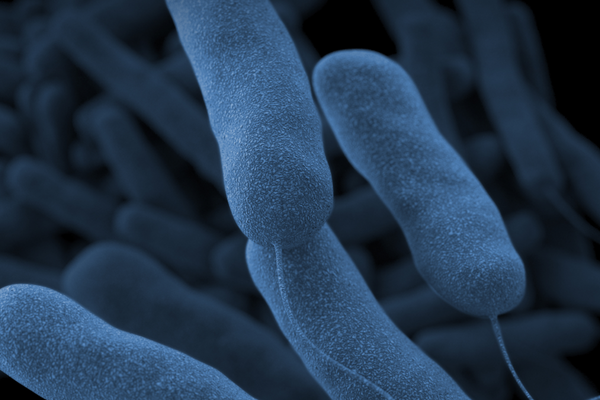

Around 4 billion years ago, life began emerging on Earth in the form of microorganisms. Whether or not life originated on our planet, or was somehow transported there by way of a traveling asteroid, is one of the biggest questions in astronomy.
Now, a new experiment favors the idea that life ended up on our planet after a long journey through space — by proving that bacteria can in fact survive the trip.
The results are detailed in a study published Wednesday in the journal Frontiers in Microbiology.
To reach their conclusions, the researchers placed samples of dried bacteria in exposure panels outside of the International Space Station (ISS), which orbits 254 miles above Earth's surface, for a period of three years.
After the three years, the samples were tested to see if they survived in space. Incredibly, the researchers found that all samples larger than 0.5 millimeters partially survived the three year journey in space.
The results suggest that, while the bacteria at the surface of the samples died off, it formed a protective layer for the bacteria beneath the surface, thereby ensuring the survival of the colony, according to the study. Based on the data, a bacterial colony measuring approximately 1 millimeter in diameter could have survived for a period of up to eight years in outer-space conditions.
If so, then a bacterial colony could theoretically survive the journey from Earth to Mars, and vice versa, which would take several months or years cruising through outer space.
What is the theory of panspermia?
The theory of panspermia suggests that life didn’t originate on Earth at all. Rather, so the theory goes, it originated elsewhere in the cosmos, and was transported to our planet through interstellar objects that traveled between planetary systems — including the asteroids that smashed into Earth all those billions of years ago.
"The origin of life on Earth is the biggest mystery of human beings," Akihiko Yamagishi, a professor at Tokyo University of Pharmacy and Life Sciences and lead author of the new study, said in a statement. "Scientists can have totally different points of view on the matter. Some think that life is very rare and happened only once in the Universe, while others think that life can happen on every suitable planet."
One of the biggest questions regarding the theory of panspermia is whether or not life could survive the journey in space.
The recent experiment provides the best-yet estimate of the survival rate of bacteria in outer space. Previous experiments suggested that bacterial might survive in space while being shielded from the space environment through a rocky celestial body. But this is the first experiment to test bacteria in the form of an aggregate or cluster.
Because of this, the experiment raises a new concept that the study authors dub 'massapanspermia.'
"If panspermia is possible, life must exist much more often than we previously thought," Yamagishi said.
Abstract: The hypothesis called "panspermia" proposes an interplanetary transfer of life. Experiments have exposed extremophilic organisms to outer space to test microbe survivability and panspermia hypothesis. Microbes inside shielding material with sufficient thickness to protect them from UVirradiation can survive in space. This process has been called "lithopanspermia," meaning rocky panspermia. We previously proposed sub-millimeter cell pellets (aggregates) could survive in the harsh space environment based on the on-ground laboratory experiment. To test our hypothesis, we placed dried cell pellets of the radioresistant bacteria Deinococcus spp. in aluminum plate wells in exposure panels attached to the outside of the International Space Station. We exposed the microbial cell pellet with different thickness to space environments. The results indicated the importance of the aggregated form of cells for surviving in harsh space environment. We also analyzed the samples exposed to space from one to three years. The experimental design enabled us to get and extrapolate the survival time course to predict the survival time of D. radiodurans. Dried deinococcal cell pellets of 500-µm thickness were alive after three years of space exposure and repaired DNA damage at cultivation. Thus, cell pellets 1 mm in diameter have sufficient protection from UV and are estimated to endure the space environment from 3 to 8 years, extrapolating the survival curve and considering the illumination efficiency of the space experiment. Comparison of the survival of different DNA