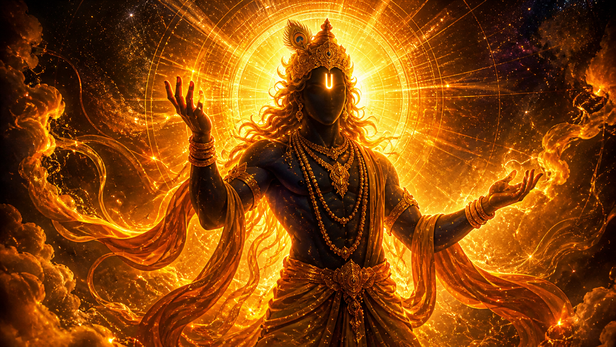
What if the protector of Dharma had to break it? It sounds uncomfortable. Almost impossible to accept. But when you look closely at the war of Mahabharata, one question keeps rising Did Krishna follow Dharma or bend it? From guiding warriors to using strategies that seemed unfair, Krishna’s role was never simple. He didn’t fight with weapons, yet he shaped every turning point. Was it manipulation or divine wisdom? Because sometimes, the truth is not black or white. Sometimes, it lives in the grey.
WHEN RULES FAILED, STRATEGY BEGAN
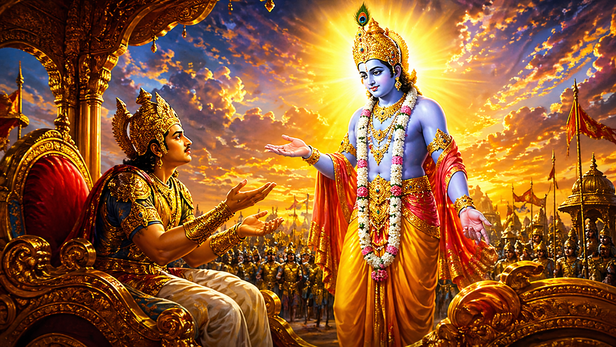
The Kurukshetra war was not a normal battle. Rules existed, but they were already broken by those in power. The Kauravas had crossed moral limits long before the war began. In such a situation, following strict rules would only protect injustice. Krishna understood this reality. He knew that Dharma cannot survive if it remains rigid while evil adapts. So, instead of blind rule-following, he chose strategy. This is where things begin to look “grey.” But in truth, it was not about breaking Dharma it was about saving it from collapse.
BHISHMA: THE UNBREAKABLE WALL
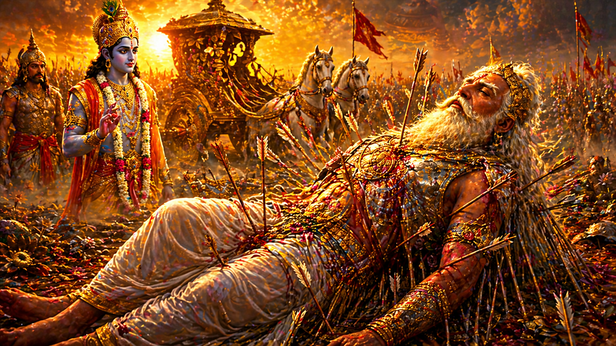
Bhishma was nearly impossible to defeat. His strength and vow made him untouchable. Krishna suggested using Shikhandi, knowing Bhishma would not fight back. On the surface, it looked unfair. But Bhishma was fighting for a side that had already abandoned justice. Krishna’s move was not about disrespect it was about ending unstoppable destruction. Sometimes, strength must be countered with intelligence, not force. This moment shows how Dharma is not always about direct action, but about choosing the only path left.
DRONA: THE POWER OF A HALF-TRUTH
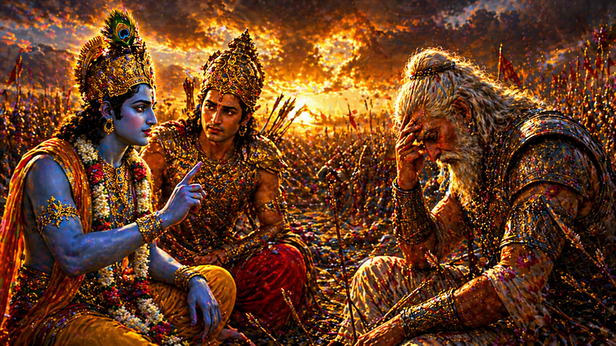
Drona was using divine weapons without restraint, causing massive destruction. Stopping him directly was nearly impossible. Krishna suggested a half-truth about his son Ashwatthama’s death. This broke Drona mentally, leading to his fall. Was it deception? Yes. But it was also necessary. When power is used without responsibility, it must be stopped. Krishna chose the lesser wrong to prevent a greater disaster. This is where the idea of higher Dharma begins to reveal itself.
KARNA AND DURYODHANA: JUSTICE OR REVENGE?
Karna was killed while unarmed, and Duryodhana was struck below the waist both against war rules. But these moments were not random. Karna had supported the unfair killing of Abhimanyu, and Duryodhana had committed grave injustices, including Draupadi’s humiliation. Krishna believed that those who break Dharma cannot demand its protection later. His decisions were not revenge they were consequences. This is the harsh reality of justice in a broken system.
THE IDEA OF HIGHER DHARMA
Krishna’s actions point to one powerful idea Dharma is not just rules, it is balance. When rules protect evil, they must be challenged. His goal was Frequently Asked Questions (FAQs)never personal victory, but restoring order. He even accepted the consequences of his actions, including the fall of his own clan. This shows that he was not above karma. Instead, he carried its weight knowingly. That is what makes his role so complex and so real.
Unlock insightful tips and inspiration on personal growth, productivity, and well-being. Stay motivated and updated with the latest at My Life XP.
Frequently Asked Questions (FAQs)
1. Did Krishna really break Dharma in the Mahabharata?Krishna did not aim to break Dharma, but to protect it. His actions may appear unconventional, yet they were meant to restore justice when traditional rules were already being misused by the Kauravas.
2. Why are Krishna’s actions called “grey”?
They are called “grey” because he used strategies like deception and indirect tactics. These actions do not fit into simple right-or-wrong categories, making his role morally complex.
3. What is “Higher Dharma”?
Higher Dharma refers to the idea that protecting truth and justice is more important than blindly following rigid rules. When rules fail to stop injustice, they may need to be adapted.
4. Why did Krishna allow unfair tactics in war?
Krishna believed that those who had already broken Dharma could not expect fairness. His strategies were responses to earlier injustices, not random decisions.
5. Did Krishna face consequences for his actions?
Yes, according to the epic, Krishna accepted the karmic consequences. The destruction of the Yadava clan and his own death reflect that even divine actions carry weight.