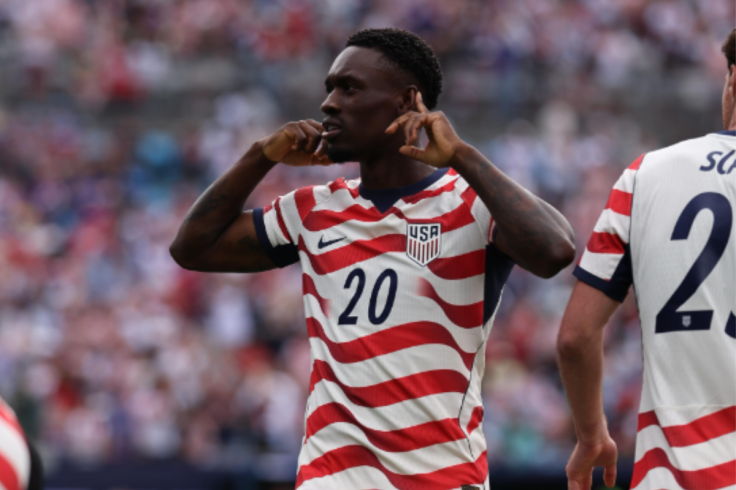
Did FIFA apply its own disciplinary rules consistently when it overturned Folarin Balogun's World Cup suspension? That is the question dividing football's governing bodies after FIFA cleared the United States striker to play against Belgium just days after he received a straight red card against Bosnia and Herzegovina.
FIFA says it acted within the authority of Article 27 of its Disciplinary Code. UEFA and the Royal Belgian Football Association do not dispute the rule itself. Their concern is different. They argue FIFA interpreted and applied the rule in a way that could weaken confidence in how future disciplinary decisions are made.
The debate has moved beyond Balogun's dismissal. Instead, attention has turned to how FIFA reached one of the tournament's most closely watched disciplinary decisions.
What Article 27 Allows
Balogun's red card carried an automatic one-match suspension, ruling him out of the United States' Round of 16 match against Belgium.
That changed when FIFA's disciplinary committee cancelled the suspension after reviewing the incident.
FIFA says Article 27 gives its disciplinary committee the authority to review and amend disciplinary sanctions in certain circumstances. After examining the available evidence, the committee decided Balogun's suspension should not stand.
The governing body also says the committee operates independently and that no outside requests influenced its decision.
Why UEFA Disagrees
UEFA is not saying FIFA ignored its own rulebook.
Its argument is that FIFA stretched Article 27 further than it should have.
In its statement, UEFA described the decision as 'unprecedented, incomprehensible and unjustifiable.' It warned that overturning an automatic suspension during the World Cup could damage confidence in the consistency of football's disciplinary process.
UEFA argues that automatic suspensions exist to ensure players and teams are treated equally. If exceptions are made without a detailed public explanation, other national associations may expect similar reviews in future tournaments.
For UEFA, that is where the concern lies.
Belgium Wanted More Answers
Belgium also challenged FIFA's decision after Balogun became eligible to face its national team.
The Royal Belgian Football Association asked FIFA to reconsider the ruling. When that request was rejected, Belgian officials criticised the governing body for providing only limited detail about how the disciplinary committee reached its decision.
Belgium argued that greater transparency would have helped competing teams understand why the suspension was lifted.
FIFA rejected the challenge and Balogun remained eligible to play.
A Debate That Will Continue After the World Cup
Donald Trump later confirmed that he had asked FIFA President Gianni Infantino to review Balogun's red card. FIFA insists its disciplinary committee acted independently and has given no indication that the request influenced its decision.
That is no longer the main issue.
The discussion now centres on whether FIFA has fully explained how Article 27 was applied in one of the World Cup's most significant disciplinary cases.
FIFA maintains that it followed its own regulations. UEFA and Belgium accept that Article 27 gives FIFA the power to review sanctions, but they argue the way it was used in Balogun's case sets a difficult precedent.
The disagreement is not over whether the rule exists. It is over how far that rule should reach. Until FIFA provides a fuller explanation of its decision, the Balogun case is likely to remain a reference point whenever future World Cup disciplinary rulings are challenged.