
A few weeks after the fatal shooting of Renee Nicole Good, Minneapolis was again rocked by the killing of Alex Jeffrey Pretti on January 24, 2026, during a federal immigration enforcement operation. Both deaths followed a grimly similar arc. Both involved fatal force used by immigration-linked federal agents against US citizens. Both were justified by official statements as responses to imminent danger. And in both cases, bystander videos and eyewitness accounts quickly complicated that narrative.
In Good’s case, an ICE agent shot her while she sat in her vehicle. In Pretti’s, agents shot him at close range after a chaotic struggle on a snow-covered street. In each instance, federal officials described dangerous encounters. In each, video evidence suggested the victims were not posing an immediate threat at the moment they were killed. The shootings occurred within the same month, amid an intensified immigration crackdown that has already triggered protests, anger and a growing crisis of trust in the city.
Who was Alex Pretti?
Alex Pretti was a 37-year-old registered nurse at the Minneapolis VA Health Care System and a resident of south Minneapolis. Family members and colleagues described him as compassionate, civic-minded and deeply shaped by a career spent caring for critically ill patients. His father said Pretti was disturbed by the scale and tactics of federal immigration operations unfolding around him.
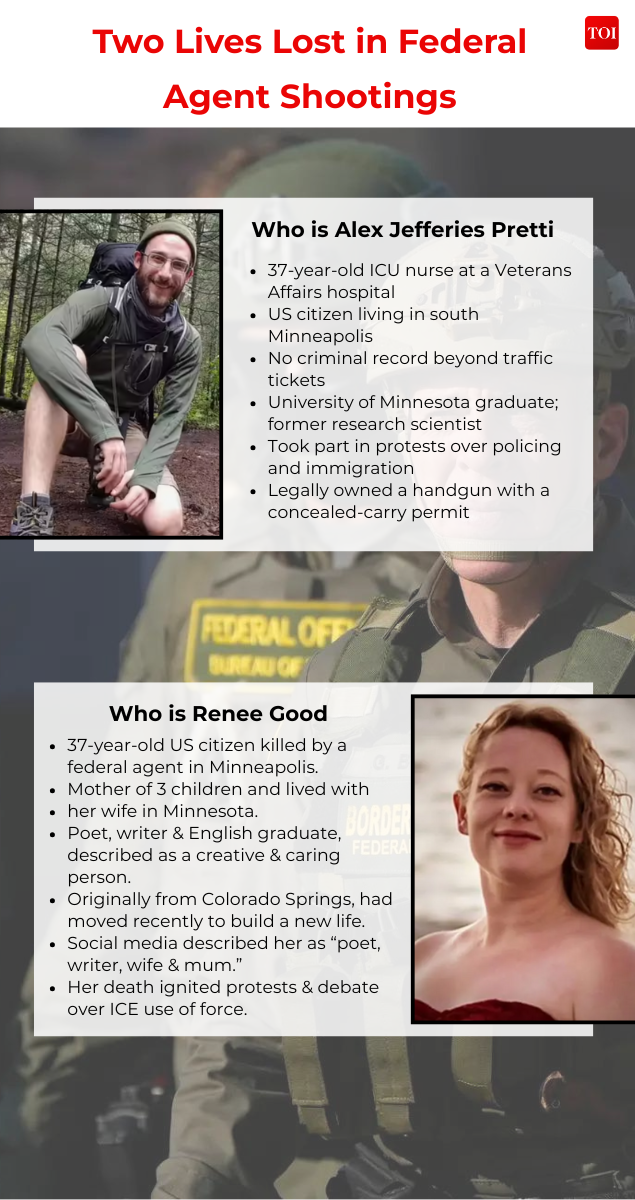
Pretti had no serious criminal history beyond minor traffic violations. He was a lawful gun owner with a valid permit to carry. His family has rejected federal claims that he posed a violent threat, saying he was filming agents and attempting to help a woman during the encounter. They described early official portrayals of him as “sickening lies” and demanded transparency and accountability.
Why was he there and what was he doing?
Pretti was present during a large federal immigration enforcement action in Minneapolis, part of a broader deployment under Operation Metro Surge. Video footage shows him holding a phone and recording agents rather than behaving aggressively.
During the encounter, a woman nearby was sprayed with a chemical agent. Pretti appears to step toward her to help, still holding his phone. Moments later, agents spray Pretti himself and then forcefully tackle him to the ground. That sequence — filming, moving to assist someone in distress, then being subdued — has been consistently described in eyewitness and video-based reporting.
What do the videos show, minute by minute?
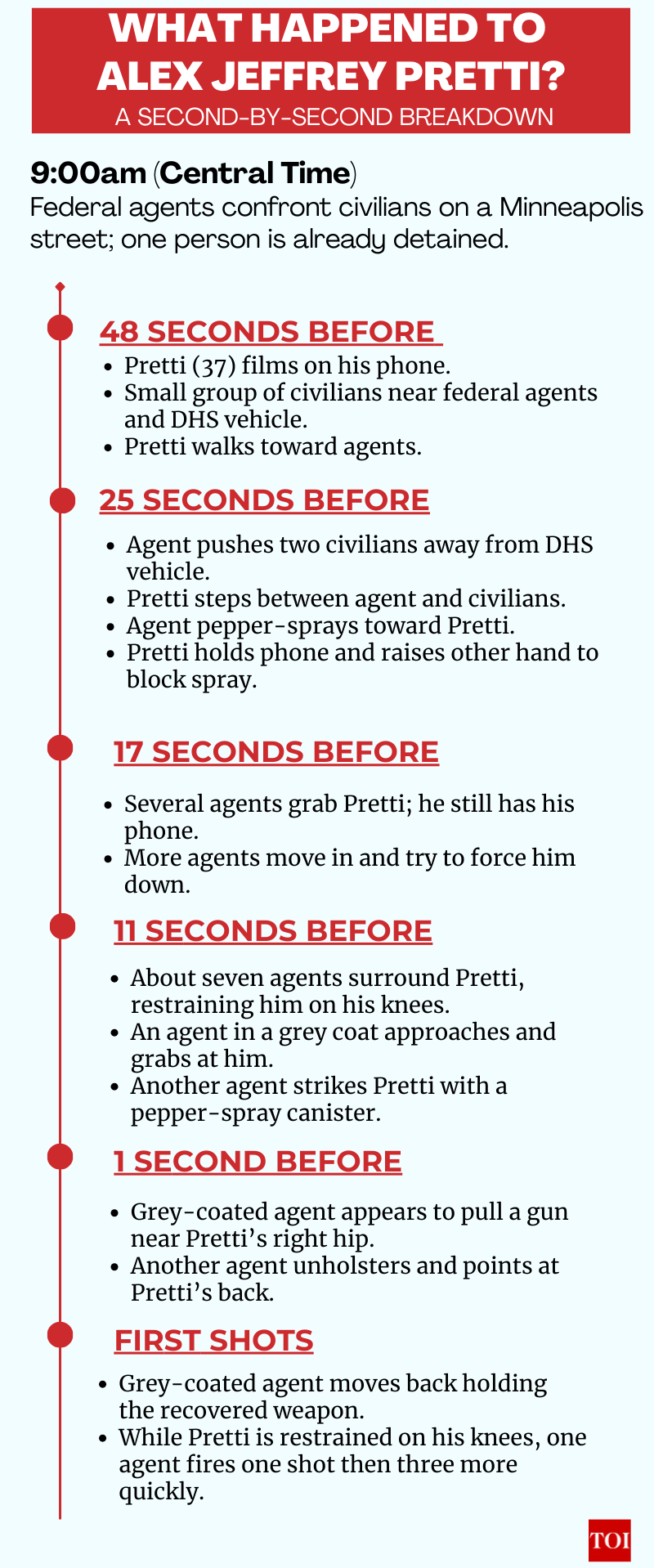
A frame-by-frame analysis by The New York Times Visual Investigations team, based on multiple verified videos, reconstructs the final moments before Alex Pretti was killed and directly contradicts key elements of the federal account.
Before physical contact
The videos show a small group of demonstrators standing in the street, speaking with a federal agent as whistles sound. Alex Pretti is visible among them, holding his phone and filming the scene, and at moments appears to be directing traffic around the protest area. No weapon is visible in his hands.
Pepper spray is deployed
An agent begins pushing demonstrators and sprays pepper spray at their faces. At this moment, Pretti’s hands are clearly visible: one holding his phone, the other raised defensively to shield himself from the spray.
Pretti moves to help another protester
As others are sprayed, Pretti moves toward a woman who has just been hit with the chemical agent and appears to assist her. Agents approach him from behind as he does so.
Agents seize and restrain him
Several agents grab Pretti and pull him away. A struggle follows as they force him to his knees and then to the ground. The footage shows agents grabbing his legs, pushing down on his back, and striking him repeatedly while restraining him.
An agent approaches with empty hands
As multiple agents pin Pretti to the ground, one agent is seen approaching the group with empty hands, reaching in as others hold Pretti down. His arms appear pinned near his head.
Shouts about a gun — after he is pinned
About eight seconds after Pretti is already restrained, agents are heard shouting that he has a gun. The timing suggests, according to the Times’ analysis, that agents may not have realised he was armed until after he was on the ground.
A gun is pulled from the struggle
The same agent who approached with empty hands pulls a handgun from within the cluster of bodies. The firearm appears to match the type that the Department of Homeland Security later said belonged to Pretti. At this point, Pretti remains pinned and under control.
Shots fired at close range
As the gun emerges, another agent aims his weapon at Pretti’s back and appears to fire a shot at point-blank range. He continues firing as Pretti collapses. A third agent then unholsters a weapon, and both agents appear to fire additional shots into Pretti as he lies motionless.
Duration and volume of fire
The NYT analysis concludes that at least ten shots were fired within roughly five seconds.
Family, colleagues and public reaction
Pretti’s family described him as someone whose professional life revolved around saving lives, not threatening them. They emphasised that he was filming and trying to help someone who had been sprayed when agents confronted him. Vigils and protests followed, reflecting a broader sense that Minneapolis was reliving a familiar and unresolved trauma. City and state leaders called for independent investigations and greater transparency.
How many such incidents have happened recently?
Pretti’s death was the third serious shooting involving federal immigration agents in Minneapolis within weeks. Earlier in January, an ICE agent shot and killed Renee Nicole Good. Days later, another federal agent shot and wounded a Venezuelan man during the same enforcement surge. Together, the incidents have fuelled claims that the city has become a testing ground for aggressive federal tactics with little margin for error.
What the federal government says
Federal officials have defended their personnel, framing Pretti’s killing as a defensive act during an attempt to disarm an armed individual. They have emphasised that he possessed a 9mm handgun and magazines and say agents acted to protect themselves. Homeland Security Secretary Kristi Noem echoed that line, saying federal agents were operating in a “high-risk environment” and had responded to what they believed was an immediate threat. She warned against “second-guessing split-second decisions” made by officers on the ground and argued that criticism of the agents risked undermining immigration enforcement efforts nationwide. Critics counter that possession alone is not the issue. The central dispute is whether Pretti posed an imminent threat at the moment lethal force was used — something the videos, so far, do not clearly establish.
Concerns about ICE training and tactics
Concerns about how Immigration and Customs Enforcement agents are trained and deployed have sharpened in the wake of recent federal actions in Minneapolis, particularly after the fatal shootings of Renee Nicole Good and Alex Pretti and the protests that followed. Critics point to several structural issues:
Compressed training timelines: ICE academy instruction has reportedly been shortened significantly in recent years, from several months to a matter of weeks. Critics argue that this compression limits agents’ ability to develop judgment, threat assessment and de-escalation skills needed in fast-moving civilian encounters.
Rapid hiring and deployment: Expanded enforcement has been accompanied by a hiring surge, raising concerns that agents are being deployed quickly into the field without sufficient experience, supervision or vetting, especially in dense urban settings.
Limited de-escalation training: Legal experts and civil liberties groups say ICE agents receive far less training in de-escalation than local police departments, despite being placed in situations involving bystanders, protests and emotionally charged confrontations.
Lack of crowd-control expertise: Federal immigration agents are not primarily trained for protest-adjacent or crowd-management scenarios, a gap that becomes visible when enforcement actions spill into public spaces with onlookers and demonstrators.
Aggressive tactical posture: Video from Minneapolis has intensified criticism of tactics such as early and liberal use of chemical sprays, rapid escalation to physical force, and domination-style restraints, which critics argue can inflame situations rather than stabilise them.
Urban mismatch: Local officials say ICE tactics often reflect a rural or border-zone enforcement mindset that does not translate well to large cities, where encounters unfold in full public view and require greater restraint and coordination.
Accountability concerns: The repeated involvement of federal agents in fatal encounters has fuelled questions about oversight, use-of-force standards and whether immigration agents are subject to the same transparency expectations as local police.
Taken together, these concerns suggest that the surge of federal immigration officers into Minneapolis, armed with compressed training and operating in a city already on edge, may be increasing the likelihood of deadly confrontations rather than preventing them.
Political reactions

The killing of Alex Pretti triggered a fierce political backlash. Kamala Harris said the videos were “heartbreaking” and that Pretti appeared to be “doing everything in his power to protect his community,” calling for a full and transparent investigation. Progressive Democrats sharpened their criticism. Ilhan Omar said the incident appeared to be “an execution by immigration enforcement,” while Elizabeth Warren called the shooting “horrific” and demanded accountability. Republicans rallied behind federal agents. Donald Trump defended the operation, saying “let ICE do their job,” and warned that criticism of enforcement would embolden criminals. Other Republicans echoed that view, stressing officer safety and law-and-order priorities.
The divide was familiar but stark: Democrats focused on video evidence, restraint and accountability; Republicans on authority, enforcement and perceived threats.