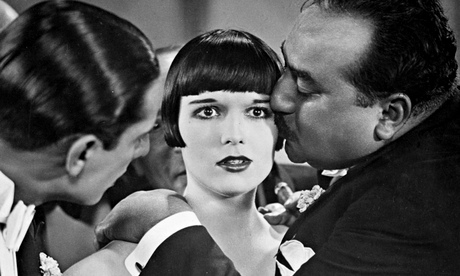
Louise Brooks (1906-85) had a couple of largely unremarkable years in Hollywood before the coming of sound, and a briefer, even less remarkable sojourn there in the 1930s. But few contemporaries, not even Garbo (her friend and, for one night at least, her lover), have generated such a mystique, some of it cultivated by Brooks herself during her long period as a recluse during which she gave teasing interviews and wrote Lulu in Hollywood, a frank and graceful autobiography about her independent, liberated life.
This enduring reputation derives from two remarkable silent films – Pandora’s Box and Diary of a Lost Girl - for which she’d been brought to Weimar Germany by GW Pabst, a gifted, currently unfashionable director. Both films are in the realistic, socially conscious style called Die Neue Sachlichkeit (the New Objectivity or New Sobriety) which succeeded expressionism, the movement concerned with the subjective and fantastical which, in the cinema at least, was fairly short-lived.
The most famous is the provocative Pandora’s Box (adapted from the same fin-de-siècle plays by Frank Wedekind that inspired Alban Berg’s Lulu), in which Brooks with her flapper pageboy haircut is a femme fatale who destroys the predatory males surrounding her before surrendering to death at the hands of Jack the Ripper. Equally impressive but less celebrated (partly because for a long time it was only available in a heavily censored version), Diary of a Lost Girl begins with the 16-year-old Thymian, daughter of a middle-aged pharmacist, being given a leatherbound diary as a first communion present, in which she records her life of shame and humiliation. It’s a story of a woman betrayed by a succession of men and women, and of her experiences first in a repressive reformatory where she’s been sent after a cold-blooded seducer has made her pregnant, and then at a high-class brothel to which she escapes.
Throughout it all, Brooks exudes a hypnotic resilience, retaining a transcendent moral decency in a corrupt world. The film is surprisingly unprurient and nonjudgmental, and there are remarkable sequences such as the one in which the brothel’s motherly madam transforms Thymian, the dowdy reform-school escapee, into the entrancing bob-haired, fashionably dressed Brooks we know. The smoothly edited film has relatively few inter-titles, and Brooks’s subtle, strikingly modern performance has none of the demonstrative gestures of the silent era. The handsomely restored disc is accompanied by an informative booklet.