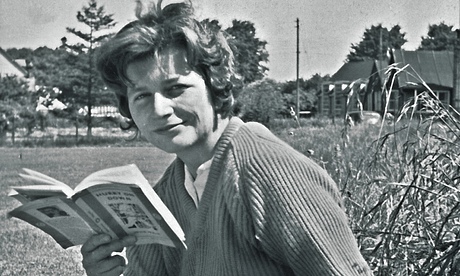
Diana Pullein-Thompson, who has died aged 90, was the author of 30 pony books – ripping yarns, full of adventure, in which plucky young heroines overcome daunting challenges and turn feeble nags into champions. When asked why so many girls are passionate about horses, Diana replied, “They smell simply lovely!” But another strong reason would be the cavalcade of books that Diana, her twin, Christine, and their slightly older sister, Josephine, produced over more than half a century.
The inspiration for the stories came from Diana’s childhood and youth, as recounted entertainingly in Fair Girls and Grey Horses (1996), the joint autobiography that the three Pullein-Thompson sisters wrote. Though Diana was born in Wimbledon, south-west London, the family soon moved to a large, draughty house, called the Grove, in the village of Peppard in south Oxfordshire. There were stables attached and the girls and their older brother Denis grew up surrounded by dogs, chickens and other animals.
Their father, Captain Harold “Cappy” Pullein-Thompson, was a first world war hero who had been horribly injured in battle, as well as seeing most of his friends killed, and this left him in constant pain, making him a distant and irritable presence. After a brief period as a schoolteacher, he tried his hand at selling refrigerators and children’s board games, with limited success. His wife supplemented the household’s meagre income by churning out numerous novels under her maiden name, Joanna Cannan. She is credited with creating the genre of pony books, to which her daughters applied themselves enthusiastically while still small children.
Diana was proud of the fact that her mother came from a literary family; a cousin, Gilbert Cannan, was a successful novelist and dramatist about whom she would write a biography, published in 1978. Her brother adopted the name Cannan when he became an actor and later a successful author of comic plays. Denis was sent to Eton, whereas the girls were largely educated, haphazardly, by their mother at home. The neighbours were taken aback by the family’s unconventional lifestyle, and when one asked Joanna about Diana and Christine, “Are your twins normal?”, she replied, “Good God! I hope not.”
The one thing Joanna did instil in all three of her daughters was the importance of language, whether in writing stories and letters or in speech. She also taught them that girls could be as good as chaps and encouraged their independence and bravery on horseback. As Diana told the Daily Mail journalist Liz Jones in 2010: “It was feeble to have nerves. You just got on with it. There was no such word as can’t.”
The girls’ first mount was a wooden rocking-horse called Dobbin, but they soon graduated to a rather decrepit former polo pony, Countess, followed by more impressive mares. Before long, all three sisters were winning trophies and rosettes at events and earning useful money by teaching other girls how to ride. After the second world war, Diana published her first pony book, I Wanted a Pony (1946), begun when she was 14. Six years later, she hoped to go to the US with Christine to become a professional horsewoman, but failed the medical test required by the immigration service as it revealed that she had TB. Thanks to the newly established NHS, she was sent to a sanatorium in Switzerland, where she breathed mountain air while sitting on a balcony writing more pony stories. Although her illness had put paid to her hopes of a career as a championship rider, this did not prevent her, on her return to Britain, from riding on her favourite mare, Favorita, all the way from John o’Groats to Land’s End in just six weeks.
Diana worked briefly in the offices of the literary agent Rosica Colin, but soon realised that her true vocation was writing, which she continued to pursue even after marrying the art historian Dennis Farr, a keen horse rider, in 1959 and while raising their two children, Benedict and Joanna. Farr was assistant keeper at the Tate in London when they married, but his career later took him and his family to Glasgow, Washington and Birmingham. They returned to London when he became director of the Courtauld Institute Galleries, and Diana did voluntary work for a number of literary organisations, including the Society of Authors.
On Dennis’s retirement, they moved to Haslemere in Surrey, where there was good riding, and Diana continued producing books, though not quite as many as her two sisters did. All the pony stories were published under her maiden name, but, as well as the biography of Gilbert Cannan, Diana wrote two other books as Diana Farr: Five at Ten (1985), a study of prime ministerial consorts from Dorothy Macmillan to Denis Thatcher; and Choosing (1988), a novel for adults.
Dennis died in 2011. Diana is survived by Benedict and Joanna.
• Diana Pullein-Thompson, writer and horsewoman, born 1 October 1925; died 21 October 2015