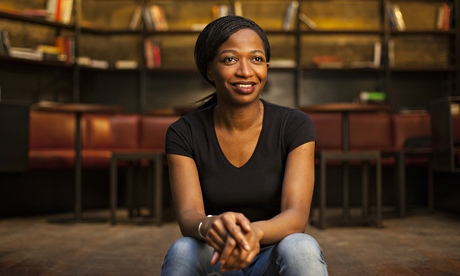
“It’s interesting,” Diana Nneka Atuona says, “how many people ask me: ‘Are you Liberian?’” They ask because she is author of a powerful new play, Liberian Girl, her debut, which opens on the main stage of the Royal Court in January. It’s about a child soldier – a 14-year-old girl who disguises herself as a boy in a bid to survive Liberia’s civil war (1989-2003) in which 200,000 people were killed. Atuona, a poised 31-year-old, politely underscores the futility of assuming a writer must have experienced personally whatever it is they are writing about. Imagination is about “subjectivity”. More importantly, it depends on “empathy”.
And no, she did not come from Liberia. She is a British-born Nigerian who grew up in a big family in Peckham. Both her parents worked for the Royal Mail, although her father is now, she says, fish-farming in Nigeria.
Peckham has done Atuona proud (and vice versa). It was at a Peckham-based writers’ group, one of the Royal Court’s local workshops, that this play began. Atuona had always wanted to write but assumed that writing plays would turn out to be “restrictive”. What she discovered through seeing plays at the Royal Court was that theatre could be diverse. She thought: “I could do that.”
How did Liberia present itself as a subject? She started with a play about African football (her accountant brother’s idea) but scrapped it when the film Africa United stole their thunder. By then she had “fallen in love with Liberia”. That seems surprising, given Liberia’s tormented history. She explains that she loves the country’s “uniqueness” and has been struck by how little most people know about Liberia: “They confuse it with Libya, or only know it through Michael Jackson’s 80s track Liberian Girl. I read a statistic which was a spur to me (I have since discovered it was flawed because they only interviewed 400 or so women) that claimed that 75% of women during the war experienced some form of sexual violence.”
Sometimes her research made her weep: “I read about a woman gang-raped so severely that her insides fell out. I came upon images of children holding entrails. I thought: how can people be so evil? But then I would think: I have to be objective.”
Liberia was an upside-down world: child soldiers call into question “the notion of childhood”. What’s more: “The number one thing in Africa is to respect your elders, and that was turned on its head. Some were even forced to have sex with their own parents.”
She acknowledges that her imagination has been fired by chaos. Liberian Girl has won the Alfred Fagon award for best new play and was performed, to acclaim, at the Global Summit to End Sexual Violence in Conflict last summer. When the Royal Court told her they were taking the play on, she was instructed not to tell a soul. “I told everyone,” she laughs.
Liberian Girl will be showing at the Royal Court, London SW1, 7-31 January