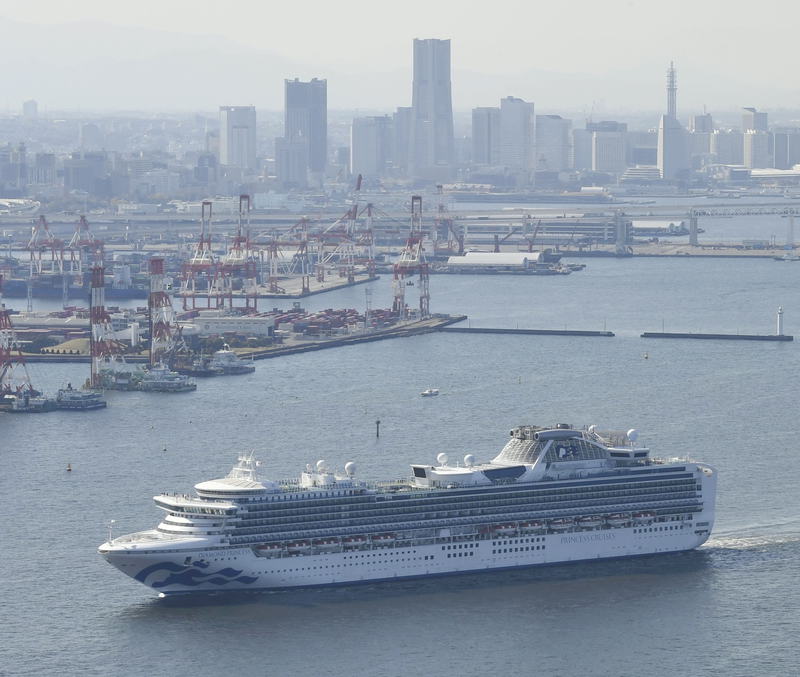
Shock waves passed throughout the Nagatacho political nerve center in early February after it was learned 30% of COVID-19 tests were positive on the Diamond Princess cruise ship, which had returned to Yokohama after an overseas trip.
Late at night on Feb. 4 -- when only about 20 cases of the novel coronavirus had been confirmed in Japan -- Chief Cabinet Secretary Yoshihide Suga and another 20 or so Cabinet ministers and bureaucrats gathered at the Hotel New Otani Tokyo in Tokyo's Kioicho district.
They were thrown into confusion, saying, "How fast can the passengers be inspected?" and "Not all of them right away."
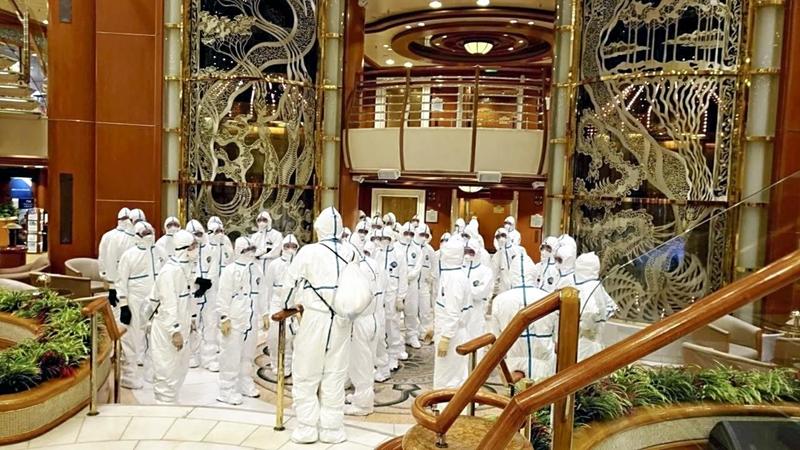
At 10 p.m. that day, it was found that 10 people on board were positive out of 31 who were tested.
A tense exchange of words ensued in a large room that had been hastily reserved at the hotel.
There were about 3,700 people on board the ship. When Hanako Jimi, a doctor and parliamentary vice minister of the Health, Labor and Welfare Ministry, heard that 10 people had tested positive, she had a hunch that an epidemic was breaking out on board.
With a 30% positive rate, as many as 1,000 people could be newly infected. Polymerase chain reaction (PCR) tests were only able to handle a few hundred cases a day in the whole nation back then.
The government could not let people disembark and go home without knowing whether they were infected or not.
Early on April 5, hours after the top-secret talks, Tokuaki Shobayashi, deputy director general for the health ministry, who had been recalled from the Environment Ministry, boarded the ship and told the captain to quarantine everyone on board. He was assigned to handle this matter because of his experience in the fight against a new strain of influenza.
-- No rules on quarantining ships
"A passenger aboard a cruise ship entering [Japanese territorial waters] has been infected with the novel coronavirus."
The Health, Labor and Welfare Ministry received this information from Hong Kong on Feb. 2. A passenger in his 80s who boarded the Diamond Princess cruise ship in Yokohama and got off in Hong Kong on Jan. 25 was found to have been infected with the virus.
The vessel had already arrived in Japan, having called at Naha Port on Feb. 1 after completing its journey as scheduled. However, the U.K.-registered ship was operated by an American company.
"No one on earth [back then] was familiar with clear rules on how to deal with cases of infections on ships," said Yasuhiro Suzuki, a chief technical official at the ministry who holds a medical license, recalling how baffled he was.
The government decided to respond to the situation within the framework for quarantining ships.
The Quarantine Law does not allow anyone aboard a ship suspected of being a carrier of a pathogen not native to Japan to disembark in the country.
By the time the vessel entered Naha Port, the ministry had suspended a quarantine it had imposed on the people on board, saying they were no longer feared infected. However, more people were subsequently found to have caught the virus, so it decided to take the unusual step of quarantining them again in Yokohama. The 3,700 passengers and crew members had their health checked while PCR tests were being carried out.
The ministry initially planned to examine only people with symptoms and those who had been in close contact with them, and to have the others disembark and go home. However, when 10 out of 31 people were confirmed positive on the night of Feb. 4, it was forced to change the policy.
Based mainly on the Infectious Diseases Law, the government decided to disembark and hospitalize those infected with the virus and keep everyone else on board under quarantine. Taking into account the incubation period of the virus, they were required to stay on board for about 14 days starting from the following day of Feb. 5.
"We couldn't find a hotel or facility on land that could accommodate more than 3,000 people. The only way to isolate them was to have them remain on the ship," a senior ministry official said.
However, the number of people infected with the virus eventually rose to 712, while 13 died as a result.
"I thought the people on board were able to stay in separate rooms [while under quarantine], but it was a total miscalculation as many of the crew members shared their rooms. There were so many things I learned only when I went inside," the official said.
-- Human rights violation
The ministry was in charge of the situation as it holds jurisdiction over cases related to the Quarantine Law and the Infectious Diseases Law.
With a task force set up inside the ship, the ministry received various support from other ministries, agencies and relevant organizations. However, many of the passengers were elderly, while the passengers and crew members were from as many as 56 countries and regions.
As the quarantine became prolonged, some people on board started feeling unwell and asking for medicine, with one of them even saying, "I want to jump off the ship."
Some overseas media criticized the situation on the Diamond Princess, describing it as a violation of human rights.
With everyone remaining on the ship eventually disembarking in late March, the quarantine finally ended.
Some said, "If there was a facility for them to stay in, the spread of infections could have been more contained, and the people under quarantine could have had less stress," while others said, "Relevant information should have been disseminated overseas more carefully."
There are a number of aspects that reflect the ministry's remorse for the way it handled the case.
However, another senior ministry official said, "It was impossible for a single ministry to manage such an extremely special, rare and large-scale operation."
Lessons from Diamond Princess case:
- Stimulate international discussions on measures to be taken in the event of an infectious disease outbreak on a passenger ship and establish a domestic system;
- Establish a control tower capable of giving flexible instructions within each ministry and agency, as there is a limit to what can be done for a ship quarantine by the Health, Labor and Welfare Ministry;
- Make effective use of the SDF and organize a medical team that does not rely on volunteers.
Read more from The Japan News at https://japannews.yomiuri.co.jp/