
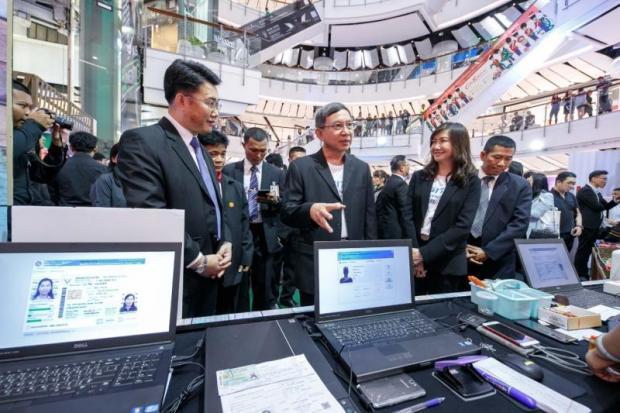
Thais will be able to download their digital national ID card and house registration in place of paper documents when contacting government services, says the Digital Government Agency (DGA).
The aim is to use blockchain technology to ensure genuine state documents for citizens and licences for business.
"By this March, the Government Digital Act should clear the National Legislative Assembly and enable online government services comparable to those offered at physical offices," Deputy Prime Minister Prajin Jungtong said at the Digital Government Summit 2019.
The law is a crucial element to achieve one-stop digital government services with less paperwork in the next three years and increase Thailand's ease of doing business ranking from 27th in 2019 to 20th in the next three years, he said.
DGA president Sak Segkhoonthod said that if the law is passed, it will integrate government data across agencies and eliminate redundancies, such as offering an e-driving licence via the Land Transport Department.
The DGA is waiting for the official Digital ID approved by Bank of Thailand, which will later enable people to download digital versions of their national ID card, house registration and business registration documents from the website.
People can use those online government services and submit digital documents through the use of Digital ID-eKYC.
When administering government services in the physical world, government officers will use national ID cards and QR code readers to extract data from digital documents.
This helps reduce copying docu- ments, which costs about 1 billion baht per year. To date, 151 agencies in 20 ministries allow no copy services, even though they use the paper for internal processes.
Meanwhile, the DGA has launched the CitizenInfo mobile app for people to find nearby locations and contact points of state agencies.
For the business, the site biz.govchannel.go.th has 40 types of business licences that businesses can submit online, and it will increase to 200 licences by this year and 300 licences by 2021. This will save the state budget an estimated 3 billion baht.
To integrate the data exchange platform among state agencies, a blockchain "hyperledger" will be used as a safeguard, ensuring that the electronic documents are original and legitimate.
The DGA will focus only on secure exchange documents, while each agency could have own its specialised networks such as the blockchain for healthcare that the Public Health Ministry is piloting for patients' reference in Sa Kaeo province.
The integrated data will allow the government to use optimised data, particularly data analytics and artificial intelligence. The DGA has set up an AI committee to handle the use of AI strategy.
The agency has signed agreements with 20 ministries to train some 100,000 state officials this year.













