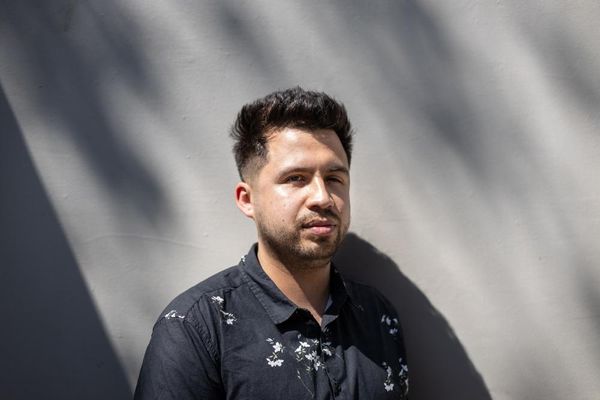
My friend and colleague Deyika Nzeribe, who has died aged 50 of unknown causes, was a leading member of the Green party in Manchester, an activist, a writer and a poet. At the time of his death, he was the Green candidate for the forthcoming Greater Manchester mayoral election, on which I worked as his campaign manager.
A former chair of the Manchester Green party, Deyika was also a key member of Greens of Colour and regularly sought to represent his community of Hulme on the city council.
But his activism was not only party political: he was involved in the Manchester Environmental Education Network and the PAC45 Foundation – which commemorates the 1945 Pan African Congress – and was a driving force behind the Northern Police Monitoring Project. He was also on the management committee of Southern Voices, devoted to raising awareness of issues facing the global south, and had recently co-authored an article calling for the release of the remaining Black Panthers for Ceasefire magazine.
Apart from his political writing, Deyika was also influential as a poet in Manchester’s cultural life. He was co-chair of Sustained Theatre Up North, which supports black and minority ethnic creatives; he was supporting the Fade to Black film festival, and he was chair of Commonword, a writing development organisation based in Manchester.
Born in Manchester, Deyika was the son of Christiana Nwapa, a baker, and Nathan Nzeribe, a train conductor. He attended Stanley Grove junior school, Burnage high school (now Burnage academy for boys) and City College, all in Manchester. In 1986 he went to Leicester Polytechnic (now De Montfort University) to study computer science. He completed his degree in computing and psychology at Manchester Metropolitan University, graduating in 1991.
To support himself and his family, Deyika worked in a number of temporary administrative positions, the last one for the Co-operative Bank. Through this, he came to know the vagaries of the “gig economy” intimately. Seeing the changes to the country’s welfare systems as someone who needed them helped to further shape his views of economic and social policy.
Deyika was involved in a diverse range of causes but there were common themes: inspiring creativity, fighting poverty and austerity, tackling racism, promoting equality and defending the environment. His many friends and colleagues have reflected on Deyika’s warmth, his humanity, and his willingness to put the welfare of those around him before his own.
He is survived by his three children, Leona, Nathan and Ejiké, by Christiana, by his sister, Ada, and by his brothers, Amodi, Gogo and Ikem.