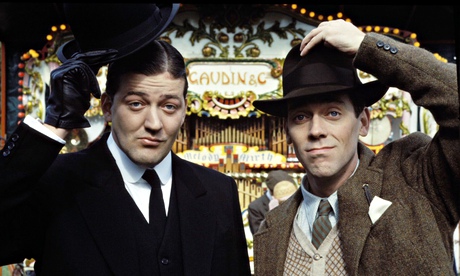
You might expect that the society devoted to the memory of PG Wodehouse and his works would celebrate its biennial “international convention” somewhere in Shropshire, deep in Wodehouse country, perhaps a bread roll’s throw from Blandings Castle. But the strange truth about the author of the Jeeves & Wooster stories is that he is as much honoured – and better remembered – in America than in Britain.
Which is one reason why the 18th convention of the Wodehouse Society was held last week in Seattle, world headquarters of Amazon, Starbucks, Microsoft and Boeing, grunge capital of the American music business and home of the late Kurt Cobain.
For the visiting Wodehouseans, such modernity is somewhat abstract. Typically for their jamboree, they renamed this cool, booming metropolis Pseattle, in tribute to Rupert (“the P is silent, as in ptarmigan”) Psmith, one of the Master’s (they tend to talk like this) best-loved characters. Yet, as you get to know them, the descent of the Wodehouseans on this remote, foggy isthmus seems rather apt. From the Church of Jesus Christ of Latter-day Saints (Mormons) to the devotees of Bhagwan Shree Rajneesh, the far west has always nurtured a taste for cults.
Major Tom Smith, the convention’s co-chair, reports that his off-beat symposium has attracted delegates from as far afield as Japan, Australia, the Indian subcontinent, the UK, the Netherlands and Russia. He concedes that “there are few, if any, references to Seattle in the Wodehouse canon”, but that will not dampen the revels.
Before the convention wraps up on Sunday there will be spats, toppers, white ties, snifters, banjos, any amount of “rannygazoo” (don’t ask), renderings of the Wodehouse anthem, Bill, and the kind of quasi-literary enthusiasm that runs the gamut from the delirious to the merely demented. Sober, middle-aged persons from stable homes and sensible professions will introduce themselves as “Madeleine Bassett”, “Honoria Glossop” and “Claude Cattermole ‘Catsmeat’ Potter-Pirbright”. This weekend Pseattle has been nothing if not pscintillating.

Few 20th-century writers could be more quintessentially English than Pelham Grenville “Plum” Wodehouse. His name guarantees an escape into a lost world of upper-class frivolity: Mayfair lounge lizards, dreamy, pig-loving earls, inscrutable butlers and, of course, the “mentally negligible” Bertie Wooster and his omniscient manservant Jeeves, who happen to be celebrating their centenary this year.
Bertie and Jeeves first sallied forth in the pages of a New York magazine in 1915. So the truth about Wodehouse is that, in his professional life, he was very much an American. He had come to the New World in search of fresh copy, fell in love with Manhattan at first sight, and would devote the rest of his career to selling Britain to America, and vice versa. Manhattan became a second home. Being in New York, he wrote later, “was like being in heaven, without going to all the bother and expense of dying”.
Seattle is not exactly heaven but, in the best traditions of any cult, the 18th convention has done its best to disseminate sweetness and light with a sparkling performance of some famous Wodehouse lyrics by soprano Maria Jette, uplifting talks on “the Modern Wodehouse” and, improbably, “Wodehouse, the Feminist”.
For a writer whose obiter dicta about the opposite sex – “she was just a sweet, simple English girl, with about as much brain as would make a jay bird fly crooked” – resonate a long way south of ecstatic, Wodehouse and his work continue to impress a surprising variety of women, some of whom made the pilgrimage to the west coast.
Jennifer Scheppers, an Australian who now lives in Bath, has come to Seattle as the author of Plumtopia, a “whimsical” blog written under the pseudonym “Honoria Glossop”. Scheppers won’t hear of Wodehouse’s alleged misogyny. “That completely misses the point,” she says. “You don’t read Wodehouse for insights into the human condition. Actually, I first read Wodehouse to escape the human condition. The women in his books are neither insipid nor vacuous. Many of them are really quite feisty, with plenty of pep.”
Will she attend the convention’s closing gala as “Honoria Glossop”, one of Bertie Wooster’s many fiancees, whose laugh is described as sounding “like a squadron of cavalry charging across a tin bridge”?
“Do you mean, will I come in costume?” Scheppers looks horrified. “That’s not really me.” Pressed about the demands of the big night in Pseattle, she acknowledges that mingling on equal terms with Wodehouse’s toffs comes at a price. “Yes,” she confesses. “I was probably going to wash my hair.”
Kris Fowler, from St Paul, Minnesota, has been reading Wodehouse since she was 17, and is a veteran of these biennial beanos. For her, the American Wodehousean is less uptight and formal than his English cousin and a more democratic, outdoor creature. She believes that “we are freer with our silliness”.
She can say that again. Here, in the wild west, the amateur bread roll throwing of Bertie and the Drones on a lively club night has been transformed into something closer to an Olympic sport. Senior members of the American Wodehouse Society refer darkly to Chicago ’97 and Houston ’99. Tom Smith insists that Seattle will celebrate costume (he will be dressing up as Lord Brabazon, who also tried to teach his pig to fly), not projectile pastries. “We banned bread roll throwing after Houston,” he mutters, recalling a painful episode. “Red wine was spilt.” Actually, in Houston, where things got seriously out of hand, it was the tortillas that did the real damage. Before Houston, there had been some mysterious “mishaps”, with the suggestion that – in Chicago? No one’s telling – “waiters were injured”.
Who knows what Wodehouse would have made of all this? From his first visit to the US in 1904, he had a soft spot for Americans and their rambunctious ways. He would, no doubt, have attributed the New World’s trouble with crusty rolls to “youthful high spirits”.
There could hardly be a more egregious example of his ability to blank out the awkward side of life. The average age of the delegates assembled in Seattle must be closer to 65 than 30. Deprived of their traditional weapons, they channel their wilder passions for Psmith, Ukridge, Mr Mulliner, Lord Emsworth and the rest into fearsome anagrams for Wodehouse characters (GOSSIPERS ROCK LORD I) and novels (BOOKSHELF DUCK NIT).
Amid the fun and games, there’s this bitter irony to the fanatical devotion of Wodehouse’s American admirers. Long ago, in 1940, it was his huge overseas audience which was, inadvertently, the ruin of the writer in his prime. At the end of the phoney war, in May 1940, Wodehouse, then living in Le Touquet, was interned by the Nazis after the fall of France. With several hundred British nationals, he was transported to a camp in Upper Silesia, in what is now southern Poland. “If this is Upper Silesia,” he remarked, “what must Lower Silesia be like?”
While Wodehouse was in the camp, thousands of fans wrote to inquire about his wellbeing. At his release in June 1941, on the eve of his 60th birthday, it was partly his determination to reassure his American correspondents that he was alive and well that persuaded him to make the now infamous Berlin broadcasts.
His disgrace followed swiftly. Part of the self-justification for his stupidity was that the US was not at war with Nazi Germany. It was a terrible error of judgment, which he paid for throughout the rest of his life.
“I’m convinced,” says Major Smith, “that Wodehouse was naive. I know he could be cold and calculating on some things, but I think that on some matters he was naive. He liked people who liked him. I believe he was really interested to communicate with his fan base in the USA – and that became his downfall.”
A proper scrutiny of the evidence indicates that none of the more hysterical charges against Wodehouse – of treachery, collaboration and doubtful patriotism – was justified. But the broadcasts made it impossible for Wodehouse to return to postwar Britain. So he crossed the Atlantic to a village in the Hamptons, where after a long retirement he died on Valentine’s Day 1975. His tombstone is inscribed with the names of his most famous characters – Lord Emsworth, Bertie Wooster and Jeeves – and he is buried as an American citizen on the south shore of Long Island.