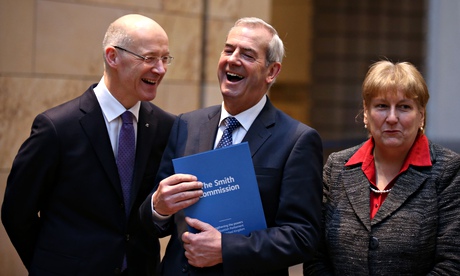
Formula One’s Lewis Hamilton isn’t the only Briton taking corners very fast. In response to the mighty jolt delivered by the Scottish referendum split, David Cameron and George Osborne are making up ramshackle constitutional reform at a dangerous speed. Today’s proposal by the cross-party Smith commission to devolve control of income tax to Scotland is another significant moment.
Where will it end? Good question. The SNP’s finance minister and (briefly) former leader, John Swinney, is already crying “we wuz robbed”.
Earlier this month George Osborne, eager to woo the lost Tory regions of Northern England, announced with little public debate or media fanfare that Greater Manchester would get extra powers and control of funds too – part of the “northern powerhouse” rhetoric which promises an overdue improvement of Liverpool-to-Hull connectivity and much else designed to diminish London’s centuries-old dominance.
The price to Manchester? A directly elected mayor of the kind Manchester voters (and eight major English cities except Bristol) explicitly rejected in the 2012 city referendums. It will be a mayor who will bundle up the job of police commissioner of the kind imposed on all English and Welsh forces, also in 2012. A bit high-handed? But so was the original commissioner blueprint which has not proved a great success.
As elected London mayor Boris Johnson does both jobs, so there is a precedent. But the speed and shape of evolving devolution lacks an overarching vision or coherence, let alone an agreed destination. It may prove to be a creative burst of British pragmatism which leaves this over-centralised country in a better place, but it’s scary, even without addressing the chippy, fantasy-enriched EU/Brexit dimension of our current turmoil.
Take Manchester. It’s been successfully run by Sir Richard Leese, , the council’s veteran Labour leader, for 18 years, most of the time in tandem with Sir Howard Bernstein , chief executive since 1998. It’s been a great partnership which has renovated the IRA-bombed city centre and forged partnerships with neighbouring boroughs on the western slopes of the Pennines. Together they have overtaken Birmingham as England’s second city – Brum whose West Midlands neighbours don’t trust it and knows it has slipped.
Though not keen, Leese – he’s 63 – has said he’ll run for mayor as the best man qualified. That’s probably right – but not for me (or nearby Tatton’s carpetbagger MP, George Osborne) to say. When some of my fellow-Cornish ask me to support devolution (occasionally independence) for Cornwall I always reply “devolution doesn’t make a poor region richer”.
Of course Manchester is a wealthy city with great resources – will Salford (which has its own elected mayor) mind me including the BBC’s media city on Salford Quays as part of the mix? – so it will prosper. So will other powerful English cities (plus thriving Cardiff) and, of course, Scotland, which also has a lot going for it, though not as much as Alex Salmond and Nicola Sturgeon keep telling their fellow Scots. The Brent crude benchmark oil price has fallen from $102 a barrell to $72 since the referendum month of September. It will rise again – probably – but it’s a roller-coaster for an oil-weighted economy like Scotland’s.
What troubles me most as the level-headed (here’s his CV) Lord Smith’s report is published is too much improvisation under pressure. The devo-max plan was promised by St Andrew’s Day – November 30 – not least via pressure from late-campaigner Gordon Brown. Yet Brown and Alistair Darling, Labour’s last two chancellors of the UK exchequer, have both warned against devolving the power to set tax rates and bands to Holyrood. It will end in “floods of tears”, warns the undemonstrative Darling.
A slippery slope which will come to haunt us all? Jim Murphy, the former Labour cabinet minister, now tipped to become Labour’s Scottish leader – it’s about time Labour found someone able to hold the SNP government effectively to account – has had to change his own mind on the issue.
“I listened to the people of Scotland,” he modestly explained on air on Thursday. Admirable in its way – Murphy is combative and smart – but not wholly encouraging. Ex-Tory Welsh secretary John Redwood (he rashly resigned to challenge John Major for the party leadership in 1995) who is an English nationalist with more brains than sense, has been out in the studios making the case for confining “English votes for English issues” at Westminster. The famous West Lothian question – why should Scots MPs from Bathgate vote for issues affecting Bath? – was an anomaly, but we could have lived with it. The former Conservative and Unionist party was happy to trouser the votes of Ulster Tories for decades without complaint.
Though most English voters are unaware of the fact, the Silk Commission – here it is – has already proposed greater fiscal devolution and other powers (eg the police) for Wales on Scottish lines, proposals which are not universally accepted. Northern Ireland is a special case, its devolved powers emeshed in the still-fragile peace process (see the fresh arrest of an IRA murder suspect in the 1972 Jean McConville case) and its public spending overhang at dangerous, unresolved levels.
But what about Leeds, Newcastle, Liverpool (which accepted an elected mayor in return for extra cash) and other big cities and sprawling rural regions? Most feel unloved by London, increasingly seen as a separate place and resented despite the huge, vital contribution its financial services and other industries give the wider country – Scotland included. The Smith report will only feed English fears and the UKIP/Redwood tendency which incoherently expresses these resentments.
English regions need devolved powers too, but also the protective arm of the British state’s deep pockets around them. Remember, devolution does not simply make poor regions richer. Without fairer distribution of tax revenues from richer areas – and individuals – to poorer ones, they risk becoming poorer. Gated communities (or regions) are not the answer.
Labour is claiming to have won two important concessions in Smith’s last-minute haggling, that Westminster will still decide personal tax allowance rates and (touch wood) that there will not be two classes of MPs at Westminster – as David Cameron rashly suggested the morning after the 55:45 vote on 18 September. With goodwill we can manage all this without breaking up Britain to the alarm of most British people in all four home countries, though not to Mr Putin.
But it will require steady heads and goodwill, all currently in short supply. The Times’s page one headline on Thursday is “Fears of a federal UK as Scots get new powers” which neatly sums up metropolitan parochialism. London has been dominant since Roman times, but it can’t be said too often that a country where most of the people – 55m out of 64m – live in one component region (England) doesn’t federalise easy.
In Edinburgh Scotland’s new first minister, Nicola Sturgeon, who may prove a formidable operator (you can never tell with the top job), is today threatening deer-stalking large estates with the loss of business rate exemptions and other reforms to make them more socially responsive. The SNP’s record in office since 2007 has been more laird-friendly in practice – Salmond was very accommodating to Donald Trump and Crofter McMurdoch – but it’s an interesting left-populist move.
It may do good (or not), but we can expect more of the same on the tax front. No harm in that if it doesn’t damage the Scottish economy. We can all learn from each other’s initiatives – as we did from Scotland’s bold lead on the public smoking ban. But a tax bidding war would help no one: just look what damage Dublin’s “double Irish” strategy has done by stealing internet giants’ tax bases from Britain on quasi-fraudulent deals which the EU is finally nailing. No wonder corporation tax is being reserved to the UK.
And did you notice the issue of devolving abortion remains a ticking time bomb, one with sectarian overtones between Westminster and Holyrood? Lively times, thinking caps and seat belts on.