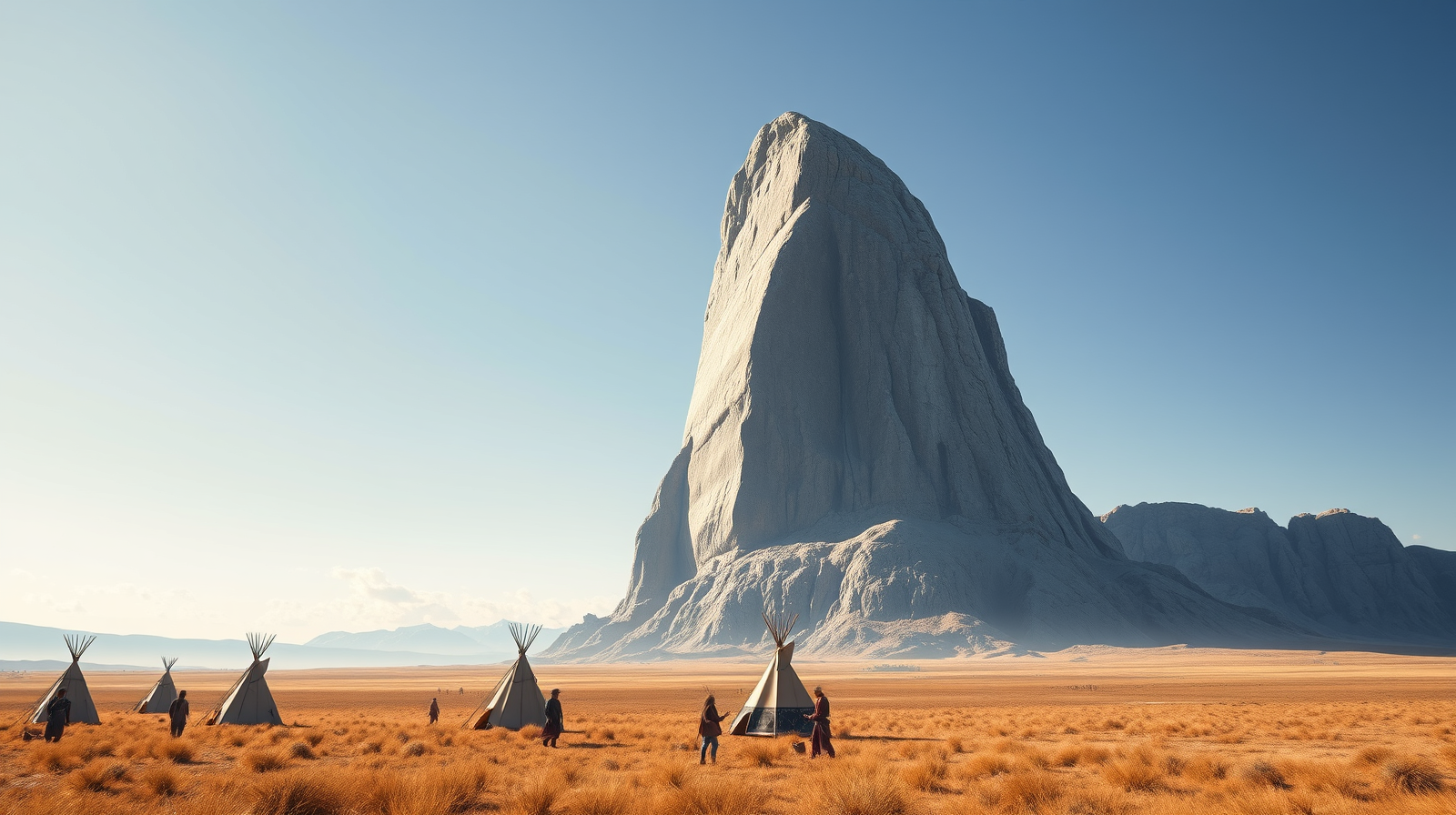
It rises 386 metres straight out of the flat plains of northeastern Wyoming like something that was placed there rather than grown from the earth, an enormous column of grey-green rock with perfectly ridged vertical sides and a flat summit that looks, from a distance, almost deliberately engineered. Devils Tower has drawn human attention for at least 10,000 years, long before European explorers arrived and long before it became the United States' first official national monument in 1906. More than two dozen Native American tribes consider it one of the most sacred places on the continent. Despite more than a century of geological study, scientists still cannot fully agree on exactly how it came to exist, making it one of the rare landmarks that remains genuinely mysterious to both the people who hold it sacred and the researchers who study it professionally.
Get breaking news anytime, anywhere. Download the TOI app now!
What the name Devils Tower actually means and why many reject it
The name most people know this formation by is not its original one and is, according to many Indigenous groups, not its correct one either. For roughly 10,000 years, the Northern Plains tribes who lived across this region knew the formation by names that all translated to some version of Bear Lodge, Bear's House, Bear's Tipi or Bear's Lair, each name reflecting the central role that bears play in the oral traditions surrounding the site. The name Devils Tower entered the record in 1875 during a military expedition led by Colonel Richard Irving Dodge, when his interpreter reportedly mistranslated the Indigenous name, rendering it as something approximating Bad God's Tower, which was eventually shortened and recorded as Devils Tower. Many tribal leaders and Indigenous scholars have since pointed out that the name is not only inaccurate but actively offensive, replacing a name of deep cultural reverence with one that carries demonic connotations. A formal proposal to rename the monument Bear Lodge was submitted to the United States Board on Geographic Names as recently as 2014, but no change has been made, which can only be done through congressional action or a Presidential Proclamation, as documented on the National Park Service's official page for the monument .
The sacred oral traditions of more than two dozen tribes
The National Park Service formally recognises Devils Tower as a Traditional Cultural Property, a designation reflecting its deep association with the beliefs, rituals and sacred narratives of the tribes affiliated with it, including the Lakota, Arapaho, Cheyenne, Crow, Kiowa and Shoshone, among others. While each tribe carries its own version of the stories surrounding the Tower, a striking common thread runs through nearly all of them, the presence of a great bear and the miraculous rising of the rock to protect people from danger. In the best known version, shared across Kiowa and Lakota traditions, a group of girls playing on the plains were chased by giant bears, fell to their knees in prayer and were saved when the Great Spirit caused the earth beneath them to rise rapidly into a towering column, carrying them out of reach. The bears clawed desperately at the rising rock as it grew, leaving the great vertical grooves that mark the Tower's sides to this day. In the Kiowa version, the girls were eventually lifted all the way into the sky, where they became the seven stars of the Pleiades constellation. The Lakota also hold that their most sacred ceremonial object, the White Buffalo Calf Pipe, was originally received at this location, adding another layer of religious significance that goes beyond the bear narratives alone.
Living ceremonies still practised at the Tower today
For the tribes affiliated with the site, Bear Lodge is not a historical relic or a place of past significance only. It remains an actively used sacred site where ceremonies continue to be performed throughout the year, with June being the most significant month when many tribes return for rituals including sweat lodges, vision quests, fasting and the Sun Dance, a sacred Lakota ceremony focused on renewal and sacrifice that was traditionally held at the summer solstice. Visitors to the monument today will often see colourful cloths and bundles tied to trees near the base of the Tower, left as personal prayer offerings, and signs throughout the park ask visitors to leave these objects entirely undisturbed. Since 1995, the National Park Service has maintained a voluntary climbing ban during the month of June out of respect for the tribes' ceremonial calendar. According to a PBS documentary on the monument, approximately 85 percent of climbers honour the ban, though it has faced legal challenges from climbing advocacy groups who argue the arrangement constitutes an unconstitutional government entanglement with religion.
The four competing theories that scientists have never resolved
What geologists cannot agree on is the precise nature of the original magmatic event that produced the Tower, and four distinct theories have each had periods of scientific favour without any achieving universal acceptance. The first and oldest theory, proposed by geologists Carpenter and Russell in the late 1800s, holds that the Tower is an igneous intrusion that never reached the surface, cooling entirely underground before the surrounding softer sedimentary rock eroded away over millions of years to reveal it. The second theory, popular in the early twentieth century after scientists Darton and O'Hara proposed it in 1907, suggests the Tower is an eroded remnant of a laccolith, a dome-shaped mass of igneous rock that pushed upward between sedimentary layers without breaching the surface, creating a rounded bulge rather than a peak. The third theory proposes that the Tower is a volcanic neck or plug, the solidified core of what was once a full volcanic vent, representing all that remains of a much larger volcanic structure that has since eroded entirely away. A fourth and more recent hypothesis, proposed by researchers Závada and colleagues and published in peer reviewed literature, suggests the Tower may have originated as a lava flow emplaced into a maar-diatreme volcano, a type of explosive volcanic crater. None of these theories has been definitively proved or disproved with the evidence currently available, and the current preferred model among IUGS researchers describes it as an exhumed volcanic neck, though even this remains contested.
How erosion eventually revealed the Tower to the surface world
Whichever theory of formation ultimately proves correct, the process by which the Tower became visible above the Wyoming plains is better understood and less disputed. After the phonolite porphyry cooled underground 40.5 million years ago, it remained buried beneath thick layers of the sedimentary formations that had been building up in the region across hundreds of millions of years, including the Triassic-era Spearfish Formation, the Jurassic Gypsum Spring Formation and the Jurassic Sundance Formation. Over tens of millions of years, water erosion gradually stripped away these softer surrounding rocks, exposing the much harder and more erosion resistant igneous core of the Tower beneath them. The Belle Fourche River, which flows near the base of the monument today, has played a central role in this ongoing erosion process, and the talus slopes of broken column fragments that skirt the Tower's base represent the continuing process of erosion that will eventually, across another vast span of geological time, reduce the Tower itself to rubble just as it reduced everything else that once surrounded it.
A formation that has been sacred for ten thousand years, studied intensively for over a century, and still resists a definitive geological explanation is doing something rare. It refuses complete possession by any single framework, whether scientific or cultural, which may be part of why so many different people keep returning to stand at its base and look up.