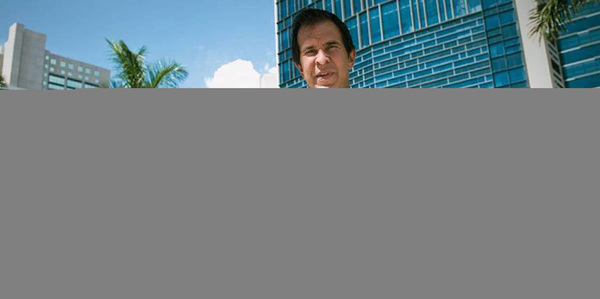
MIAMI _ In the cocaine capital of Latin America, Miami attorney Joaquin Perez is known as the "devil's lawyer," especially at notorious La Picota prison in Bogota, where Colombians charged with drug trafficking in the United States are held until their extradition.
Perez, a Cuban-American lawyer who has represented major narco-traffickers for decades, has been a fixture at the Colombian prison. He is among the pioneering criminal defense lawyers in Miami who fine-tuned the craft of serving up prized cooperating defendants to assist federal prosecutors in exchange for lower prison sentences.
Perez's stock in trade would be to deliver them. They would supply intel on the drug cartels, serve prison time and sometimes get visas to stay in the United States. And, through it all, he got rich off huge legal fees.
But now Perez's lucrative legal career may be threatened after he was thrown out of La Picota in mid-January when a prison director berated him and another American lawyer for trying to visit extraditable inmates without proper permission. The prison wrote up a complaint and referred it to the Colombia Attorney General's Office. Now, prosecutors are considering filing criminal charges, according to a Colombian law enforcement source.
It's unclear whether Perez is named in the complaint. But Perez has been banished from Colombia, after immigration authorities issued an order to that effect, the Miami Herald has learned.
A spokesman for Colombia's Prison Institute, INPEC, confirmed the investigation into how two foreign lawyers "illegally" entered a maximum security bloc at La Picota without registering and signing in. The spokesman did not name the lawyers and declined to comment further.
As part of the probe, Colombian investigators are trying to determine whether bribes may have been paid to guards so that Perez and his colleague could gain improper access to their clients at La Picota.
Perez, 65, who has been profiled in New York magazine and other news media, confirmed that he had been removed from La Picota's visiting area but adamantly denied he violated prison protocols, paid any bribes or was barred from Colombia: "Absolutely not," he told the Miami Herald on Friday. "It's politically motivated. It doesn't make sense."
Perez said the government action against him was unprecedented in his long legal career: "First time in 40 years," he said.
Perez's run-in with Colombian prison officials dramatizes La Picota's new policy eliminating special visiting privileges for American lawyers. It has rankled the small club of Miami defense attorneys who make much of their living off the extradition of Colombian drug traffickers.
Perez said he visited the prison on January 15 along with a Texas defense attorney, Rafael de la Garza, to see three Colombian inmates who together face extradition on cocaine trafficking charges in federal court in Plano. Perez said he was helping de la Garza because it was the man's first visit to La Picota, and the colleague wanted to meet with his client, a 21-year-old Colombian. Perez represents the other two inmates in the same case.
But Perez said that he and de la Garza _ accompanied by a Colombian lawyer _ were not allowed to see their clients because they were stopped by the director of Bogota's prison system, Col. German Ricaurte, who happened to be at La Picota that day.
The director accused Perez and de la Garza of entering the prison improperly and confronted them. A prison videotape, obtained by a Colombian radio station, shows them quarreling. Eventually, as the prison director made internal inquiries, Perez and de la Garza left La Picota.
Perez told the Herald that he and de la Garza had permission from the Ministry of Justice to see their clients. "We went through the regular screening process," he said. "What's upsetting to me is they have changed the rules, and they are not allowing American attorneys to see the inmates."
Perez's altercation with the top Colombia prison official has stirred up a buzz in Bogota and Miami, especially among the cadre of defense attorneys who have competed for years to represent high-level drug traffickers indicted on cocaine distribution charges in the United States. In the past year, Miami lawyers have had a hard time visiting their clients at La Picota because of a revised policy, which treats U.S. attorneys like any other visitor to the prison. In other words, no special privileges for U.S. lawyers _ get in line with the rest of the inmates' relatives and friends.
In effect, all foreign lawyers, including U.S. attorneys, cannot enter La Picota anymore as lawyers _ only as social visitors. After the Perez scandal, it's probably going to get worse. Colombia's prison spokesman insisted no foreign lawyers were being barred from La Picota.
What prompted the change in La Picota's policy? About a year ago, a scandal erupted when an American attorney entered the prison, bribed guards and negotiated a huge payment to have a client put on a list that gives amnesty to members of a left-wing guerrilla group, the FARC, as part of its peace accord with the government.
Other Miami lawyers who compete with Perez for high-profile drug trafficking clients said Colombian prison officials have made visiting their clients intolerable.
"Why do we have to jump through so many hoops?" said Miami criminal defense attorney Ruben Oliva. Oliva has written several emails complaining about the restrictive Colombian prison policy to U.S. officials based in Bogota. "I'm livid," he said.
Miami defense attorney Rick Diaz said in the past, an American lawyer could arrange to see a client at La Picota through the Ministry of Justice by holding a passport, work visa and Florida Bar card, along with an inmate's name, ID card and his authorization for the visit. He said the prison, in the southern section of Bogota, has a series of checkpoints with corrections officers, security dogs and electronic surveillance.
"With the new policy, I can only go in as a friend, as a social visitor, to see my client after he puts me down on a list," said Diaz, who in late January visited La Picota to meet with his client, Edison Washington Prado Alva, known as the "Ecuadorian Pablo Escobar." He faces cocaine-distribution charges in Miami federal court.
Diaz said the series of examinations by the prison guards on the way to the visiting room was "very intense" _ no belt, tie, money, watch, pen, pencil, notebook or documents allowed _ and that he was allowed only to talk with his client briefly with other inmates and visitors sitting at nearby tables. "The process is an ordeal," he said. "You have to spend practically the whole day there just to see your client for one to one and half hours."
Miami defense attorney David Weinstein, who once headed the U.S. attorney's narcotics section in South Florida, said that whatever progress may have been made to reverse this Colombian prison policy has been lost because of the Perez controversy. "These allegations are certainly going to be a setback to those efforts," he said.