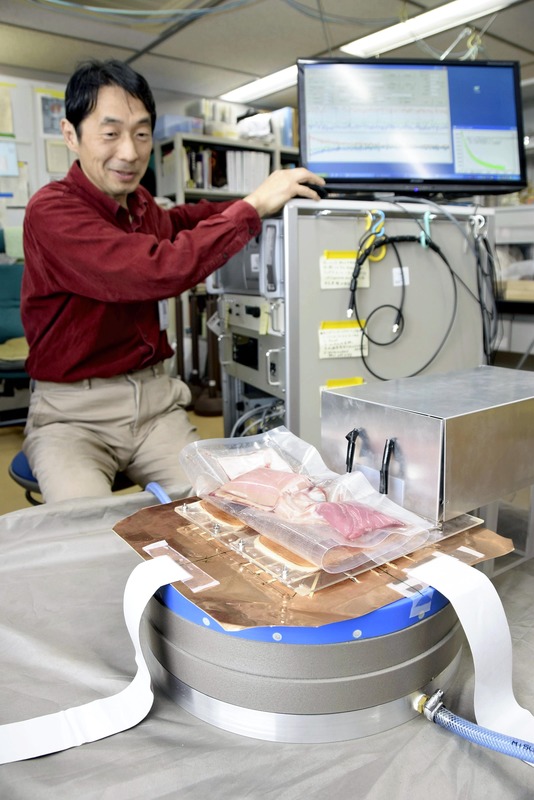
TSUKUBA, Ibaraki -- A research group of the National Institute of Advanced Industrial Science and Technology has developed a device that measures the proportion of fat in tuna without the need to cut into the fish.
The device can determine otoro (most fatty), chutoro (medium fattiness) and lean, the group said. Generally, highly skilled professionals judge the approximate amount of fat in a tuna by looking at a cross-section of the tail.
The group made use of a phenomenon called nuclear magnetic resonance -- used in medical diagnostic imaging units to scan people -- for the device. The device radiates electromagnetic waves onto hydrogen atoms to analyze the difference between the signals that come from the fat and water in muscles.
The device can measure fat at a depth of about 3 centimeters from the surface of a tuna within 10 seconds. The group tested a bluefin tuna fillet and was able to measure the amount of fat of each fillet, such as about 40 percent of otoro, about 20 percent of chutoro, and less than 10 percent of lean tissue. They said the device can be used to improve technology for cultivating fish because it helps to assess the fat in living tuna.
The device costs over 10 million yen to produce, and is as large as a small refrigerator. "Reducing the cost and miniaturizing it are tasks for us," chief senior researcher Yoshito Nakashima said.
Read more from The Japan News at https://japannews.yomiuri.co.jp/