In this year's spring labor negotiations, as company performance has varied widely amid the spread of novel coronavirus infections, further deviation is likely from the conventional "follow-the-leader" pattern of firms in the same industry settling on similar wage hikes.
Facing harsh prospects, the labor unions of both Honda Motor Co. and Mazda Motor Corp. have formulated a policy of shelving their calls for a pay scale increase -- for raising the level of base wages -- during this year's shunto spring wage talks.
The Japanese Electrical Electronic & Information Union, which comprises labor unions of electric and electronic machinery makers, announced Tuesday that it will call for an increase in its unified pay scale of more than 2,000 yen or more to monthly pay, 1,000 yen down from last year's demand.
Prospects for small and midsize companies are even tougher as the number of companies offering wage hikes had been on the decline even before the coronavirus pandemic.
"We should respond to calls for wage hikes within the scope of assuring job security," said Akio Mimura, chairman of the Japan Chamber of Commerce and Industry.
The method of negotiations between labor and management is also likely to change.
The Japan Business Federation (Keidanren), has called for a departure from the traditional style of wage settlements with labor unions. Rather than the "follow-the-leader" pattern of companies within the same industry settling on similar wage hikes or an across-the-board wage hike for employees within each company, Keidanren suggests it is important for companies to decide on wages that fit the actual situation they are in.
In the spring labor talks, labor unions have traditionally negotiated with management by advocating sector-wide, unified amounts or target levels for their demands regarding hikes in wages or pay scales, thus trying to raise the overall level of pay. But even among individual labor unions, negotiating with management according to the business performance of each company has also been spreading.
The Federation of All Toyota Workers' Unions has decided not to present a target amount in its demand for an improvement to wages, equivalent to a hike in pay scale, in this year's spring labor negotiations. The Confederation of Japan Automobile Workers' Unions and the Japan Federation of Aviation Industry Unions also do not plan to present to management unified demands for pay scale hikes.
Yasutoshi Nishimura, the minister in charge of economic revitalization, said, "I hope that both labor and management will negotiate sincerely so that the momentum of wage hikes can be sustained."
But a prevailing view has it that, as Yoshiki Shinke of the Dai-ichi Life Research Institute puts it, "It is highly likely that wage hikes will fall short of 2%," which has been the minimum raise since 2014.
-- Perception gap persists
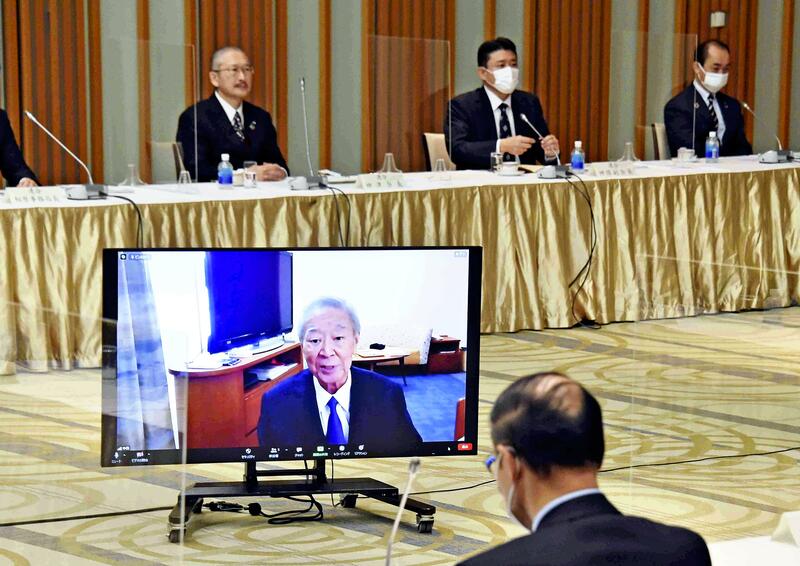
The leaders of Japan's business organizations and labor unions, including Keidanren Chairman Hiroaki Nakanishi via teleconference and Japanese Trade Union Confederation (Rengo) President Rikio Kozu, held a meeting on Wednesday at Keidanren Kaikan in the Otemachi district of Tokyo to kick off the spring labor talks.
During the talks, the leaders from management and labor agreed on the importance of pay hikes, but a discrepancy stood out clearly. Keidanren emphasized work style reforms and job security, while Rengo sought to raise the overall level of pay.
Nakanishi, who is currently hospitalized, was aware of the wage problem, saying, "Japan's wage levels have become considerably low" among major industrialized countries. But he added, "The issue of creating a work environment where people can feel worthwhile and feel they are in a pleasant working condition will become an important issue in the negotiations this time."
In response, Kozu said: "Among Keidanren member companies and the like, wage hikes have been realized to some extent, but the hikes have not been realized for the whole country. If companies that ought to be able to raise wages should take passive measures, coupled with the shock of the coronavirus pandemic, we will be forced to endure additional decades of futility."
Regarding pay scale hikes, Keidanren's stance is that it should be decided by each company in accordance with its business performance. Rengo, meanwhile, calls for an about 4% wage hike, combining an increase in the pay scale and scheduled pay raises.
Sector-wide and company labor-management talks will get into full swing from February onward.
Read more from The Japan News at https://japannews.yomiuri.co.jp/