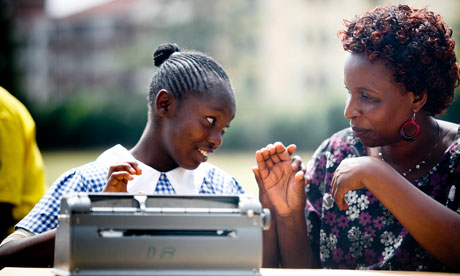
Over the next few months a new curriculum will be rolled out in Kenya's 10 deafblind education units in specialist schools. This is a result of a partnership between Sense International Kenya and the Kenyan Institute for Education (KIE) that we hope will result in a much improved standard of education for deafblind children in the country.
Many specialist teachers were struggling without a curriculum. The classrooms could be chaotic, lacking in direction and teachers were asking us what they could do to ensure the correct ground was being covered and how they should measure children's progress.
As a result we approached KIE to ask them if they would work with us to create a new national curriculum for deafblind children. Over the next few months we worked with KIE bringing with us a great deal of practical experience from working with deafblind children and their families and a desire to create a curriculum that would improve the standard of teaching for the children and allow us to measure their progress.
We also arranged for parents of deafblind children and teachers to share their views on what should go into the new curriculum. Parents often have their own unique insight into the skills that a deafblind child needs to help around the home or what their child has found the most useful to learn in school. It was essential that they were included in the process.
One of the main challenges we faced during the work was the level of bureaucracy that needed to be waded through in order to introduce the new curriculum. This ranged from delays in approval of certain sections of the curriculum to small amends taking a great deal of time. The teachers that we work with were often frustrated by the time it took for the new curriculum to be completed, hoping to see the results sooner rather than later. There was also a general election during the process which meant certain aspects were slowed down while a new officials took over. As with any major project, wrangling for money to ensure the resources are available has also been hard work and will continue to be a challenge.
However, the hardwork has paid off and the resulting new curriculum will ensure that deafblind pupils will receive a uniform level of education that addresses their needs and can help prepare them for post-school life.
There are around 17,000 deafblind people in Kenya and without intervention and support many of these will lead short and lonely lives. School and the opportunity for a formal education isn't always an option for these children. For some families the distance to a suitable school placement is too far or the cost of boarding fees too great. In Tanzania the government is paying for transport costs and we are encouraging the Kenyan government to adopt a similar policy. The next big project for us will be to develop a standard curriculum for those receiving a home-based education to ensure they receive the same benefits as children in schools. We have received funds for this work from AusAid and will begin in September.
Deafblindness is a minority disability and as a result can be overlooked by national institutions. We are grateful to KIE, but the reality is for many government institutions disability and deafblindness aren't priorities. In some countries, they don't even have a word for deafblindness. However, this project has shown just what can be achieved with political will and the expertise of organisations such as ourselves. We are proud of what has been achieved and are now keen to repeat the process for home-based education.
Edwin Osundwa is country representative for Sense International Kenya. Follow @Sensetweets on Twitter
This content is brought to you by Guardian Professional. To get more articles like this direct to your inbox, sign up free to become a member of the Global Development Professionals Network