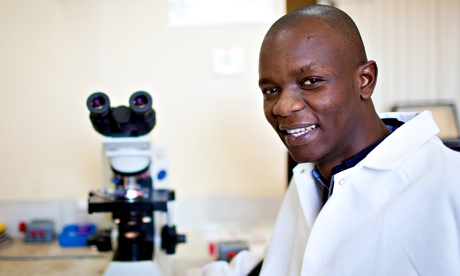
After a recent lecture at the University of Cape Town, I was greeted warmly by biomedical engineering students and professors eager to share their ideas for changing the world. One student pulled me aside to demonstrate his mobile-assisted blood pressure cuff. A moment later, his professor whisked me into his office to discuss a glove he’s developed that delivers biofeedback to help people suffering from disease-related nerve damage.
As the Technology Solutions program leader at Path, I’m fortunate to meet smart, dedicated people like this all over the world. I see the same arc of ingenuity everywhere I go: identify a need, consider the resources at hand, contemplate solutions, and set about designing a solution.
At Path, we’ve been developing affordable, breakthrough technologies for low-resource settings for nearly 40 years, and every project — from new vaccines to devices — begins with that same arc. Now, we’re working with country partners to support the crucial work that comes next: driving those smart ideas to wide-scale use. Together, we’re strengthening the innovation ecosystems necessary to bring lifesaving, locally-sourced health solutions to the women, children, and communities who need them most.
Too far from home
Over the past 24 years, innovative technologies and approaches have transformed the health of women and children worldwide. A recent study by the Institute for Health Metrics and Evaluation showed that 4.2m fewer children died in 2013 compared with 1990 thanks to new vaccines, drugs, diagnostics, and other innovations. Still, an estimated 6.3m children died before their fifth birthdays in 2013, and 293,000 women died from pregnancy-related causes, most of which were preventable.
We know smart interventions work. We know more are needed. And I’ve seen first-hand that the world is rich with innovators thinking beyond boundaries to save lives. So what’s holding us back?
When it comes to developing health technologies for low to middle-income countries, there has long been an Achilles’ heel to the global community’s approach. Too often, the work that goes into developing products, from design and revision to manufacture and commercial introduction, is far removed from the places they will be used, which can weaken their design, impact, and sustainability.
I’ve spent the past decade helping innovators develop products for low-resource settings: in the industry, as a professor of biomedical design at Stanford, and at Path. Here are three critical actions we can take to support local product development:
- Build strong local ecosystems: local innovators need the skills and capacity to carry their inspiration forward. We must build the national ecosystems necessary to translate good ideas into viable solutions.
- Align financial and political support: innovation, especially in global health, carries some risk, requires substantial investment, and has a long investment horizon. Ensuring that products achieve their full reach and impact requires a supportive policy environment.
- Leverage global networks: innovators can’t always access the global network of partners they need to introduce their technologies globally. Opening access to global markets can reduce the risk/return ratio of advancing technologies at home.
A new era for global health innovation
The good news is that today, with global support, several middle-income countries are harnessing their burgeoning political will, research and engineering talent, and thriving academic and business sectors to advance lifesaving global health products.
Perhaps very few countries are better prepared to develop low-cost, high-impact global health technologies than South Africa, where a deep pool of biomedical research talent and strong academic institutions are supported by the Department of Science and Technology and aligned with a Department of Health that has clearly identified its country’s greatest health needs.
That’s why, earlier this month, we announced with our partner, the South African Medical Research Council, the launch of the Global Health Innovation Accelerator (GHIA) — a centre of innovation designed to fast-track product development and introduce promising technologies to address the health needs of vulnerable women and children in South Africa and beyond.
For example, the GHIA is advancing a simple, affordable new test that can quickly diagnose anemia without a blood draw, potentially saving millions of women and infants from complications during pregnancy and childbirth. And we’re supporting the widespread use of a mobile phone-assisted device that helps safely pasteurise donated human breast milk, giving vulnerable infants an improved chance to thrive.
To build on this initial pipeline, the GHIA is also working to attract investment from donors, public and private sector investors, and others, and to leverage the capacity and technical expertise of new partners.
Ultimately, Path and our partners plan to establish a network of health innovation hubs like the GHIA around the world. Together, they will share resources, find the best technologies, strengthen the link between technology development and local needs, and maximise resources and efficiencies to make sure lifesaving technologies reach the people who need them.
To join the effort, contact Path’s Global Health Innovation Hub project director, Dipika Matthias: dmatthias@path.org
Content produced and managed by Path