DETROIT _ Most of the auto industry saw a monthslong decline in sales continue in July.
Among the Detroit Three, General Motors fared worst, with July sales 15.4 percent lower than during the same period a year ago. Fiat Chrysler Automobiles sales fell 10 percent, and Ford's were down 7.5 percent.
Japanese automaker Toyota, in a departure from the overall trend, notched a 3.6 percent increase.
The results continue a general drop-off in sales for most automakers that has been ongoing after record sales last year, indicating the industry is in a post-peak period. Much of the decline was attributed to lower fleet sales.
Karl Brauer, executive publisher for Autotrader, Kelley Blue Book and Dealer.com, said although sales are down, there's no need to panic.
"There's no denying the ongoing drop in auto sales, but this is a drop from record levels to near-record levels, unlike what happened in 2009," he said in a news release. "Brands with fresh and appealing trucks or SUVs continue to do well, many of them seeing record volume on vehicles with high profit margins. After seven years of perpetual growth it's a tough wake-up call for some brands to face flat or slightly declining sales numbers. Only a few brands are really suffering in the current market, and those are the nameplates that depend heavily on coupe and sedan sales. The rest of the industry remains quite healthy."
GENERAL MOTORS
Sales declines in July affected all GM brands, but the company noted crossovers and trucks accounted for 80 percent of sales.
Buick fell 30.5 percent, Cadillac dropped 21.7 percent, Chevrolet fell 15.3 percent and GMC dropped 7.3 percent.
The company saw total July sales fall from 267,258 a year ago to 226,107.
"U.S. auto sales continue to moderate from last year's record pace, but key U.S. economic fundamentals remain supportive of strong vehicle sales," said Mustafa Mohatarem, GM chief economist. "Under the current economic conditions, we anticipate the second half of 2017 will be much stronger than the first half."
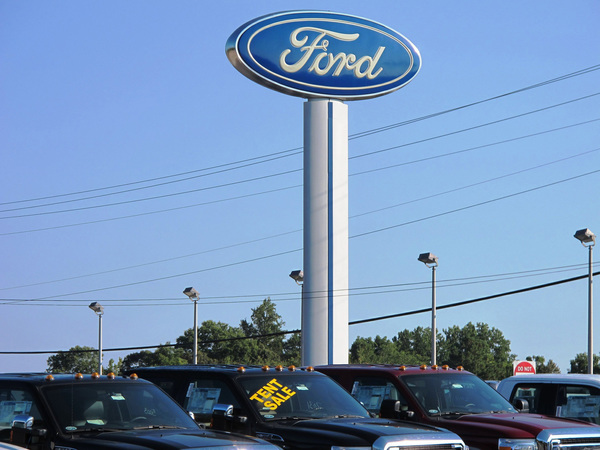
FORD
Ford's monthly sales numbers dropped from 216,479 last summer to 200,212.
The Ford brand fell 7.7 percent, and Lincoln brand fell 2.5 percent. F-series trucks were up 5.8 percent, and the Fusion sedan was down 42 percent.
The company did, however, see strong SUV sales.
"Customers across the country drove retail gains of Ford brand SUVs in July. SUV retail sales were up 9.1 percent nationally, with growth in every region of the country. High-series SUVs were in strong demand with customers representing nearly 30 percent of retail sales," Mark LaNeve, Ford vice president of U.S. marketing, sales and service, said in a news release.
FIAT CHRYSLER
Most of FCA's brands were down or flat for the month: Jeep dropped 12 percent, Chrysler was down 30 percent, Dodge fell 12 percent, Ram was flat and Fiat fell 18 percent
Despite Jeep's sales decline, it posted an 8 percent uptick for the Compass. The company is in the midst of significant production changes as it rolls out the new Compass to replace the old Compass and Patriot.
The bright spot for FCA was the low volume Alfa Romeo brand, which saw sales increase from 43 to 1,255, a 2,749 percent increase. Alfa launched two highly anticipated vehicles in the last year, the Giulia sedan and Stelvio SUV.
FCA sales for the month were 161,477, compared to 180,389 units in July 2016.
TOYOTA
The Japanese automaker soared past expectations for a surprise sales gain. The company's flagship Toyota brand and luxury Lexus brand were each up 3.6 percent.
With the strong sales performance, Toyota surpassed Ford in July as the nation's second-largest automaker for the month, behind only GM.
Leading the way was the red-hot RAV4 crossover, which hit an all-time monthly sales record of 41,804 units, up 31.1 percent for the month.
Still, Toyota's passenger cars declined 11.5 percent for the month, reflecting the general industry trend. Sales of crossovers, pickups and SUVs rose 17.4 percent.
HONDA
The Japanese automaker's passenger cars continued to display resiliency despite the segment's struggles. Passenger car sales rose 1.9 percent, while sales of crossovers, SUVs and pickups fell 4.2 percent.
The company's namesake Honda brand was down 1.7 percent, while the Acura luxury brand was up 3.7 percent.
NISSAN
The Japanese automaker's crossovers, SUVs and pickup trucks recorded a 5.3 percent increase, but sales of passenger cars declined 11.2 percent
The company's namesake brand fell 4.1 percent, while the luxury Infiniti lineup increased 9 percent.
VOLKSWAGEN GROUP
The German automaker's namesake Volkswagen brand posted a 5.8 percent sales decline for the month. Its Audi luxury brand was up 2.5 percent. Porsche sales rose 0.6 percent.
Analysts with LMC Automotive, Kelley Blue Book and Edmunds.com predicted a sales decline of between 1.2 percent and 6.2 percent for automakers.
SUBARU
The Japanese automaker's hot streak continued as its sales surged despite the industry's downturn. Subaru's top seller was the Outback, which rose 19.6 percent to 17,581 units.
HYUNDAI-KIA
Korean automaker Hyundai's sales plummeted 27.9 percent as the company continued to reduce its previously heavy reliance on fleet sales. Sister brand Kia's sales fell 5.9 percent for the month.
"July is historically a strong month, but with disappointing sales and inventories still building, something needs to give," Jessica Caldwell, Edmunds executive director of industry analysis, said in news release. "A lot is riding on late-summer sales events to help move vehicles before 2018 models start arriving at dealer lots.
Caldwell noted that "consumers may be waiting for automakers to loosen the purse strings on incentives to get them to pull the trigger on making a purchase."
Vehicles were also sitting longer on dealership lots, 72 days in inventory, which is the highest level since 2009, according to J.D. Power.
"The second half of the year will continue to present challenges to manufacturers as they navigate a hyper competitive and dynamic marketplace, while working to find the optimal mix of production cuts and discounting necessary to align supply, demand and inventory levels," Thomas King, vice president of PIN OEM operations, media and marketing at J.D. Power, said in a news release.
Despite the lower numbers, Tim Fleming, an analyst for Kelley Blue Book, predicted a bright spot later this summer.
"We're in the midst of the steady summer sales months when new vehicles tend to stay relatively consistent after peaking during the Memorial Day weekend in May. Kelley Blue Book expects to see sales start to jump back up again in August and September thanks to model-year closeouts and the Labor Day holiday," Fleming said in a news release.
Alec Gutierrez, senior analyst for Kelley Blue Book, said that even though sales were down a bit more than expected, analysts are maintaining a seasonally adjusted annual rate forecast of 17.1 million units.