The durations of detentions of foreign nationals at facilities operated by the Immigration Bureau for illegal stays and other reasons have been growing longer. The Justice Ministry's strict operation of the "provisional release" system -- allowing detainees to live outside the facilities -- is believed to the reason for the longer detentions. While one desperate detainee committed suicide in an unusual situation, solutions have not yet been found as security concerns remain unresolved.
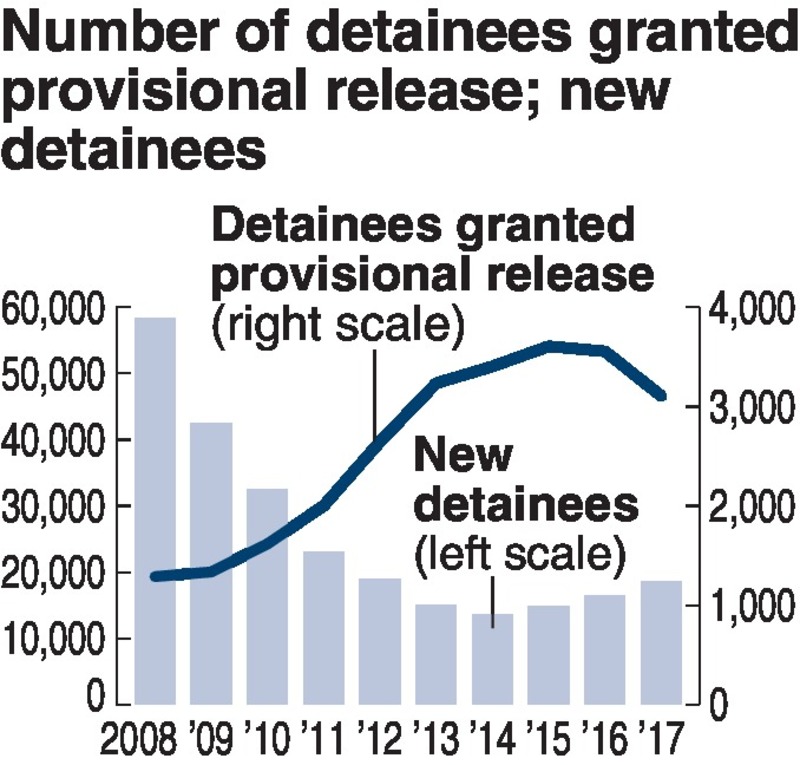
Foreign nationals who are ordered to be deported due to illegal work or illegal stays are sent to 17 immigration facilities across the nation until their returns to their home countries. Last year, such facilities took in 18,633 detainees.
According to the ministry, 1,351 people were being held at the facilities at the end of last year, and 576 of those, or about 42 percent, had been held for six months or longer, which is considered a "prolonged period." That ratio has increased significantly from about 31 percent as of the end of October 2013, and the longest detention period was more than five years.
Since the facility is for temporary stays, detainees can return to their home countries immediately if they accept deportation. However, if detainees refuse a departure order, or if the governments of their countries refuse to issue them passports, detainees will stay at the facility over a long period of time.
For those cases, a provisional release system is designed for humanitarian reasons to allow detainees to live outside the facilities. However, there have been a number of cases of detainees refusing deportation in the hope of being entitled to provisional releases. In addition, many other detainees repeatedly submit applications for refugee recognition, which halts the repatriation process until the refugee recognition procedures are finalized. Last year, 913 foreigners detained for illegal stays applied for refugee recognition.
Crimes related to drugs, assaults and others committed by those on provisional release has been reported. Some of those cases involved murder, robbery and other heinous crimes.
In response to such situations, the ministry notified immigration offices across the country to take thorough measures such as revoking provisional release status in September 2015 and September 2016, while strengthening monitoring of foreigners under provisional release such as by patrolling around their houses. In February 2018, the ministry decided on its policy of not granting provisional release to detainees punished for serious crimes or who repeatedly apply for refugee status.
As a result, the number of people who were granted provisional releases dropped to 3,106 in 2017, decreasing for two consecutive years after reaching 3,606 in 2015. It had risen to that level from just 416 in 2004 and afterward.
On the other hand, some detainees have been kept at facilities over a long period of time. Some have staged hunger strikes and one committed suicide. In April, a 31-year-old man from India hung himself with a towel in a shower room at the Higashi-Nihon Immigration Center in Ushiku, Ibaraki Prefecture. The man had been detained for about nine months and a provisional release was not granted. He is believed to have become desperate about his uncertain future.
Read more from The Japan News at https://japannews.yomiuri.co.jp/