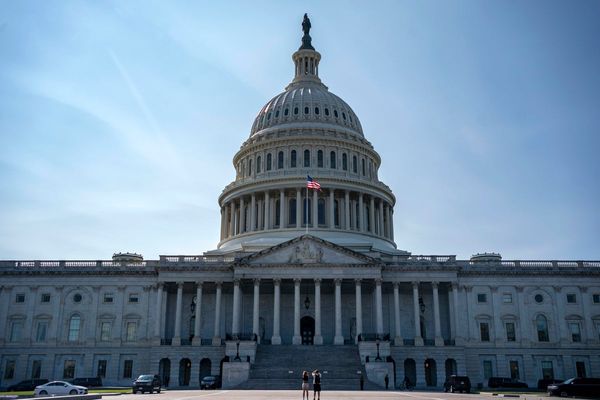
This summer of discontent seems a perfectly awful time to hold a national political convention.
The two presumptive White House nominees, Donald Trump and Hillary Clinton, have record-high disapproval ratings. Polls show their respective parties are held in similarly low regard.
Yet come November, as surely as summer turns to fall, the overwhelmingly majority of voters _ probably 80 percent or more _ will cast ballots for the two candidates marching beneath their respective party banners.
Donald Trump or Donald Doe, it wouldn't matter whom Republicans nominate this week in Cleveland. The same goes for Hillary Clinton and the Democratic convention next week in Philadelphia. Anyone with the "R" or "D" beside his or her name can count on the overwhelming support of fellow partisans.
Indeed, for all the talk of fading political allegiances, about the two major parties dying off, about the rise of independent voters, party labels are still the single best predictor of voting behavior. They telegraph how an individual will cast a ballot far better than age, income, gender, education, sexual orientation, or whether someone lives in a big city, the suburbs or the countryside.
"No matter what the race looks like, you've got about 2 out of 3 voters already predestined as soon as the nominees come out of their conventions," said Peter Hart, a Democratic strategist who has been sampling voter opinion for decades. The level of party loyalty rises from there.
About 9 in 10 Democrats voted for President Barack Obama in his two White House campaigns, and 90 percent or more of Republicans backed the GOP nominee in both contests. Trump may struggle to achieve that level of support, given widespread disaffection within his party, but he undoubtedly will win the vast majority of Republican votes.
Part of the reason is habit. Once individuals form their political views, usually sometime in their 20s and often based on how their parents voted, they tend to stick with that party and support its candidates for the rest of their life.
Part of it is human nature; we tend toward like-minded individuals, and once we find them we stick together, warts and all. (When it comes to self-described independents, most in fact habitually vote for one party or the other, though they prefer not to think of themselves as partisan.)
A great deal of it owes to the country's political polarization and how the two major parties are increasingly defined by their opposition to each other, which influences the way voters think and behave.
"Even when they're not thrilled by their own side, they're much less thrilled by the other side," said Gary Jacobson, a University of California, San Diego political scientist who has long studied Washington's partisan divide.
The sentiment is articulated in the oft-heard statement from people who can't stand Trump but consider Clinton even worse. Or vice versa.
The lesser-evil attitude is reflected in a spring survey taken by the Pew Research Center.
Among Republicans, nearly 7 in 10 said a major reason they identify with the GOP is that "the Democratic Party's policies are harmful to the country," and fewer than two-thirds said it was because they believed Republican policies helped the country.
Democrats were more positive. Just about 7 in 10 said a major reason for their party affiliation was because they thought Democratic policies helped the country. But more than 6 in 10 still cited negative feelings toward the GOP as one of their reasons for being a Democrat.
"What was a line in the sand" between the parties "has become a chasm," said Mark Mellman, a veteran Democratic pollster. "That's increased animosity and negative feelings but also increased loyalty to one's own group."
As partisan divisions have deepened, the old notion that seeing is believing has been inverted.
In 2013, Mellman and Republican pollster Whit Ayres conducted a survey for USA Today and the Bipartisan Policy Center in which respondents were presented with two supposedly different education plans.
The exact same elements were presented with identical wording, but as soon as one was labeled the Democratic or Republican plan, support and opposition rose or fell accordingly. Democrats who backed the Democratic plan rejected the Republican plan, and vice versa.
The importance of issues in driving voter behavior may be overrated anyway.
Donald Green, who teaches political science at Columbia University, has extensively researched partisan attachments and suggested that most voters aren't like politicians, political consultants or, for that matter, political journalists.
"The ordinary person doesn't have a kind of well-articulated ideological vantage point," he said.
Rather, he said, they rely on notions _ some going back decades _ of which party is, say, friendlier to business or working-class people, which attracts environmentalists, or Christian conservatives, or blacks, or Southerners, and then gravitate where they feel they best fit in.
"What they know about the parties often has less to do with a detailed assessment of a platform vis-a-vis issues, and more about the sense of social stereotypes that go with the parties," Green said.
Trump, of course, has scrambled many of the conceptions surrounding the GOP, not least by challenging its orthodoxy on free trade and the party's chummy relationship with Wall Street.
But come Election Day, reflexive party loyalty is likely to overpower any doubts or concerns the overwhelming majority of Republican faithful have about their nominee, just as the overwhelming majority of Democratic faithful will snap into line and rally behind Clinton.
Forget all the lofty talk of promise and principles flowing from the convention podiums. The reason, suggested Thomas Mann, a political scholar at the Brookings Institution, is downright primitive.
"It's much more tribal," he said, "than philosophical."