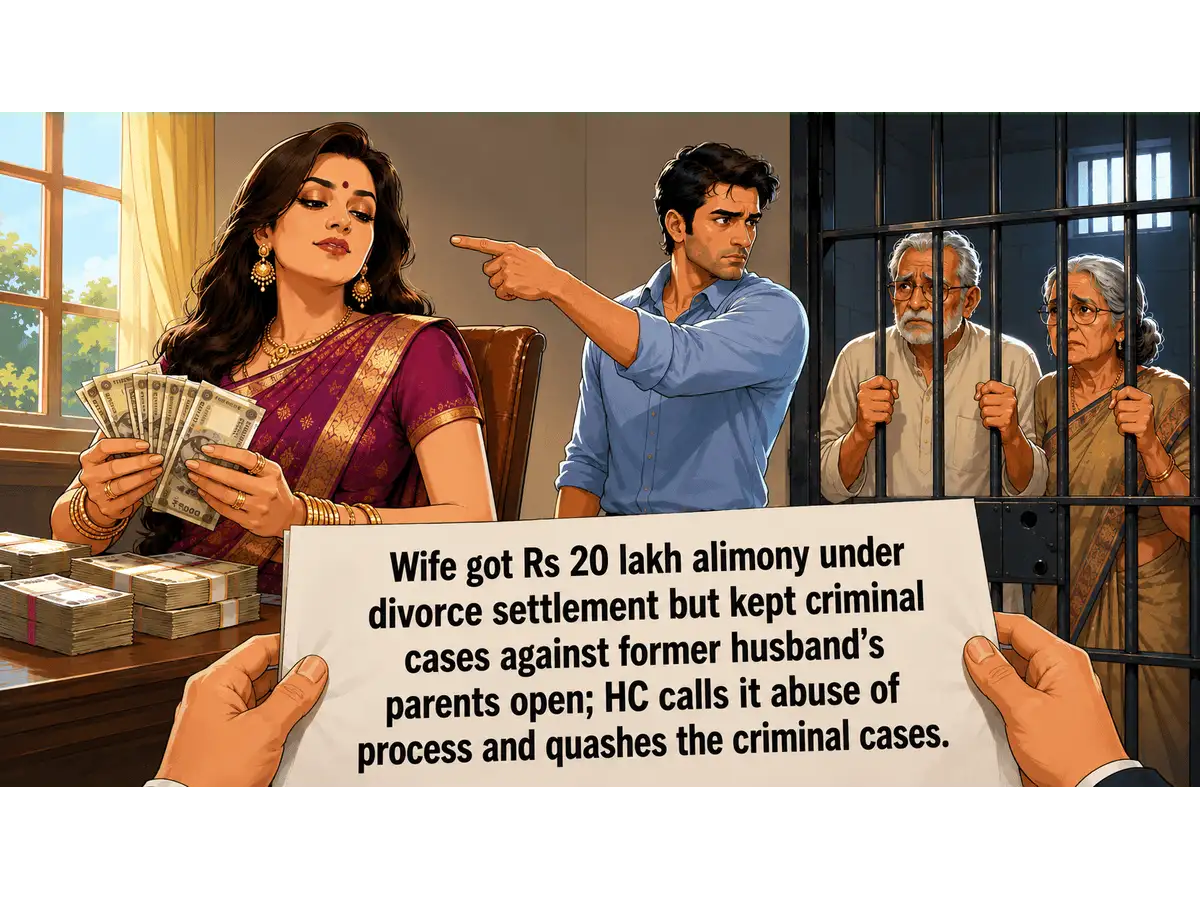
The Rajasthan High Court recently granted relief to the old parents of a man who has been facing criminal cases initiated by his wife despite her having signed a settlement agreement and received permanent alimony. The high court held that continuation of criminal cases against the husband's parents is an abuse of the process of the court, especially given that the divorced wife had entered into a settlement agreement and received Rs 20 lakh as permanent alimony and agreed to withdraw all cases but did not honour the undertaking.
The high court also observed that the conduct of a divorced wife clearly indicates that the criminal proceedings filed were only intended to harass her husband's parents, and thus, if the criminal cases against his parents are allowed by the court to go on, it would be an abuse of process of the court.
Why did she get Rs 20 lakh permanent alimony?
In this case, the wife (now divorced) received Rs 20 lakh permanent alimony from her former husband by signing a settlement agreement for the divorce.
Even though her former husband paid this agreed alimony amount to her via a demand draft, she kept the criminal cases of cruelty (498A), dowry, and others open against her ex-husband's parents. Moreover, when she received the court notice to appear in the witness box, she ignored it and did not attend the court proceedings.
The Rajasthan High Court said that the matter indicated a "reverse trend" where, despite having settled the dispute with her husband and securing a decree of divorce by mutual consent, the wife sought to continue criminal proceedings against her husband and his family members.
The court said this would compel them to undergo the ordeal of protracted criminal proceedings, suffer the ignominy of facing trial, make repeated visits to courts and advocates, incur expenses, and face the hardships and mental agony until the proceedings reach finality.
Qualified but not working? HC denies maintenance to doctor wife, says she can’t burden husband
Background circumstances for this prolonged dispute
The couple got married on November 27, 2009, but their marriage did not last long, and matrimonial disputes arose between them after some time. In 2013, she lodged an FIR against her husband's entire family. The Rajasthan Police investigated the matter and submitted a charge-sheet. The charge sheet with the findings of the investigation was sent to the Additional Chief Judicial Magistrate, Niwai, District Tonk.
On August 29, 2018, the chief judicial magistrate court framed criminal charges against her husband's entire family for an offence punishable under Sections 498A and 406 IPC and under Section 4 of the Dowry Prohibition Act.
Parallel to this criminal case, divorce proceedings were ongoing in the Jaipur Family Court. She filed an application for dissolution of their marriage under Section 13 of the Hindu Marriage Act, 1955. The Family Court, Jaipur, on October 18, 2019, dissolved their marriage.
Shortly after the family court order, she signed a compromise settlement agreement by filing a case before the Rajasthan High Court (D.B. Civil Misc. Appeal No.5735/2019). This compromise settlement agreement was for two aspects: a divorce by consent decree and the quashing of all the criminal proceedings.
According to the compromise settlement agreement, confirmed by the Rajasthan High Court on February 12, 2024, he paid her a lump sum permanent alimony of Rs 20 lakh by demand draft. On February 17, 2025, the Rajasthan High Court finalised the divorce as the family court dissolved the marriage. Both parties had mutually agreed to divorce, and the settlement agreement was also fulfilled.
However, despite receiving the permanent alimony of Rs 20 lakh, she did not appear before the Trial Court for the proceedings of the criminal case pending since 2013. The lawyer of her husband's parents told the Rajasthan High Court that the continuation of criminal cases against them (his parents) after signing the settlement agreement and getting the permanent alimony amounts constituted an abuse of the process of law.
The lawyer also told the court that she was not appearing in the witness box for recording her statements, nor were her family members appearing before the Trial Court for the pending criminal cases; thus, the lawyer appealed to the high court to quash the criminal cases.
The Rajasthan High Court cited the agreement between both parties in which she herself confirmed before the court that she would give divorce by mutual consent and withdraw the criminal cases and he (the husband) would pay her the agreed permanent alimony.
However, she did not honour that agreement, which amounted to misusing the process of the court, which cannot be allowed, observed the HC. "The court proceedings ought not to be permitted to degenerate into a weapon of harassment or persecution," the high court said.
Thus, on these grounds, the high court quashed all criminal cases against her husband's parents (case no. S.B. Criminal Miscellaneous (Petition) No.4251/2022, dated May 21, 2026).
Also read: Signed away maintenance agreement? HC says wife can still claim more; here’s why
Rajasthan High Court order and discussion
A summary of the judgement is as follows:
She has not appeared in the criminal case proceedings since 2018
The Rajasthan High Court said on the basis of her consent, the agreement was signed, and he (her husband) paid her Rs 20 lakh as permanent alimony, and the judgement and decree passed by the Family Court with regard to dissolution of their marriage were upheld, and thereafter, the decree of divorce was prepared by the Registrar (Judicial) of the Rajasthan High Court on February 17, 2025.
However, when the Rajasthan High Court perused the order sheets of the trial court where the criminal cases' proceedings were ongoing, it indicated that since 2018 neither she nor the other witnesses have appeared in the witness box for the recording of their evidence, and in the meantime, more than eight years have passed.
It seems she filed the criminal cases to harass his parents
The Rajasthan High Court said that it appears that in spite of the dissolution of the marriage between the parties on the basis of consent given by her before the Division Bench of the Rajasthan High Court and in spite of receiving permanent alimony of Rs 20 lakh by her, the whole and sole objective of her is to harass his parents.
The Rajasthan High Court observed that he (the husband) has discharged his part of the obligation as agreed in the terms of the compromise settlement and she has also received the decree of divorce from him without contest on the basis of the terms of the compromise (the Rs 20 lakh permanent alimony), and thus now cannot be allowed to go back upon their proclaimed stand and take a somersault.
Her lawyers took a stand that criminal proceedings are independent of divorce proceedings. The high court said that in the light of the facts of the case, this stand cannot be accepted.
The Rajasthan High Court said: "The conduct of the respondent wife clearly indicates that the criminal proceedings filed by her were only intended to harass the accused-petitioners (his parents). In view of the subsequent events and the conduct of the respondent-wife, allowing the criminal proceedings of the petitioners to go on would indeed be an abuse of process of the court."
Also read: Wife’s MBA degree or past employment with MNCs can’t stop her from demanding maintenance, rules HC
It seems wife is misusing the process of the court
The Rajasthan High Court said that this is a very unfortunate situation.
The high court said: "This is very unfortunate that the respondent-wife is now backing out from her undertaking. She is estopped in law from withdrawing her undertaking and representation. This would amount to misleading the court."
From the agreements entered into between the parties and which were confirmed by her before the Rajasthan High Court, there is no doubt that this was a compromise/settlement for divorce by consent decree as well as for quashing the criminal proceedings. "By denying to honour that agreement, she is certainly misusing the process of the court. The court would not allow a party to misuse its process."
High court can quash a criminal case if it thinks it is an abuse of the process of court
The Rajasthan High Court said that they have the power to quash a proceeding if they come to the conclusion that allowing the proceeding to continue would be an abuse of the process of the court.
The high court said: "If it is satisfied that the ends of justice require that the proceedings ought to be quashed, it can do so, despite objection by respondent-wife."
The Rajasthan High Court said that the court proceedings ought not to be permitted to degenerate into a weapon of harassment or persecution.
The high court said: "In a criminal case, the veiled object behind a lame prosecution, the very nature of the material on which the structure of the prosecution rests and the like would justify this court in quashing the proceeding in the interest of justice."
The high court also observed that though justice has got to be administered according to laws made by the legislature, but the ends of justice are higher than the ends of mere law.
High court order
The high court said that continuation of the proceedings against the petitioners (his parents) is tantamount to abuse of process of law. Hence, in order to secure the ends of justice, the entire proceedings arising out of the aforesaid criminal case pending against the petitioners stand quashed and set-aside.
Order: Accordingly, the instant criminal misc. petition stands allowed. Stay application as well as all pending applications, if any, stand disposed of.