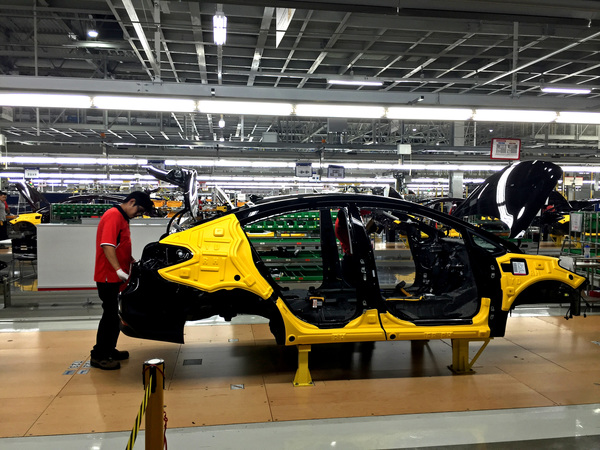
SAN LUIS POTOSI, Mexico��Enrique Zarate, 19, had spent just a year in college when he landed an apprenticeship at a new BMW facility in San Luis Potosi, Mexico. If he performs well, in a year he'll win a well-paid position, with benefits, working with robots at the company's newest plant.
Within a decade or so, most of the BMW 3 series cars that Americans buy will probably come from Mexico, built by people like Zarate.
"When you start with such little experience, and get such a big salary, it's unbelievable," said Zarate, whose father is a taxi driver and whose mother is a housewife.
Mexico is in a manufacturing boom.
Exports from Mexican factories have increased 13 percent since 2012. The country already ranks as the seventh-largest producer of cars in the world, and Chrysler, Honda and Volkswagen have major operations here. Over the next five years, another wave of big automakers, including Ford, Audi and Toyota, plan to open new plants.
It's not just cars. Bombardier, Cessna and Hawker Beechcraft have opened aircraft assembly lines in Queretaro and Chihuahua. Plastics and iron and steel exports have steadily risen.
In the process, workers like Zarate are being lifted into the middle class by the thousands.
That sounds like an exported version of the American dream, circa 1965, in places such as Dearborn, Mich., or Marysville, Ohio. The influx of such jobs to Mexico has enraged Ford employees in Wayne, Mich., and the makers of furnaces in Indianapolis.
Donald Trump called the North American Free Trade Agreement "the worst trade deal in history." Bernie Sanders said that an American company moving to Mexico is "the kind of corporate behavior that is destroying the middle class." Even Hillary Clinton, who once praised NAFTA, has expressed increasing skepticism about trade deals.
But Mexico's manufacturing surge has not been an unalloyed disaster for American workers.
U.S. manufacturing is also rising. Factory output is up more than 30 percent since 2009.
Partly because of automation, there are far fewer factory jobs since the peak of more than 19 million in 1979. But they have been climbing slowly since the end of the 2007-00 recession. Over the past six years, U.S. manufacturers hired 744,000 new workers.
The bottom line, say economists and company executives, is that what's good for Mexico's factory workers is good for some U.S. workers too.
That's because the chain of goods that supplies Mexico's factories is very different from the one for China. Mexico needs to consume U.S. goods in order to make its own.
Around 40 cents of every dollar that the United States imports from Mexico comes from the U.S., compared with just 4 cents of every dollar in Chinese imports, according to the Woodrow Wilson Center.
The influx of auto factories in Mexico might sustain hundreds of supplier jobs in Deforest, Wis., or Calhoun, Ga.
"Instead of thinking of Mexico as a separate part of production, it's now part of our manufacturing process," said Raymond Robertson, an economist at Texas A&M University. "Mexican companies aren't just producing products that rival ours, they are producing parts of our products."
The evolution of factory work in the United States, Mexico and China is illustrated by Evco Plastics, a family-owned, Wisconsin-based plastics maker.
Dale Evans, the owner of Evco Plastics, is not ashamed to admit that recently he's been hiring more people in Mexico than in Wisconsin _ or Dongguan, China.
In the last two years, Evco has added 100 people to its three Mexican plants, and has been hiring more slowly in its five U.S. facilities. Meanwhile, the company is shrinking two Chinese plants into one.
But Evans said that being able to give clients the option of getting their plastic parts made in Mexico more cheaply has allowed him to move much of his 500-member staff in Wisconsin and Georgia to higher-skilled tasks, such as programming robots.
"The easy things _ people picking things up and putting them in boxes _ that (work) left," said Evans. It's too expensive for him to employ rote manual laborers in America.
He has instead invested in training his employees to maintain huge, potentially dangerous robots handling plastic parts. "The difficult things you can do with machinery, that stayed."
The shift is driven in part by labor costs.
Evans said he used to pay Chinese workers $1 an hour, but now pays them closer to $3 per hour. In Mexico, he said, he now pays a typical plastics assembler around $4 per hour, which is just a dollar more than what he paid when he first set up shop there in 2001.
"It's just gotten cheaper in Mexico," Evans said.
One of the workers who has benefited is Tania Berenice Salazar, a 25-year-old from Monterrey. The single mom was working as a cashier earning about $1.60 a week before she got an entry-level job packing up plastic materials at Evco in 2012.
Now she supervises other packagers and makes about $1.80 per hour, even as the peso has plummeted. That's significantly above the minimum wage in Mexico of around $4 a day.
"I feel that this is a step forward. I am rising, I am not stuck," Salazar said.
As she spoke, two nearby plastic injection robots were loudly stamping out pieces of dashboards for Mexican-made Kia sedans and lamp fixtures. The drab Evco factory floor in Monterrey sounds like the inside of a washing machine.
U.S.-supplied raw materials account for 60 percent of the cost of the plastic incubators and ATV parts the company makes in Mexico. For Evco's China plant, the figure is just 15 percent.
Evco's experience supports the findings of several studies on the effects of NAFTA, which 22 years ago loosened barriers to trade among the U.S., Mexico and Canada.
While China's prowess in electronics and textiles appears to have made a lasting dent on U.S. manufacturing _ costing up to 2.4 million jobs from 1999 to 2011, according to one study _ trade flows with Mexico have been more balanced.
Multinational manufacturing companies hire an extra 250 U.S. workers for every 100 employees they take on in Mexico, according to a 2014 study by researchers at the Peterson Institute for International Economics, a nonpartisan organization.
Dean Baker, co-director of the left-leaning Center for Economic and Policy Research, was an early critic of NAFTA and continues to believe that "it put downward pressure on manufacturing wages" in America.
Still, he acknowledges that the trade deal had benefits, at least for U.S. corporations.
"It helped the competitive position of our automakers," he said. NAFTA was "bad, but not as bad for U.S. workers as China."
None of that research is any comfort to Frank Staples, who will lose his job supervising an assembly line when Carrier moves 1,400 furnace-manufacturing jobs from Indianapolis to Monterrey, Mexico, by 2018.
Staples, who has worked at the company for 11 years, blames the move on "corporate greed."
"I think NAFTA was one of the biggest screw-ups that has ever been put in place," he said.
Staples has been working with his hands _ in demolition, then in warehouses, and now at Carrier's factory _ since graduating from high school two decades ago. Now, for the first time, he's worried about how he'll support his family.
Staples said that anyone who says trade comes with more pros than cons has no idea what it's like to be on the losing side of that equation.
"People can say what they want to say (about trade), but they aren't experiencing it firsthand," Staples said.
United Technologies, which owns Carrier, said the move reflects "the steady migration of the company's competitors and suppliers to Mexico, as well as ongoing cost and pricing pressures driven in part by evolving regulatory requirements." The company said it would pay for four years of traditional or technical education for laid-off employees.
NAFTA hit low-skill factory jobs hardest. Many garment manufacturers deserted Los Angeles for border maquiladoras in the 1980s and '90s. Starting in the 2000s, though, some aircraft builders and carmakers, which were already firing up plants in the U.S. Southeast, followed in earnest.
Today, the United States has a $67 billion trade deficit with Mexico in cars and car parts, according to the National Association of Manufacturers.
Some factory work is returning to the United States, but jobs aren't necessarily following. New generations of robots can do the work faster and more precisely than humans can.
Even in Mexico, with its lower labor costs, machines are replacing people.
At a new Kia factory in Nuevo Leon, robots dominate the vast production spaces where the skeletons of Forte compacts take shape. The facility occupies an expanse of arid land that would comfortably accommodate three plants the size of Tesla's main hub in Fremont, Calif.
In a welding area at the center of the assembly line, more than 300 automated machines work in concert with one another to fuse sedan doors to roofs and attach trunks to bumpers.
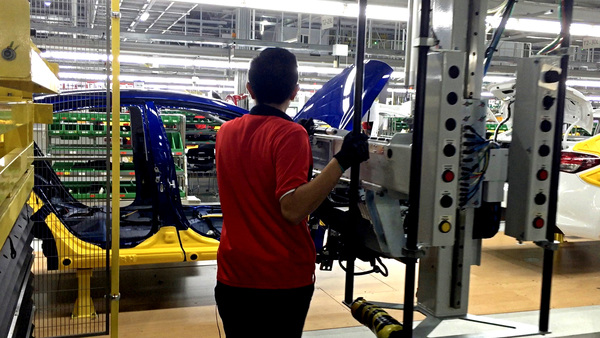
Workers rarely interact with the robots.
Even when people are using their hands to, say, install a car hood, they are just guiding a machine holding the steel to the front of the car and pushing it forward until the piece slots in.
"It's so he doesn't tire his back," said Victor Aleman, a spokesman for Kia, watching as a welder pushed a huge machine toward the shell of a future Forte. Virtually all of the Forte sedans and hatchbacks purchased in the United States will be produced at this plant in Mexico, Kia said.
"We are really happy because these workers don't complain," Aleman said.
A Mexican autoworker at the Kia plant earns $3.75 an hour, the company said. A typical auto manufacturer in the United States makes about $40 per hour, according to data from the Bureau of Labor Statistics.
But cheap labor south of the border hasn't derailed Bernie Degenhardt's career.
The father of two started working at Evco Plastics headquarters in Deforest, Wis., in 1986, when he was a sophomore in high school. He never left.
Degenhardt began as a machine operator, making about $5.50 an hour plucking plastic parts from an injection molding machine. He quickly realized that the influx of robots onto the factory's floor might pose a threat.
"You want to be managing the new automation and technology, and not worried about 'something is going to take my job away,'" Degenhardt said. So he got an associate degree in electronics, and then in 2006, a bachelor's in mechanical engineering.
Today, Degenhardt earns about $120,000 a year as the plant's automation manager, supervising about 20 people.
At Evco's Wisconsin plants, robots do the work Degenhardt once did, pulling just-made plastic from its mold.
"The robots do my (old) job, and I am managing people that manage them," he said.