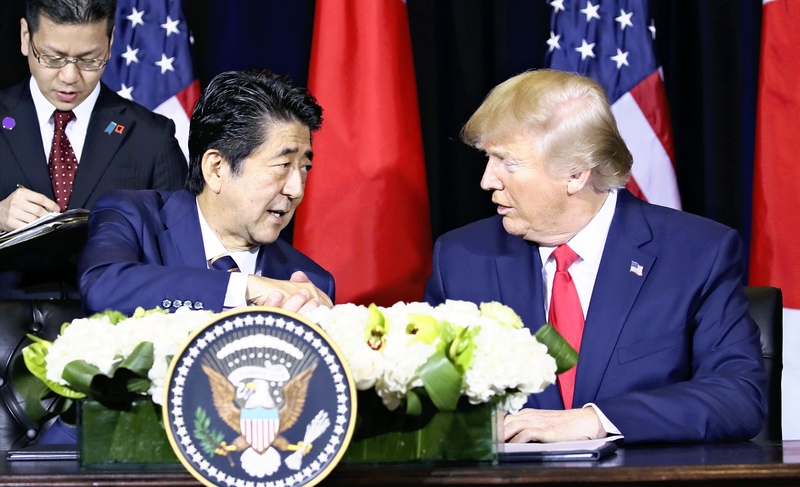
Prime Minister Shinzo Abe, who on Friday announced his intention to step down, considered economic revitalization as the "top priority issue" and pushed forward his Abenomics economic policy package of government spending, monetary easing and pushing for growth. The Yomiuri Shimbun examines how his centerpiece policy -- promoted over the past 92 months -- will be evaluated, and how a new Cabinet will succeed it.
-- Economic diplomacy
"In deploying our diplomacy based on a bird's-eye view of the world, we have created an economic zone that is free and fair, with Japan at the center."
Abe, during a press conference on Friday, cited economic diplomacy as one of his accomplishments. To be specific, the above remark refers to the Comprehensive and Progressive Agreement for the Trans-Pacific Partnership (TPP) involving 11 countries, the Japan-U.S. Trade Agreement, and the Japan-EU Economic Partnership Agreement (EPA).
The bringing in of economic growth abroad was an absolute must, and Abe resolutely forced through the TPP accord -- a leading requisite -- despite strong objections from agricultural organizations. When U.S. President Donald Trump declared America's withdrawal from the TPP on the grounds that it would harm the U.S. job market, Japan took the lead in having the trade pact signed by 11 countries, sans the United States, to bring it into effect.
The TPP11 countries, including Australia and Canada, have a combined population of 500 million people, and their combined gross domestic product totals about 10 trillion dollars (about 1,050 trillion yen), representing about 13% of world GDP.
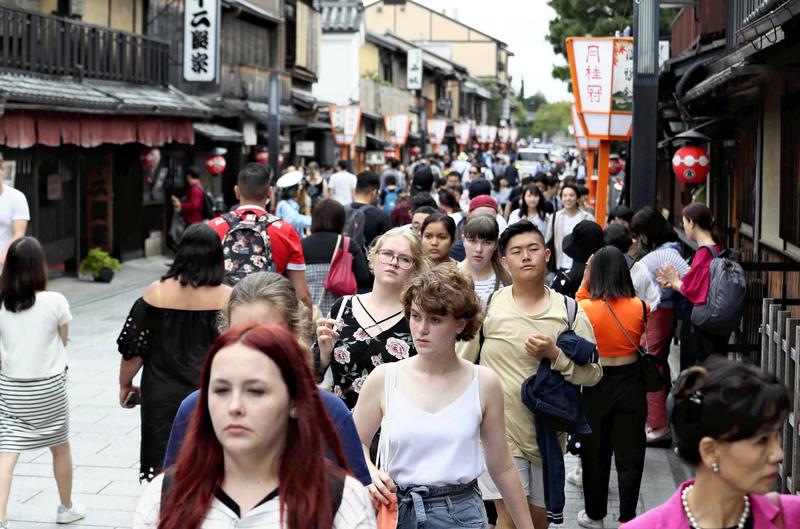
As the government eased visa requirements in order to increase tourism, the number of foreign visitors, which stood at 8.36 million in 2012, nearly quadrupled to 31.88 million in 2019. In real GDP, the value of exports at an annual rate, including domestic consumption by foreign visitors to Japan, totaled 91 trillion yen during the October-December quarter in 2019, showing an about 30% increase from the time when the second Abe administration was launched in December 2012. The average price of all types of land in rural areas rose for the first time in 28 years, according to a survey on official land prices of Japan in 2020 by the Land, Infrastructure, Transport and Tourism Ministry, while the employment environment also improved markedly. The period of economic growth lasted for 71 months, only two months short of the record-long postwar economic expansion.
-- 'Period of deflation'
Yet the country's potential growth rate, which shows the real strength of Japan's economy, hovers around 1%, almost unchanged from the "period of deflation." Although the government tried to stimulate growth through a corporate tax cut and other means, there has been a sense of disappointment over a "failure in sufficiently improving the corporate mind," floating within the government.
Backed by an upturn in business performances, the amount of cash and deposits held by Japanese firms rose to 223 trillion yen in fiscal 2018. But the proportion of expenditures on investment in plant and equipment, and R&D, out of their earnings, has not risen. Japanese companies' capabilities to develop those goods and services with high added value remain weak, while they also lag behind internationally in digital-sector investments such as software development and intellectual property. There has so far been no leading technology company coming to the fore in Japan to match those created in the United States and China.
"The tendency among companies to take to reducing costs is strongly rooted," a government source said disappointedly. Prioritizing sales at low prices and thus pressuring subcontractors to cut costs excessively will lead the scale of an overall economy to contract. In a survey of companies listed on stock exchanges conducted by the government in 2019, only about 20% of them cited a "review of business components," such as sell-off of low-growth businesses, as part of their efforts to enhance profitability.
An official related to the Prime Minister's Office said, "Even if the environment is improved to facilitate private-sector firms' activities through a growth strategy, it is the private firms that will make the final decision, a difficult proposition for all."
The collapse of Lehman Brothers in 2008 and an ensuing financial and economic crisis became and still remain traumatic for many corporate managers, and there is a fear that they would consider their "defensive corporate management" under the impact of the novel coronavirus as a successful experience.
-- Side-effects
"At the start of the inauguration [of his second administration], the Cabinet took on risks, but it gradually stopped carrying out any growth strategy, such as regulatory reforms that would conflict with opposing forces," opined a Finance Ministry official. A new Cabinet needs not only to run a stable administration but also to tackle to change policies, even going to the length of confronting resistance.
A case in point is the issue of online medical examinations, in which a doctor examines a patient remotely via telephone or the internet. Due to strong opposition from the Japan Medical Association, restrictions on such practices have been only slightly eased, making it a matter of urgency how the health care sector should respond to growing needs for such services amid and beyond the coronavirus outbreak.
Also needed is a way to deal with side effects brought on by the Bank of Japan's monetary easing and the government's fiscal spending, both of which are bywords of Abenomics.
As companies that would normally be unable to survive are prolonging their lives and industry as a whole is not being rejuvenated, Japan's labor productivity is noticeably low at around 60% of the U.S. level. Improving this level is an important policy issue.
The coronavirus shock has completely changed the favorable winds that had been blowing from abroad for the Japanese economy. Also, in moving ahead with a growth strategy, it is necessary to promote structural readjustments while financially supporting sectors such as the airline and restaurant industries, which would be affected greatly.
For the time being, measures to cope with the outbreak, self-restraint in new investments due to deteriorating business performances, and an increase in the government's assistance would pose a risk to push down the potential growth rate, which hovers only at around 1%.
The new Cabinet will be pressed to briskly take on the difficult task of carrying out a thorough examination of Abenomics.
Read more from The Japan News at https://japannews.yomiuri.co.jp/