Despite some progress made at Saturday's summit meeting between Prime Minister Shinzo Abe and Russian President Vladimir Putin, a path to resolve the northern territories issue remains unclear, prompting calls to review the government's strategy toward Russia.
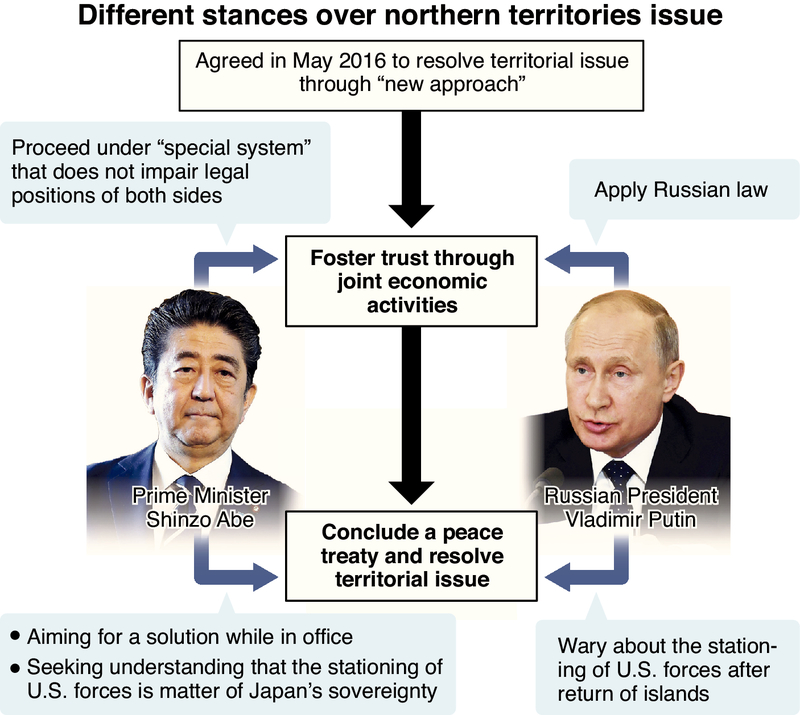
At the summit meeting on Saturday, the two leaders agreed to dispatch a research team to realize Japan-Russia joint economic activities in the northern territories. However, Russia has yet to show signs of softening its attitude toward the conclusion of a peace treaty and a solution to the territorial issue.
At a joint press conference after the summit meeting, Abe stressed: "If we take one step forward, the path ahead will open up. By proceeding with the matter in this way, we have produced some results."
Abe is aiming to first deepen the relationship of trust with Russia through joint economic activities in a bid to conclude a peace treaty and resolve the northern territories issue while in office.
A government official who accompanied Abe on his visit to Russia also highlighted some results from the talks, saying, "Japan and Russia have entered a new stage of working on [joint activities]."
However, any details related to specific projects that were the main focus of the bilateral meeting this time were not announced after the talks.
According to sources who accompanied the prime minister on his trip to Russia, the Japanese government sounded out the Russian side about announcing an agreement between the two leaders on starting the farming of sea urchins as well as greenhouse cultivation of strawberries, but the Russian side was reluctant.
Prior to the Russian presidential election in March, Russia had maintained a cautious stance on joint economic activities because it could have led to territorial issue-related discussions.
A source close to the Prime Minister's Office, therefore, expressed expectation, saying, "Moscow's stance will be softened after the presidential election."
The latest summit meeting is the first such occasion between Abe and Putin since Putin was elected Russian president for a fourth term.
A senior Foreign Ministry official, however, said with a sigh, "There was no change in the position of Japan wanting to rush to produce results and Russia resisting it."
In addition, Russia is said to be watching whether Abe, who has been shaken by recent scandals involving school operators Moritomo Gakuen and the Kake Educational Institution, will be able to win a third term in the Liberal Democratic Party's presidential election slated for this autumn.
If Abe is reelected for a third term after his return to power in 2012, he can remain in the post up to September 2021 at the longest under the party's regulations.
Some LDP members are concerned that economic cooperation alone may move forward, but that Japan's technology and money could be exploited by Russia in the process.
A mid-ranking LDP member said, "It may be necessary to review the strategy [toward Russia] to produce results in the prime minister's remaining time in office."
Read more from The Japan News at https://japannews.yomiuri.co.jp/