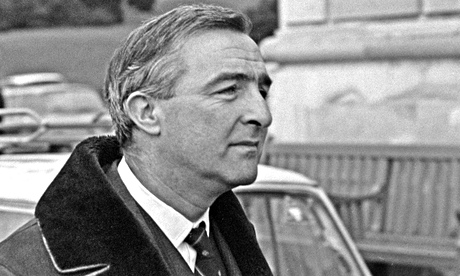
Desmond Boal, who has died aged 86, was an eminent barrister and QC in Northern Ireland and one of the earliest allies of the Protestant and unionist firebrand the Rev Ian Paisley. Throughout his career, Boal was an extraordinarily complex and often apparently contradictory figure, especially when it came to pursuing his radical ideas for a political settlement in Ireland.
He first came to public prominence in 1957, in a well-publicised legal case in which he was instructed by a Protestant woman who had fled north from the Irish Republic with her two young children. Boal was sent to the woman’s wealthy Roman Catholic husband with an ultimatum that he renounce his faith, sell up, emigrate to Canada or Australia and permit the children to be brought up as Protestants. The case touched raw nerves because the Catholic church frowned on “mixed” marriages and made parents pledge to bring up their children as Catholics. Eventually the wife went to Scotland with her children.
In 1960, Boal stood in a byelection and became the Ulster Unionist MP for Shankill in the Stormont parliament. His advancement coincided with efforts by the prime minister, Terence O’Neill, to dilute 40 years of unionist hegemony and reach out to the minority nationalist community. The unelected Paisley had already embarked on a noisy “O’Neill must go” campaign, and soon Boal and Paisley were making common cause. As the political crisis at Stormont gathered pace, Boal was among those unionists who opposed all the reforms demanded by the civil rights campaign. O’Neill was eventually deposed but, even after the army had been deployed in August 1969, Paisley, Boal and other hardliners hounded his successor, James Chichester-Clark, to the point where he, too, stood down.
Brian Faulkner, who had previously shared Boal’s views, became the next prime minister, but he also was subjected to withering hostility by Paisley and Boal. Their political union was sealed in 1971 when they jointly established the Democratic Unionist party (DUP), with Boal as founding chairman.
In 1972, the British government prorogued the Stormont parliament and introduced direct rule, causing Boal to lose his seat. Paisley, at the urging of Boal, had opposed the earlier introduction of internment without trial and then refused to engage in the political talks that culminated in the 1973 Sunningdale Agreement. Soon afterwards, Boal, ever the individualist, broke from the DUP because of conflicting ideas about what the party should stand for.
Instead he devoted his considerable intellect, forensic cross-examining skills and compelling advocacy powers to his legal career, taking silk in 1973. Despite his well known political standpoint, he was constantly employed in the no-jury Diplock courts, vigorously defending republicans, as well as loyalists, who were accused of causing the worst outrages of the Troubles. Indeed, he was often the first-choice barrister for republicans because of his considerable track record in gaining acquittals.
Although he was fastidious in respecting the etiquette of the courts, it was always clear that Boal only did so on sufferance. He was especially critical of the quasi-judicial tribunals set up to consider evidence – usually provided from behind a screen by an unnamed police officer – to determine whether suspects detained without trial could be safely released. Internees were allowed an advocate, but Boal reputedly showed his contempt for these proceedings by turning up in an Aran sweater and wellington boots for a hearing.
From time to time, during subsequent periods of political crisis, Boal made himself available to Paisley, often suggesting, after long nights of discussion, means for Paisley to disown damaging acts or utterances.
Periodically, and always discreetly, Boal became involved in political initiatives with adversaries and ideas entirely at odds with his apparent unionist views. The most notable of these private engagements took place in 1976 when he and Seán MacBride, the former IRA chief of staff turned politician and international statesman, secretly but unsuccessfully explored the idea of a federal Irish parliament with subsidiary assemblies in both parts of the country, a concept Boal had long fostered.
In latter years, Boal more usually made the headlines in court reports, but one case caused widespread hilarity, not least within his profession. In 1987, the gossip column in a Sunday tabloid claimed that Boal and Robert McCartney, a fellow QC, had caused a public kerfuffle in a bakery about who was entitled to the last chocolate eclair. After a lengthy libel action, they walked away with £50,000 damages each.
The last significant episode in Boal’s life took place in 2007, shortly after Paisley had reversed the intransigence of a lifetime and agreed to go into government with Sinn Féin at Stormont. Boal was incensed and called to see Paisley. He said it was not a friendly visit, returned some books and chided him for putting some of his erstwhile terrorist clients into government. Despite their long years of friendship, the rift had not been settled by the time Paisley died in 2014.
Third of five children of James, a cashier, and Kathleen (nee Walker), Boal was born in Derry and educated at Foyle college, Derry, and Portora Royal school, Enniskillen. He graduated in law from Trinity College Dublin. He was a dedicated teetotaller but hosted epic poker schools at his home in Holywood, Co Down.
He is survived by his wife, Annette, and four sisters.
• Desmond Norman Orr Boal, lawyer and politician, born 8 August 1928; died 22 April 2015
• This article was amended on 18 May 2015. Because of an editing error, Desmond Boal’s year of birth was wrongly given as 1938.